Alonso-Sardón Montserrat, Iglesias-de-Sena Helena, Fernández-Martín Luz Celia, Mirón-Canelo José Antonio
Area of Preventive Medicine and Public Health, School of Medicine, University of Salamanca, Institute of Biomedical Research of Salamanca, Avd de Alfonso X El Sabio s/n, Facultad de Medicina, Universidad de Salamanca, 37007, Salamanca, Spain.
Day Psychiatric Hospital of the University Clinic Hospital of Salamanca, Salamanca, Spain.
BMC Health Serv Res. 2019 Jan 23;19(1):63. doi: 10.1186/s12913-018-3856-5.
The aim of this study was to assess the relation between perceived social support and personal autonomy of individuals with intellectual disabilities and Health-Related Quality of Life.
A cross-sectional study with a multicentre sample was carried out including 162 institutionalized individuals with intellectual disability. The measurement tool was a structured questionnaire with sociodemographic variables, and three scales: Functional Independence Measure(FIM) scale, Duke-UNC Functional Social Support Questionnaire, and SF-36 Health Survey, which were completed during an individual/family interview.
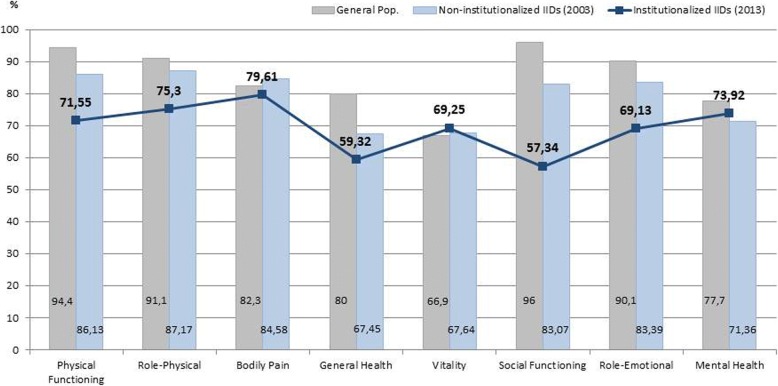
The perception of received social support is high on all 11 items of the Duke-UNC questionnaire, with an average of 3.45 for item-1 and 4.85 for item-11, which represents a total perceived support of an average 47.98 points (±SD7.30) (normal support). The Mental-Health component is rated worse than Physical-Health (67.41 vs. 71.74). The average rates for the different dimensions range from 57.34 points for Social-Functioning (the lowest rating) to 79.61 points for Bodily-Pain (highest rating). A multiple linear regression analysis reveals that the dimensions of Physical-Functioning (p < 0.001), Role-Physical (p = 0.016) and Bodily-Pain (p = 0.022), which are elements of the Physical-Health component, are independent predictive variables with the Degree of Autonomy (FIM) as a dependent variable. Social-Support (Duke-UNC) as a dependent variable is determined by the dimensions of Vitality (p = 0.014), Role-Emotional (p = 0.001) and Mental-Health (p < 0.001), which are part of the Mental-Health component and act as independent predictive variables.
Individuals with intellectual disability and a higher degree of personal autonomy determined by institutional and family support report better Health and Quality of Life.
本研究旨在评估智障人士所感知到的社会支持与个人自主性以及健康相关生活质量之间的关系。
开展了一项多中心横断面研究,纳入了162名机构照料的智障人士。测量工具为一份包含社会人口学变量的结构化问卷,以及三个量表:功能独立性评定量表(FIM)、杜克大学-北卡罗来纳大学功能性社会支持问卷和SF-36健康调查,这些量表在个体/家庭访谈期间完成。
杜克大学-北卡罗来纳大学问卷的所有11个项目上,所感知到的社会支持程度都很高,项目1的平均分为3.45,项目11的平均分为4.85,这代表总感知支持平均为47.98分(±标准差7.30)(正常支持)。心理健康部分的评分低于身体健康部分(67.41对71.74)。不同维度的平均得分从社会功能的57.34分(最低评分)到身体疼痛的79.61分(最高评分)不等。多元线性回归分析显示,身体健康部分的身体功能维度(p < 0.001)、角色-身体维度(p = 0.016)和身体疼痛维度(p = 0.022)是自主性程度(FIM)作为因变量的独立预测变量。以社会支持(杜克大学-北卡罗来纳大学问卷)作为因变量时,活力维度(p = 0.014)、角色-情感维度(p = 0.001)和心理健康维度(p < 0.001)是独立预测变量,这些维度属于心理健康部分。
由机构和家庭支持所决定的具有较高个人自主性程度的智障人士报告了更好的健康状况和生活质量。