ISR-Lisboa/LARSyS and Department of Bioengineering, Instituto Superior Técnico, Universidade de Lisboa, Lisbon, Portugal.
Department of Neurophysiology, Centro Hospitalar Psiquiátrico de Lisboa, Lisbon, Portugal.
Sci Rep. 2019 Jan 24;9(1):638. doi: 10.1038/s41598-018-36976-y.
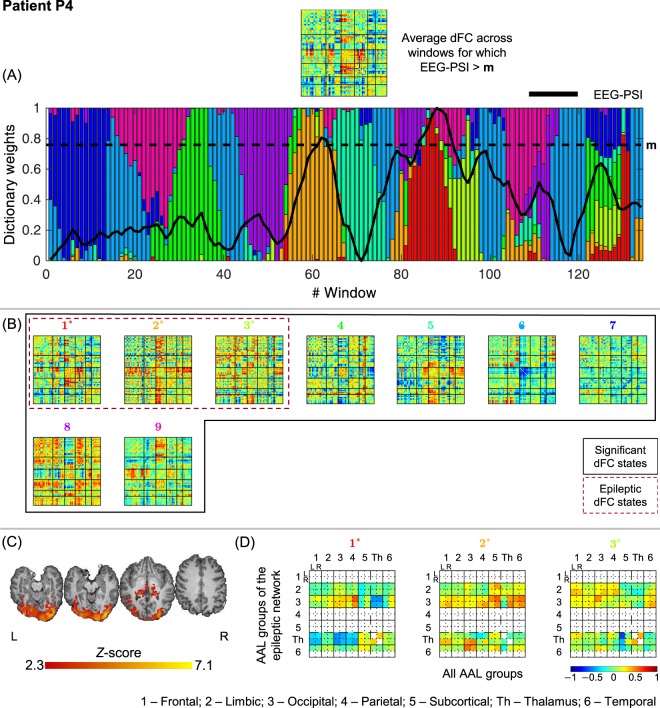
Most fMRI studies of the brain's intrinsic functional connectivity (FC) have assumed that this is static; however, it is now clear that it changes over time. This is particularly relevant in epilepsy, which is characterized by a continuous interchange between epileptic and normal brain states associated with the occurrence of epileptic activity. Interestingly, recurrent states of dynamic FC (dFC) have been found in fMRI data using unsupervised learning techniques, assuming either their sparse or non-sparse combination. Here, we propose an l-norm regularized dictionary learning (l-DL) approach for dFC state estimation, which allows an intermediate and flexible degree of sparsity in time, and demonstrate its application in the identification of epilepsy-related dFC states using simultaneous EEG-fMRI data. With this l-DL approach, we aim to accommodate a potentially varying degree of sparsity upon the interchange between epileptic and non-epileptic dFC states. The simultaneous recording of the EEG is used to extract time courses representative of epileptic activity, which are incorporated into the fMRI dFC state analysis to inform the selection of epilepsy-related dFC states. We found that the proposed l-DL method performed best at identifying epilepsy-related dFC states, when compared with two alternative methods of extreme sparsity (k-means clustering, maximum; and principal component analysis, minimum), as well as an l-norm regularization framework (l-DL), with a fixed amount of temporal sparsity. We further showed that epilepsy-related dFC states provide novel insights into the dynamics of epileptic networks, which go beyond the information provided by more conventional EEG-correlated fMRI analysis, and which were concordant with the clinical profile of each patient. In addition to its application in epilepsy, our study provides a new dFC state identification method of potential relevance for studying brain functional connectivity dynamics in general.
大多数关于大脑内在功能连接(FC)的 fMRI 研究都假设这种连接是静态的;然而,现在很明显,它会随时间变化。这在癫痫中尤为重要,癫痫的特征是癫痫和正常大脑状态之间的持续转换,与癫痫活动的发生有关。有趣的是,已经使用无监督学习技术在 fMRI 数据中发现了动态 FC(dFC)的反复状态,假设它们是稀疏或非稀疏组合。在这里,我们提出了一种 l-范数正则化字典学习(l-DL)方法用于 dFC 状态估计,该方法允许在时间上具有中间和灵活的稀疏度,并展示了其在使用同时 EEG-fMRI 数据识别与癫痫相关的 dFC 状态中的应用。通过这种 l-DL 方法,我们旨在适应癫痫和非癫痫 dFC 状态之间交换时潜在的变化稀疏度。同时记录 EEG 用于提取代表癫痫活动的时间过程,将其纳入 fMRI dFC 状态分析中,以告知选择与癫痫相关的 dFC 状态。我们发现,与两种极端稀疏度的替代方法(k-均值聚类,最大;和主成分分析,最小)以及具有固定时间稀疏度的 l-范数正则化框架(l-DL)相比,所提出的 l-DL 方法在识别与癫痫相关的 dFC 状态方面表现最佳。我们进一步表明,与更传统的 EEG 相关 fMRI 分析相比,与癫痫相关的 dFC 状态提供了对癫痫网络动力学的新见解,并且与每位患者的临床特征一致。除了在癫痫中的应用外,我们的研究还提供了一种新的 dFC 状态识别方法,对于研究大脑功能连接动力学具有潜在的相关性。