Gershuni Victoria M, Friedman Elliot S
Department of Surgery, Perelman School of Medicine, Hospital of the University of Pennsylvania, 3400 Spruce Street, 4 Maloney, Philadelphia, PA, 19104, USA.
Division of Gastroenterology, Perelman School of Medicine, University of Pennsylvania, Philadelphia, PA, USA.
Curr Gastroenterol Rep. 2019 Jan 26;21(1):4. doi: 10.1007/s11894-019-0668-7.
The goal of this paper is to review current literature on the gut microbiome within the context of host response to surgery and subsequent risk of developing complications, particularly anastomotic leak. We provide background on the relationship between host and gut microbiota with description of the role of the intestinal mucus layer as an important regulator of host health.
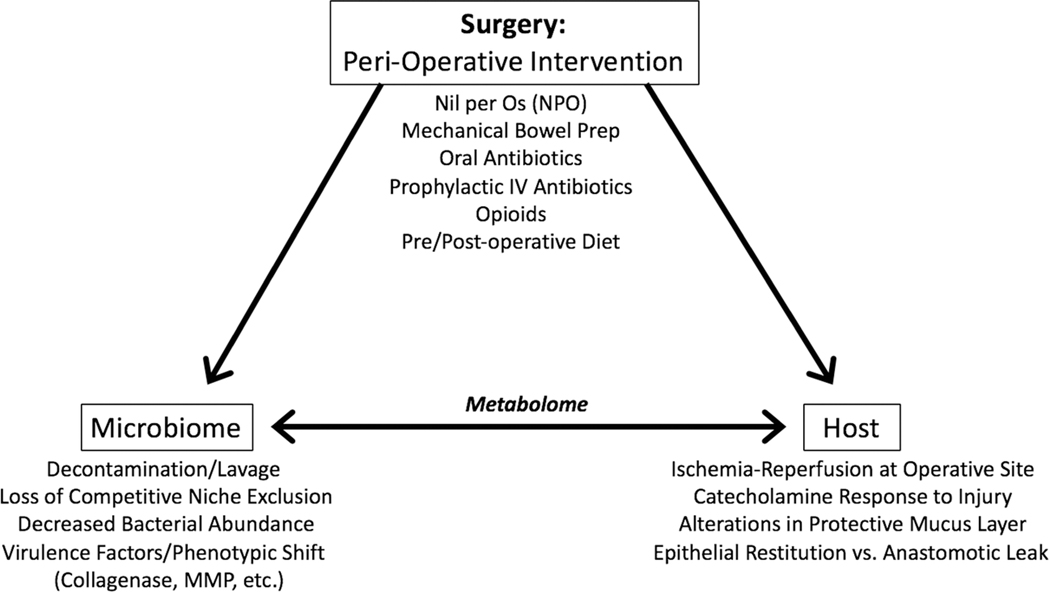
Despite improvements in surgical technique and adherence to the tenets of creating a tension-free anastomosis with adequate blood flow, the surgical community has been unable to decrease rates of anastomotic leak using the current paradigm. Rather than adhere to empirical strategies of decontamination, it is imperative to focus on the interaction between the human host and the gut microbiota that live within us. The gut microbiome has been found to play a potential role in development of post-operative complications, including but not limited to anastomotic leak. Evidence suggests that peri-operative interventions may have a role in instigating or mitigating the impact of the gut microbiota via disruption of the protective mucus layer, use of multiple medications, and activation of virulence factors. The microbiome plays a potential role in the development of surgical complications and can be modulated by peri-operative interventions. As such, further research into this relationship is urgently needed.
本文旨在回顾当前关于肠道微生物群的文献,探讨宿主对手术的反应以及术后发生并发症(尤其是吻合口漏)的风险。我们介绍了宿主与肠道微生物群之间的关系背景,并描述了肠道黏液层作为宿主健康重要调节因子的作用。
尽管手术技术有所改进,且遵循了创建无张力吻合口并保证充足血流的原则,但手术界仍无法通过当前模式降低吻合口漏的发生率。不应坚持经验性的去污策略,而必须关注人类宿主与体内肠道微生物群之间的相互作用。已发现肠道微生物群在术后并发症(包括但不限于吻合口漏)的发生中可能起作用。有证据表明,围手术期干预可能通过破坏保护性黏液层、使用多种药物以及激活毒力因子,在引发或减轻肠道微生物群的影响方面发挥作用。微生物群在手术并发症的发生中可能起作用,且可通过围手术期干预进行调节。因此,迫切需要对这种关系进行进一步研究。