Physik Department, Walter Schottky Institute, Technische Universität München, Am Coulombwall 4a, 85748, Garching, Germany.
Angew Chem Int Ed Engl. 2019 Feb 25;58(9):2680-2684. doi: 10.1002/anie.201812463. Epub 2019 Jan 29.
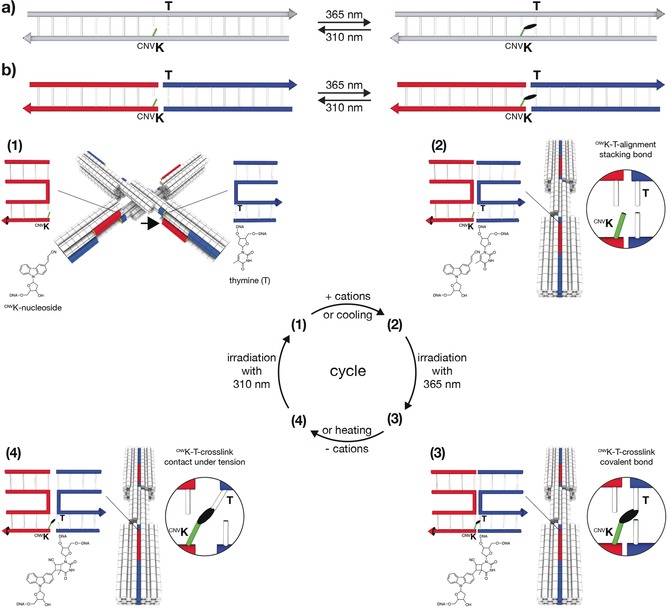
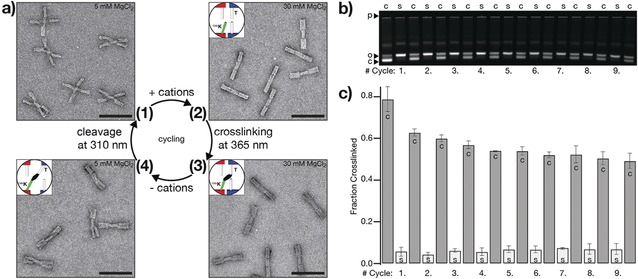
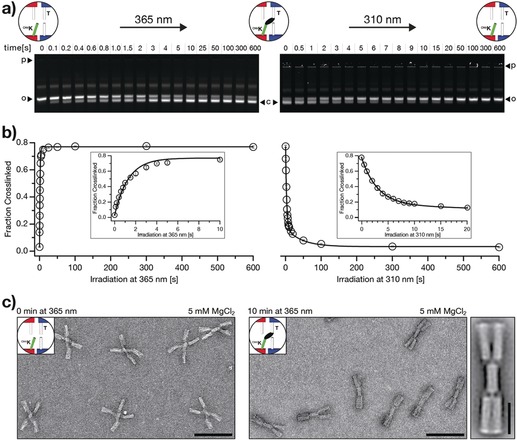
Stacking bonds formed between two blunt-ended DNA double helices can be used to reversibly stabilize higher-order complexes that are assembled from rigid DNA components. Typically, at low cation concentrations, stacking bonds break and thus higher-order complexes disassemble. Herein, we present a site-specific photochemical mechanism for the reversible covalent stabilization of stacking bonds in DNA assemblies. To this end, we modified one blunt end with the 3-cyanovinylcarbazole ( K) moiety and positioned a thymine residue (T) at the other blunt end. In the bound state, the two blunt-ended helices are stacked together, resulting in a co-localization of K and T. Such a configuration induces the formation of a covalent bond across the stacking contact upon irradiation with 365 nm light. This bond can also be cleaved upon irradiation with 310 nm light, allowing repeated formation and cleavage of the same covalent bond on the timescale of seconds. Our system will expand the range of conditions under which stacking-bond-stabilized objects may be utilized.
双链 DNA 双螺旋体的末端之间形成的堆积键可以用来可逆地稳定由刚性 DNA 组成的高级复合物。通常,在低阳离子浓度下,堆积键会断裂,从而导致高级复合物解体。在此,我们提出了一种用于 DNA 组装中堆积键的可逆共价稳定的特定位置光化学机制。为此,我们用 3-氰基乙烯基咔唑(K)部分修饰一个钝端,并在另一个钝端定位胸腺嘧啶残基(T)。在结合状态下,两条末端的螺旋体堆积在一起,导致 K 和 T 的共定位。这种构象诱导在 365nm 光照射下在堆积接触处形成共价键。该键也可以在 310nm 光照射下断裂,允许在几秒钟的时间尺度上重复形成和断裂相同的共价键。我们的系统将扩大可以利用堆积键稳定的物体的条件范围。