Seni Jeremiah, Falgenhauer Linda, Simeo Nabina, Mirambo Mariam M, Imirzalioglu Can, Matee Mecky, Rweyemamu Mark, Chakraborty Trinad, Mshana Stephen E
Department of Microbiology and Immunology, Catholic University of Health and Allied Sciences Mwanza, Tanzania.
Institute of Medical Microbiology, Justus-Liebig UniversityGiessen, Germany; German Center for Infection Research, DZIF Partner Site Giessen-Marburg-LangenGiessen, Germany.
Front Microbiol. 2016 Feb 11;7:142. doi: 10.3389/fmicb.2016.00142. eCollection 2016.
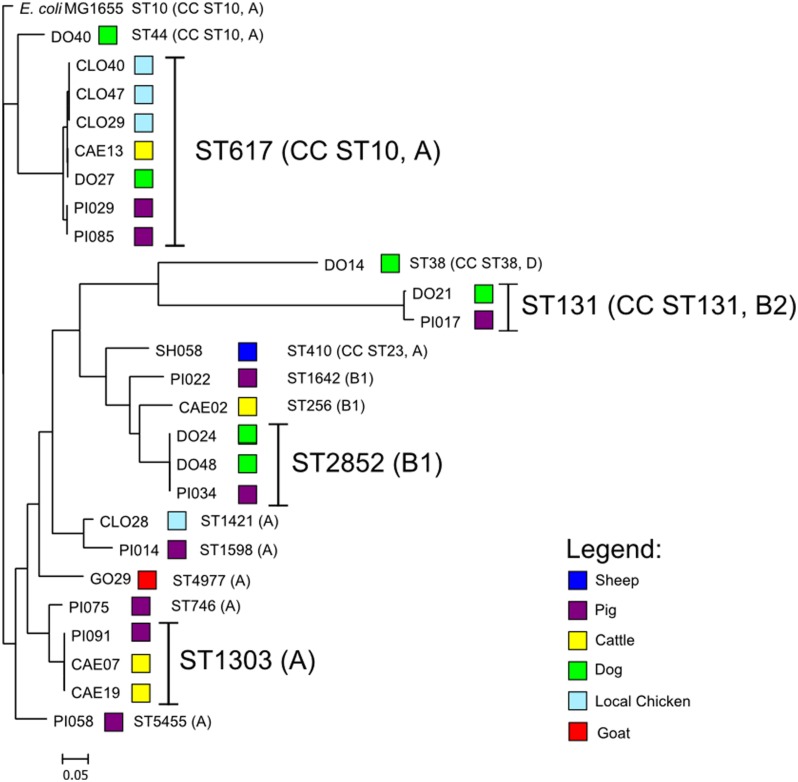
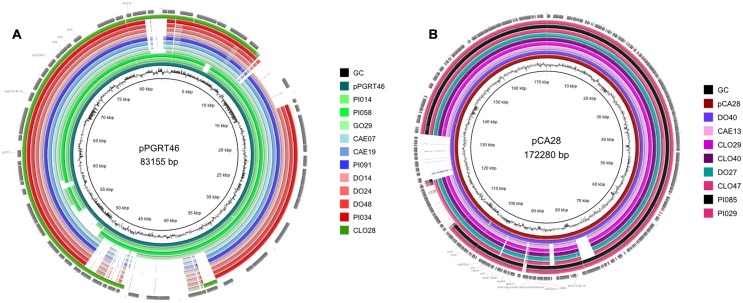
The increased presence of extended-spectrum beta-lactamase (ESBL)-producing bacteria in humans, animals, and their surrounding environments is of global concern. Currently there is limited information on ESBL presence in rural farming communities worldwide. We performed a cross-sectional study in Mwanza, Tanzania, involving 600 companion and domestic farm animals between August/September 2014. Rectal swab/cloaca specimens were processed to identify ESBL-producing Enterobacteriaceae. We detected 130 (21.7%) animals carrying ESBL-producing bacteria, the highest carriage being among dogs and pigs [39.2% (51/130) and 33.1% (43/130), respectively]. The majority of isolates were Escherichia coli [93.3% (125/134)] and exotic breed type [OR (95%CI) = 2.372 (1.460-3.854), p-value < 0.001] was found to be a predictor of ESBL carriage among animals. Whole-genome sequences of 25 ESBL-producing E. coli were analyzed for phylogenetic relationships using multi-locus sequence typing (MLST) and core genome comparisons. Fourteen different sequence types were detected of which ST617 (7/25), ST2852 (3/25), ST1303 (3/25) were the most abundant. All isolates harbored the bla CTX-M-15 allele, 22/25 carried strA and strB, 12/25 aac(6')-lb-cr, and 11/25 qnrS1. Antibiotic resistance was associated with IncF, IncY, as well as non-typable plasmids. Eleven isolates carried pPGRT46-related plasmids, previously reported from isolates in Nigeria. Five isolates had plasmids exhibiting 85-99% homology to pCA28, previously detected in isolates from the US. Our findings indicate a pan-species distribution of ESBL-producing E. coli clonal groups in farming communities and provide evidence for plasmids harboring antibiotic resistances of regional and international impact.
在人类、动物及其周围环境中,产超广谱β-内酰胺酶(ESBL)细菌的出现日益增多,这引起了全球关注。目前,关于全球农村养殖社区中ESBL存在情况的信息有限。2014年8月/9月期间,我们在坦桑尼亚的姆万扎进行了一项横断面研究,涉及600只伴侣动物和家畜。对直肠拭子/泄殖腔标本进行处理,以鉴定产ESBL的肠杆菌科细菌。我们检测到130只(21.7%)动物携带产ESBL细菌,其中狗和猪的携带率最高[分别为39.2%(51/130)和33.1%(43/130)]。大多数分离株为大肠杆菌[93.3%(125/134)],并且发现外来品种类型[比值比(95%置信区间)=2.372(1.460 - 3.854),p值<0.001]是动物中ESBL携带情况的一个预测指标。使用多位点序列分型(MLST)和核心基因组比较分析了25株产ESBL大肠杆菌的全基因组序列,以确定其系统发育关系。检测到14种不同的序列类型,其中ST617(7/25)、ST2852(3/25)、ST1303(3/25)最为常见。所有分离株都携带bla CTX-M-15等位基因,22/25携带strA和strB,12/25携带aac(6')-lb-cr,11/25携带qnrS1。抗生素耐药性与IncF、IncY以及不可分型质粒有关。11株分离株携带与pPGRT46相关的质粒,此前在尼日利亚的分离株中曾有报道。5株分离株的质粒与pCA28具有85 - 99%的同源性,pCA28此前在来自美国的分离株中被检测到。我们的研究结果表明,产ESBL大肠杆菌克隆群在养殖社区中呈泛物种分布,并为携带具有区域和国际影响的抗生素耐药性的质粒提供了证据。