Center for Infectious Medicine, Department of Medicine Huddinge, Karolinska Institutet, Karolinska University Hospital, Stockholm, Sweden.
Laboratorio de Inmunología de Enfermedades Respiratorias, Instituto de Medicina Experimental, Consejo Nacional de Investigaciones Científicas y Técnicas (CONICET), Academia Nacional de Medicina.
J Infect Dis. 2019 May 5;219(11):1832-1840. doi: 10.1093/infdis/jiz005.
Hantavirus pulmonary syndrome (HPS) is caused by Andes virus (ANDV) and related hantaviruses in the Americas. Despite a fatality rate of 40%, the pathogenesis of HPS is poorly understood and factors associated with severity, fatality, and survival remain elusive.
Ninety-three ANDV-infected HPS patients, of whom 34 had a fatal outcome, were retrospectively studied. Serum levels of cytokines and other inflammation-associated markers were analyzed using multiplex immunoassay and enzyme-linked immunosorbent assay. Associations with disease severity, fatal outcome, and survival were identified using logistic regression.
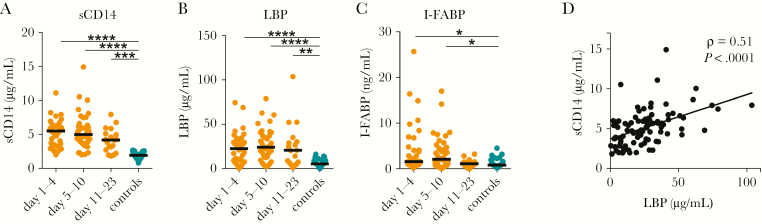
HPS patients exhibited increased serum levels of markers associated with inflammation, intestinal damage, and microbial translocation compared to controls. Patients with fatal outcome displayed higher levels of interleukin (IL) 6, IL-10, interferon-γ, soluble tumor necrosis factor-related apoptosis-inducing ligand, and intestinal fatty acid-binding protein (I-FABP) than survivors. Levels of complement factor 5/5a were higher in survivors compared with fatal cases. IL-6 and I-FABP, the latter a marker for intestinal damage, were by multivariate analyses identified as independent markers associated with disease severity (odds ratio [OR], 2.25; 95% confidence interval [CI], 1.01-5.01) and fatal outcome (OR, 1.64; 95% CI, 1.01-2.64), respectively.
HPS patients displayed a multifaceted, systemic inflammatory response, with IL-6 and I-FABP as independent markers of disease severity and fatality, respectively.
汉坦病毒肺综合征(HPS)由美洲的安第斯病毒(ANDV)和相关汉坦病毒引起。尽管死亡率为 40%,但其发病机制仍知之甚少,与严重程度、死亡率和存活率相关的因素仍难以捉摸。
回顾性研究了 93 名感染 ANDV 的 HPS 患者,其中 34 例死亡。使用多重免疫分析和酶联免疫吸附试验分析血清细胞因子和其他炎症相关标志物的水平。使用逻辑回归确定与疾病严重程度、致命结局和存活相关的因素。
与对照组相比,HPS 患者的炎症、肠道损伤和微生物易位相关标志物的血清水平升高。与幸存者相比,死亡患者的白细胞介素(IL)6、IL-10、干扰素-γ、可溶性肿瘤坏死因子相关凋亡诱导配体和肠脂肪酸结合蛋白(I-FABP)水平更高。与致命病例相比,幸存者的补体因子 5/5a 水平更高。IL-6 和 I-FABP,后者是肠道损伤的标志物,通过多变量分析被确定为与疾病严重程度(比值比 [OR],2.25;95%置信区间 [CI],1.01-5.01)和致命结局(OR,1.64;95% CI,1.01-2.64)相关的独立标志物。
HPS 患者表现出多方面的全身性炎症反应,IL-6 和 I-FABP 分别是疾病严重程度和死亡率的独立标志物。