Department of Chemistry, Chemistry Research Laboratory , University of Oxford , 12 Mansfield Road , Oxford , OX1 3TA , U.K.
J Org Chem. 2019 Mar 1;84(5):2741-2755. doi: 10.1021/acs.joc.8b03149. Epub 2019 Feb 12.
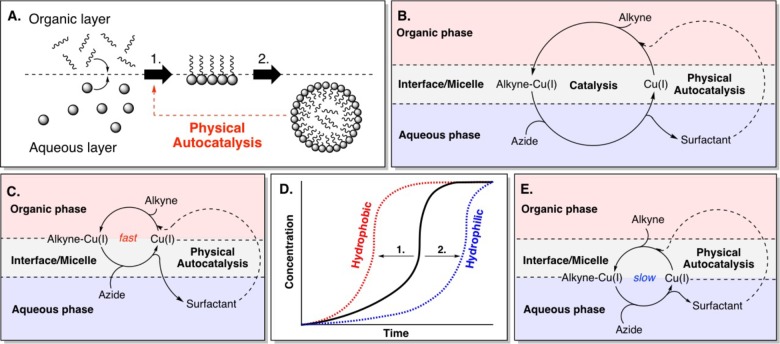
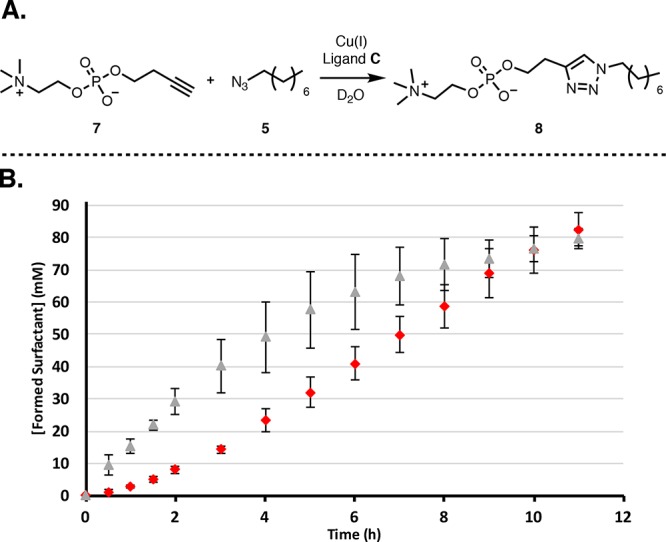
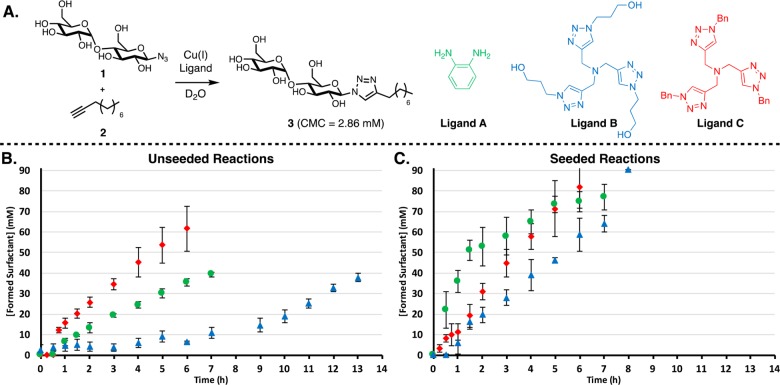
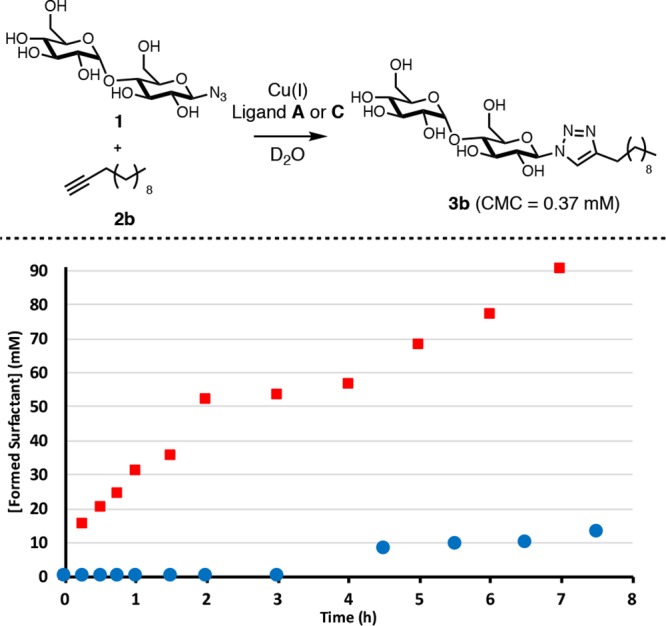
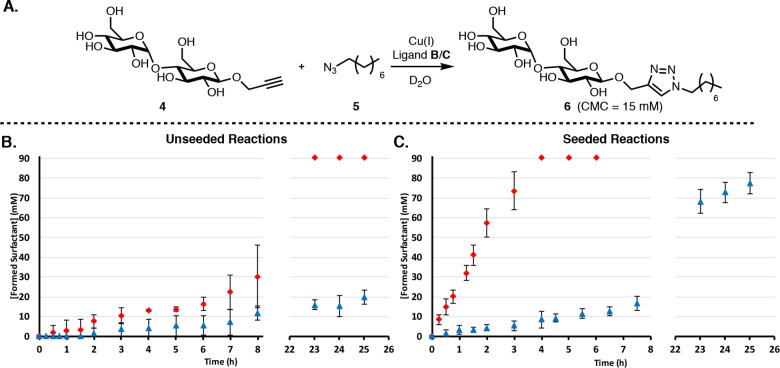
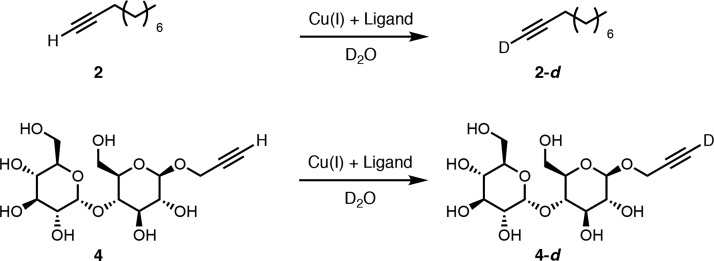
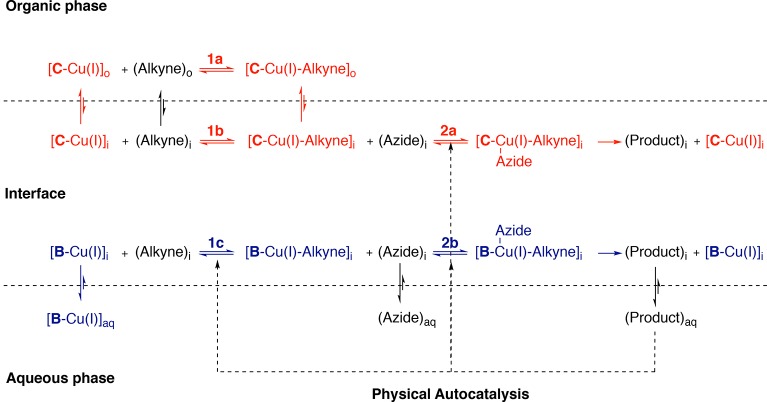
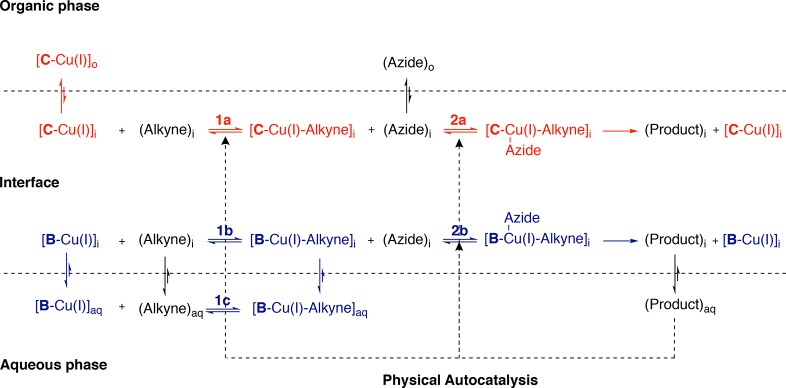
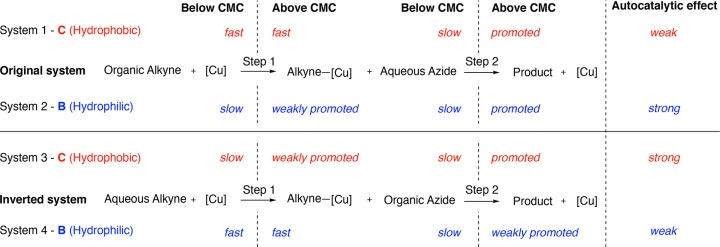
Compartmentalization of reactions is ubiquitous in biochemistry. Self-reproducing lipids are widely studied as chemical models of compartmentalized biological systems. Here, we explore the effect of catalyst location on copper-catalyzed azide-alkyne cycloadditions which drive the self-reproduction of micelles from phase-separated components. Tuning the hydrophilicity of the copper-ligand complex, so that hydro-phobic or -philic catalysts are used in combination with hydro-philic and -phobic coupling partners, provides a wide range of reactivity patterns. Analysis of the kinetic data shows that reactions with a hydrophobic catalyst are faster than with a hydrophilic catalyst. Diffusion-ordered spectroscopy experiments suggest compartmentalization of the hydrophobic catalyst inside micelles while the hydrophilic catalyst remains in the bulk aqueous phase. The autocatalytic effects observed can be tuned by varying reactant structure and coupling a hydrophilic alkyne and hydrophobic azide results in a more pronounced autocatalytic effect. We propose and test a model that rationalizes the observations in terms of the phase behavior of the reaction components and catalysts.
反应的分区化在生物化学中无处不在。自复制脂质被广泛研究作为分隔生物系统的化学模型。在这里,我们探索了催化剂位置对铜催化叠氮-炔环加成反应的影响,该反应驱动从相分离组分中自复制胶束。通过调整铜配体配合物的亲水性,使得疏水性或亲水性催化剂与亲水性和疏水性偶联剂结合使用,可以提供广泛的反应性模式。对动力学数据的分析表明,具有疏水性催化剂的反应比具有亲水性催化剂的反应更快。扩散有序光谱实验表明,疏水性催化剂在胶束内部被分隔化,而亲水性催化剂则留在本体水相中。通过改变反应物结构并将亲水性炔烃和疏水性叠氮偶联,可以观察到自动催化效应,并且可以调节更明显的自动催化效应。我们提出并测试了一个模型,根据反应成分和催化剂的相行为来合理化观察结果。