School of Applied Psychology/Menzies Health Institute, Griffith University, Gold Coast, Queensland, Australia.
Griffith Institute for Educational Research, Griffith University, Gold Coast, Queensland, Australia.
PLoS One. 2019 Jan 30;14(1):e0210746. doi: 10.1371/journal.pone.0210746. eCollection 2019.
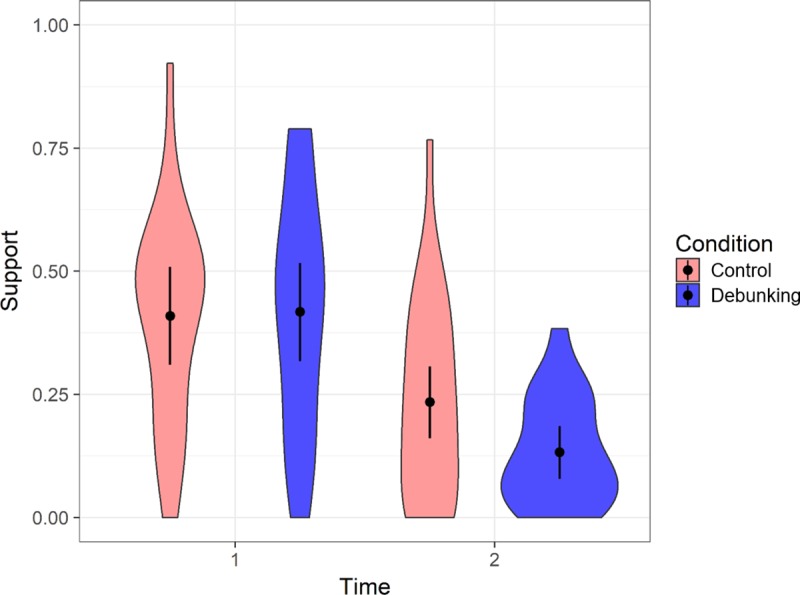
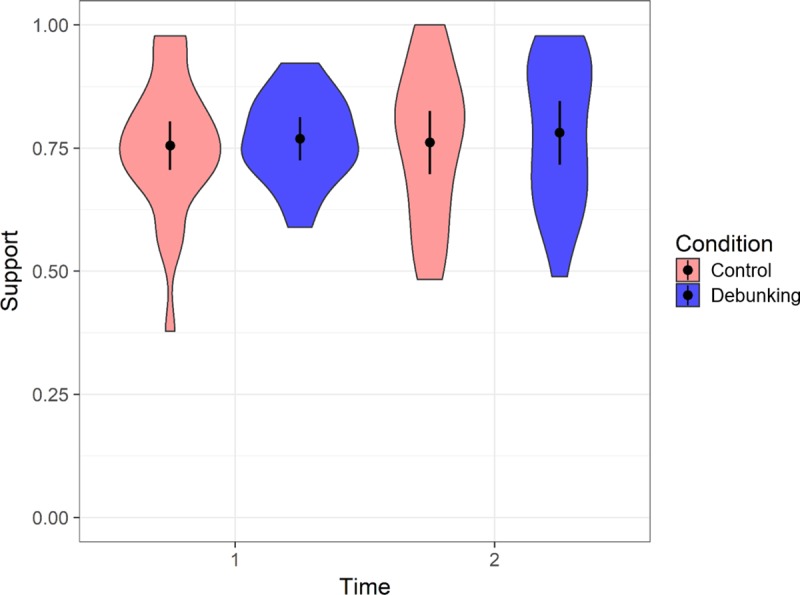
Misinformation poses significant challenges to evidence-based practice. In the public health domain specifically, treatment misinformation can lead to opportunity costs or direct harm. Alas, attempts to debunk misinformation have proven sub-optimal, and have even been shown to "backfire", including increasing misperceptions. Thus, optimized debunking strategies have been developed to more effectively combat misinformation. The aim of this study was to test these strategies in a real-world setting, targeting misinformation about autism interventions. In the context of professional development training, we randomly assigned participants to an "optimized-debunking" or a "treatment-as-usual" training condition and compared support for non-empirically-supported treatments before, after, and six weeks following completion of online training. Results demonstrated greater benefits of optimized debunking immediately after training; thus, the implemented strategies can serve as a general and flexible debunking template. However, the effect was not sustained at follow-up, highlighting the need for further research into strategies for sustained change.
错误信息对循证实践构成重大挑战。特别是在公共卫生领域,治疗错误信息可能导致机会成本或直接伤害。唉,揭穿错误信息的尝试证明效果不佳,甚至被证明“适得其反”,包括增加误解。因此,已经开发出优化的揭穿策略,以更有效地打击错误信息。这项研究的目的是在现实环境中测试这些策略,针对自闭症干预措施的错误信息。在专业发展培训的背景下,我们将参与者随机分配到“优化揭穿”或“常规治疗”培训条件,并在在线培训完成前后以及六周后比较对非经验支持治疗的支持。结果表明,优化揭穿在培训后立即产生更大的益处;因此,实施的策略可以作为一般和灵活的揭穿模板。然而,这种效果在随访时并未持续,这凸显了需要进一步研究持久变化的策略。