Orthopaedic and Arthritis Center for Outcomes Research and Policy and Innovation eValuation in Orthopaedic Treatments (PIVOT) Center, Department of Orthopaedic Surgery, Brigham and Women's Hospital, Boston, Massachusetts, United States of America.
Harvard Medical School, Boston, Massachusetts, United States of America.
PLoS One. 2019 Jan 30;14(1):e0211231. doi: 10.1371/journal.pone.0211231. eCollection 2019.
To evaluate physical activity (PA) and sedentary time in subjects with knee osteoarthritis (OA) measured by the Fitbit Charge 2 (Fitbit) and a wrist-worn ActiGraph GT3X+ (AGW) compared to the hip-worn ActiGraph (AGH).
We recruited a cohort of subjects with knee OA from rheumatology clinics. Subjects wore the AGH for four weeks, AGW for two weeks, and Fitbit for two weeks over a four-week study period. We collected accelerometer counts (ActiGraphs) and steps (ActiGraphs, Fitbit) and calculated time spent in sedentary, light, and moderate-to-vigorous activity. We used triaxial PA intensity count cut-points from the literature for ActiGraph and a stride length-based cadence algorithm to categorize Fitbit PA. We compared Fitbit wear times calculated from a step-based algorithm and a novel algorithm that incorporates steps and heart rate (HR).
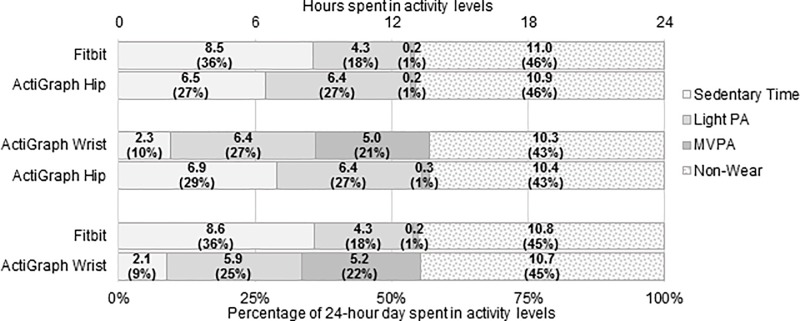
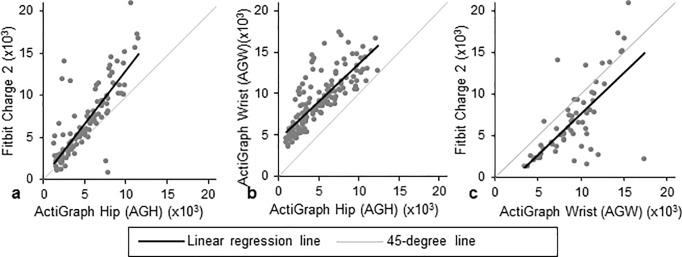
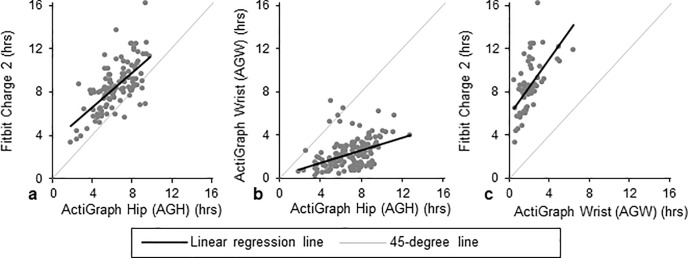
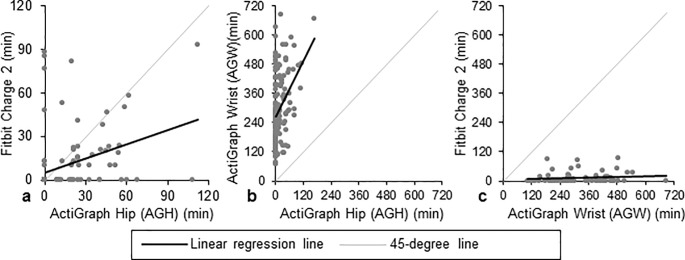
We enrolled 15 subjects (67% female, mean age 68 years). Relative to AGH, Fitbit, on average, overestimated steps by 39% and sedentary time by 37% and underestimated MVPA by 5 minutes. Relative to AGH, AGW overestimated steps 116%, underestimated sedentary time by 66%, and captured 281 additional MVPA minutes. The step-based wear time Fitbit algorithm captured 14% less wear time than the HR-based algorithm.
Fitbit overestimates steps and underestimates MVPA in knee OA subjects. Cut-offs validated for AGW should be developed to support the use of AGW for PA assessment. The HR-based Fitbit algorithm captured more wear time than the step-based algorithm. These data provide critical insight for researchers planning to use commercially-available accelerometers in pragmatic studies.
使用 Fitbit Charge 2(Fitbit)和腕戴式 ActiGraph GT3X+(AGW)评估膝关节骨关节炎(OA)患者的身体活动(PA)和久坐时间,与髋戴式 ActiGraph(AGH)进行比较。
我们从风湿病诊所招募了一组膝关节 OA 患者。研究对象在四周的研究期间内佩戴 AGH 四周、AGW 两周和 Fitbit 两周。我们收集了加速度计计数(ActiGraphs)和步数(ActiGraphs、Fitbit),并计算了久坐、轻度和中度至剧烈活动的时间。我们使用文献中的三轴 PA 强度计数切点和基于步长的节奏算法对 ActiGraph 进行 PA 分类,并比较了基于步长算法和包含步数和心率(HR)的新型算法计算得出的 Fitbit 佩戴时间。
我们共招募了 15 名患者(67%为女性,平均年龄 68 岁)。与 AGH 相比,Fitbit 平均高估了 39%的步数和 37%的久坐时间,低估了 5 分钟的中高强度活动时间。与 AGH 相比,AGW 高估了 116%的步数,低估了 66%的久坐时间,记录了 281 分钟额外的中高强度活动时间。基于步长的 Fitbit 佩戴时间算法比基于 HR 的算法少记录了 14%的佩戴时间。
在膝关节 OA 患者中,Fitbit 高估了步数,低估了中高强度活动时间。应制定针对 AGW 的验证后切值,以支持使用 AGW 进行 PA 评估。基于 HR 的 Fitbit 算法比基于步长的算法记录了更多的佩戴时间。这些数据为计划在实用研究中使用商业可用加速度计的研究人员提供了重要的见解。