Guangdong Provincial Institute of Public Health, Guangdong Provincial Center for Disease Control and Prevention, Guangzhou 511430, China.
State Key Laboratory of Resources and Environmental Information System, Institute of Geographic Sciences and Natural Resources Research, Chinese Academy of Sciences, Beijing 100101, China.
Int J Environ Res Public Health. 2019 Jan 29;16(3):376. doi: 10.3390/ijerph16030376.
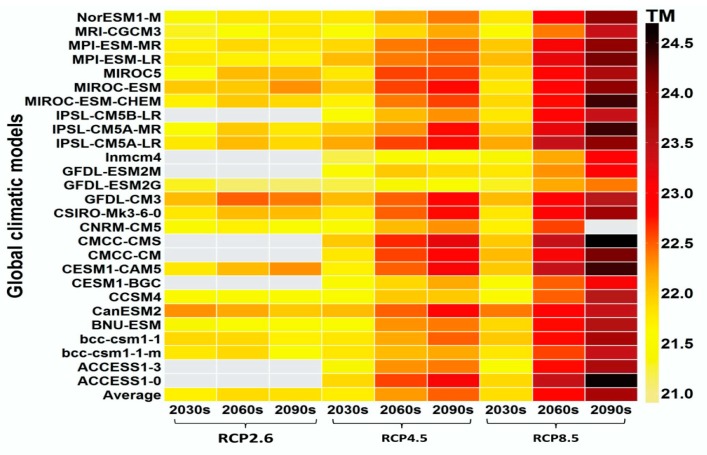
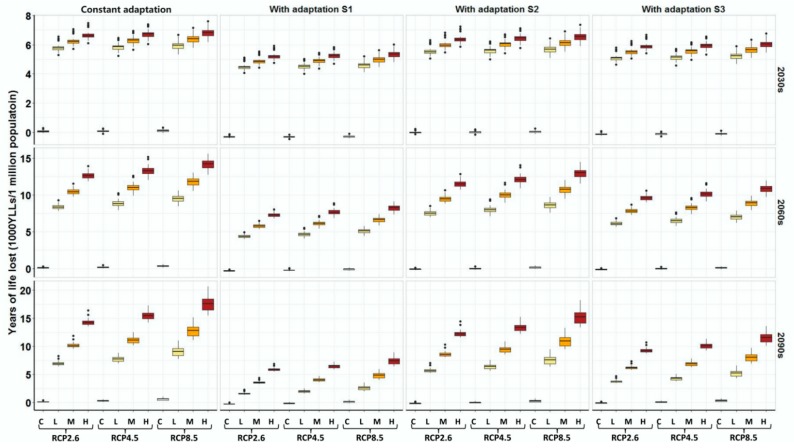
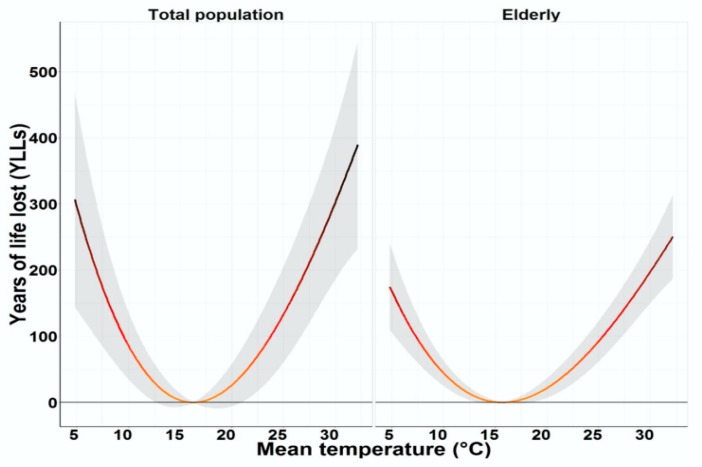
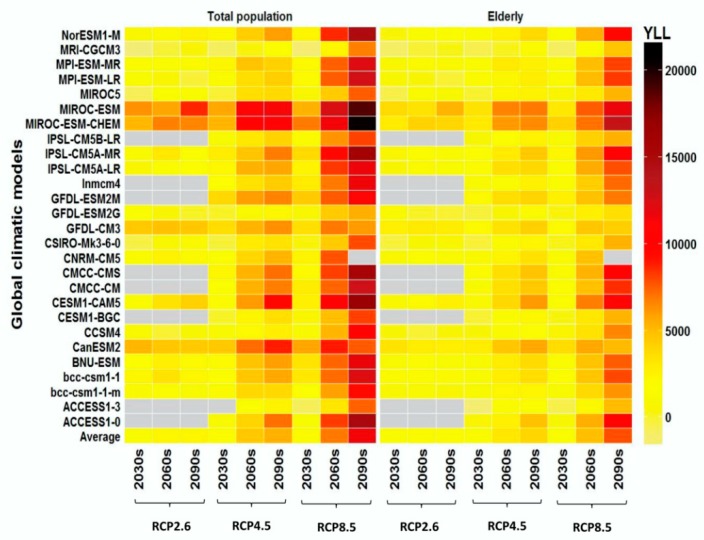
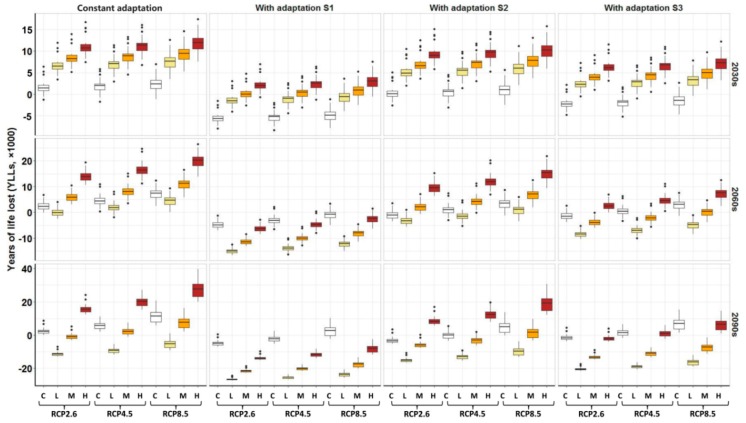
(1) Background: Although the health effects of future climate change have been examined in previous studies, few have considered additive impacts of population expansion, ageing, and adaptation. We aimed to quantify the future heat-related years of life lost () under different Representative Concentration Pathways (RCP) scenarios and global-scale General Circulation Models (GCMs), and further to examine relative contributions of population expansion, ageing, and adaptation on these projections. (2) Methods: We used downscaled and bias-corrected projections of daily temperature from 27 GCMs under RCP2.6, 4.5, and 8.5 scenarios to quantify the potential annual heat-related YLLs in Guangzhou, China in the 2030s, 2060s, and 2090s, compared to those in the 1980s as a baseline. We also explored the modification effects of a range of population expansion, ageing, and adaptation scenarios on the heat-related . (3) Results: Global warming, particularly under the RCP8.5 scenario, would lead to a substantial increase in the heat-related in the 2030s, 2060s, and 2090s for the majority of the GCMs. For the total population, the annual heat-related under the RCP8.5 in the 2030s, 2060s, and 2090s were 2.2, 7.0, and 11.4 thousand, respectively. The heat effects would be significantly exacerbated by rapid population expansion and ageing. However, substantial heat-related could be counteracted by the increased adaptation (75% for the total population and 20% for the elderly). (4) Conclusions: The rapid population expansion and ageing coinciding with climate change may present an important health challenge in China, which, however, could be partially counteracted by the increased adaptation of individuals.
(1) 背景:尽管先前的研究已经考察了未来气候变化对健康的影响,但很少有研究考虑人口扩张、老龄化和适应措施的综合影响。我们旨在量化不同代表性浓度路径(RCP)情景和全球规模通用环流模型(GCM)下未来与热相关的生命损失年数(),并进一步研究人口扩张、老龄化和适应措施对这些预测的相对贡献。(2)方法:我们使用 RCP2.6、4.5 和 8.5 情景下 27 个 GCM 的逐日温度降尺度和偏差校正预测结果,来量化与 1980 年代基线相比,中国广州在 2030 年代、2060 年代和 2090 年代的潜在年度与热相关的 YLL。我们还探讨了一系列人口扩张、老龄化和适应情景对与热相关的的修正效果。(3)结果:全球变暖,特别是在 RCP8.5 情景下,将导致大多数 GCM 中 2030 年代、2060 年代和 2090 年代与热相关的增加。对于总人口,RCP8.5 情景下 2030 年代、2060 年代和 2090 年代的年度与热相关的分别为 2.2、7.0 和 11.4 千。快速的人口扩张和老龄化将显著加剧热效应。然而,个体适应能力的增强(总人口的 75%和老年人的 20%)可以部分抵消与热相关的损失。(4)结论:人口快速扩张和老龄化与气候变化同时出现,可能给中国带来重大的健康挑战,但个体适应能力的增强可能会部分缓解这一挑战。