Department of Gastroenterology, The First Affiliated Hospital of Nanchang University, Nanchang 330006, Jiangxi Province, China.
World J Gastroenterol. 2019 Jan 28;25(4):485-497. doi: 10.3748/wjg.v25.i4.485.
Endoscopic sphincterotomy (EST) for the management of common bile duct stones (CBDS) is used increasingly widely because it is a minimally invasive procedure. However, some clinical practitioners argued that EST may be complicated by post-endoscopic retrograde cholangiopancreatography (ERCP) pancreatitis (PEP) and accompanied by a higher recurrence of CBDS than open choledochotomy (OCT). Whether any differences in outcomes exist between these two approaches for treating CBDS has not been thoroughly elucidated to date.
To compare the outcomes of EST OCT for the management of CBDS and to clarify the risk factors associated with stone recurrence.
Patients who underwent EST or OCT for CBDS between January 2010 and December 2012 were enrolled in this retrospective study. Follow-up data were obtained through telephone or by searching the medical records. Statistical analysis was carried out for 302 patients who had a follow-up period of at least 5 years or had a recurrence. Propensity score matching (1:1) was performed to adjust for clinical differences. A logistic regression model was used to identify potential risk factors for recurrence, and a receiver operating characteristic (ROC) curve was generated for qualifying independent risk factors.
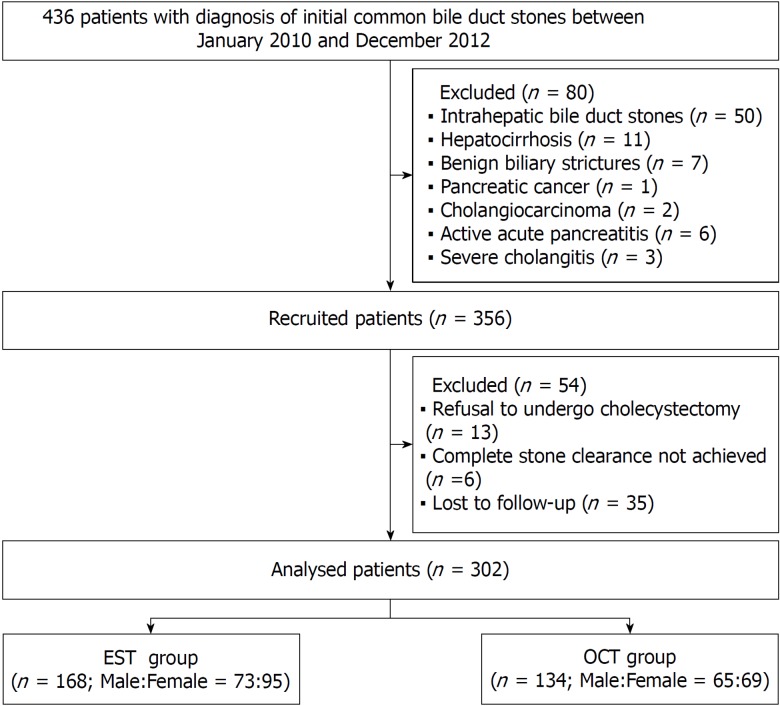
In total, 302 patients undergoing successful EST ( = 168) or OCT ( = 134) were enrolled in the study and were followed for a median of 6.3 years. After propensity score matching, 176 patients remained, and all covariates were balanced. EST was associated with significantly shorter time to relieving biliary obstruction, anesthetic duration, procedure time, and hospital stay than OCT ( < 0.001). The number of complete stone clearance sessions increased significantly in the EST group ( 0.009). The overall incidence of complications and mortality did not differ significantly between the two groups. Recurrent CBDS occurred in 18.8% (33/176) of the patients overall, but no difference was found between the EST (20.5%, 18/88) and OCT (17.0%, 15/88) groups. Factors associated with CBDS recurrence included common bile duct (CBD) diameter > 15 mm (OR = 2.72; 95%CI: 1.26-5.87; = 0.011), multiple CBDS (OR = 5.09; 95%CI: 2.58-10.07; < 0.001), and distal CBD angle ≤ 145° (OR = 2.92; 95%CI: 1.54-5.55; = 0.001). The prediction model incorporating these factors demonstrated an area under the receiver operating characteristic curve of 0.81 (95%CI: 0.76-0.87).
EST is superior to OCT with regard to time to biliary obstruction relief, anesthetic duration, procedure time, and hospital stay and is not associated with an increased recurrence rate or mortality compared with OCT in the management of CBDS.
内镜下括约肌切开术(EST)用于治疗胆总管结石(CBDS)的应用越来越广泛,因为它是一种微创的方法。然而,一些临床医生认为,EST 可能会导致内镜逆行胰胆管造影(ERCP)后胰腺炎(PEP),并且与开腹胆总管切开术(OCT)相比,CBDS 的复发率更高。这两种治疗 CBDS 的方法的结果是否存在差异,目前尚未得到充分阐明。
比较 EST 和 OCT 治疗 CBDS 的结果,并阐明与结石复发相关的危险因素。
本回顾性研究纳入了 2010 年 1 月至 2012 年 12 月期间接受 EST 或 OCT 治疗 CBDS 的患者。通过电话或查阅病历获得随访数据。对至少随访 5 年或复发的 302 例患者进行了统计学分析。采用倾向评分匹配(1:1)调整临床差异。采用 logistic 回归模型识别复发的潜在危险因素,并生成受试者工作特征(ROC)曲线以确定独立的危险因素。
共纳入 302 例成功进行 EST(n=168)或 OCT(n=134)的患者,中位随访时间为 6.3 年。经过倾向评分匹配后,仍有 176 例患者入组,所有协变量均得到平衡。EST 在缓解胆道梗阻的时间、麻醉持续时间、手术时间和住院时间方面明显短于 OCT(<0.001)。EST 组的完全结石清除次数明显增加(<0.009)。两组患者的并发症总发生率和死亡率无显著差异。总体而言,176 例患者中有 18.8%(33/176)复发 CBDS,但 EST 组(20.5%,18/88)和 OCT 组(17.0%,15/88)之间无差异。与 CBDS 复发相关的因素包括胆总管(CBD)直径>15mm(OR=2.72;95%CI:1.26-5.87;=0.011)、多发 CBDS(OR=5.09;95%CI:2.58-10.07;<0.001)和远端 CBD 角≤145°(OR=2.92;95%CI:1.54-5.55;=0.001)。纳入这些因素的预测模型的受试者工作特征曲线下面积为 0.81(95%CI:0.76-0.87)。
EST 在缓解胆道梗阻、麻醉持续时间、手术时间和住院时间方面优于 OCT,与 OCT 相比,EST 治疗 CBDS 不会增加复发率或死亡率。