Peking University Institute of Mental Health (Sixth Hospital), Beijing, 100191, China.
National Clinical Research Center for Mental Disorders & Key Laboratory of Mental Health, Ministry of Health, Peking University, Beijing, 100191, China.
Transl Psychiatry. 2019 Jan 31;9(1):48. doi: 10.1038/s41398-019-0385-x.
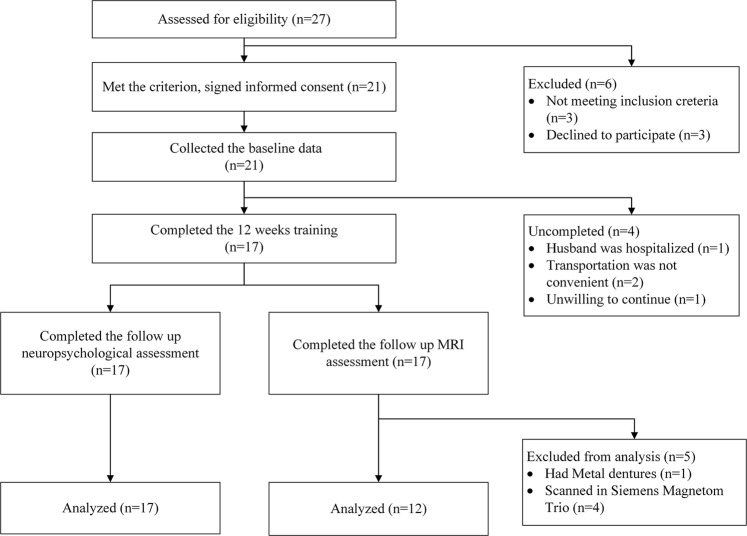
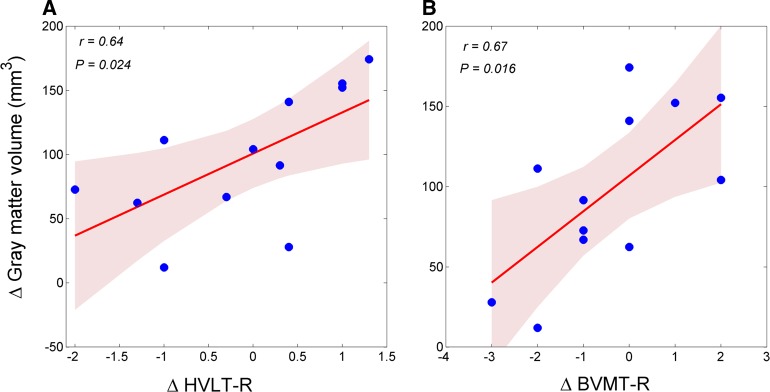
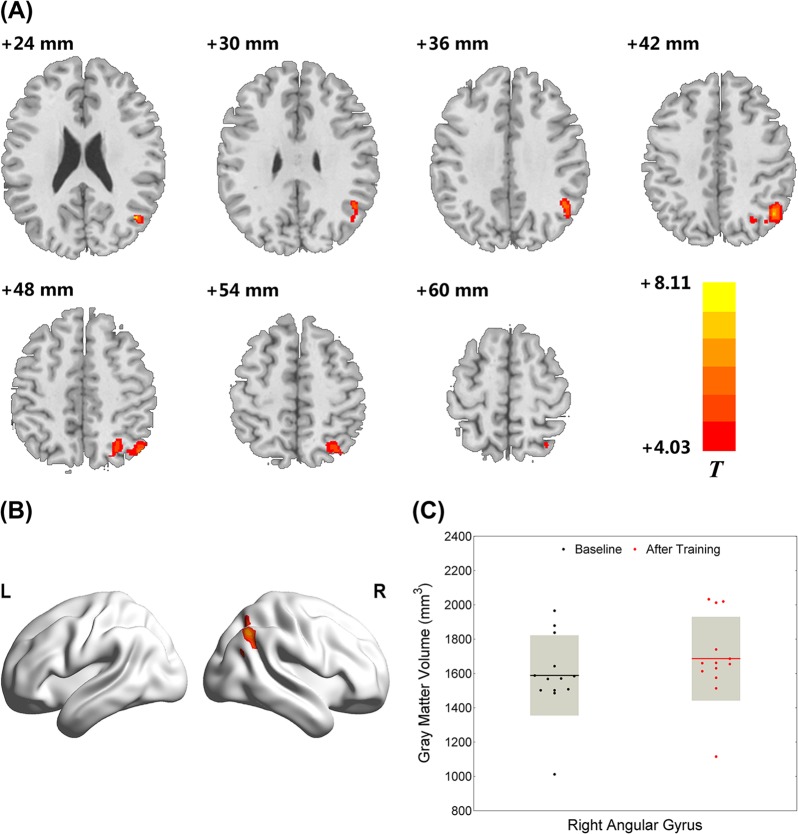
The present study aimed to explore the effect of computerized multi-domain cognitive training (MDCT) on brain gray matter volume and neuropsychological performance in patients with amnestic mild cognitive impairment (amnestic MCI). Twenty-one patients with amnestic MCI participated in a computerized MDCT program. The program targeted a broad set of cognitive domains via programs focused on reasoning, memory, visuospatial, language, calculation, and attention. Seventeen Participants completed the intervention and all completed a battery of neuropsychological tests to evaluate cognitive function while 12 out of 17 underwent 3 T MRI scanning before and after the intervention to measure gray matter (GM) volume. We examined correlations between the changes in neuropsychological scores and GM volumes across participants after the intervention. After training, we observed significant increases in GM volume in the right angular gyrus (AG) and other parietal subareas near the intraparietal sulcus (p < 0.05, FWE-corrected, 10000 permutations). However, we found no significant changes in neuropsychological test scores (p > 0.05). A correlation analysis revealed positive correlations between the changes in GM volume in the right AG and scores in the immediate recall component of the Hopkins Verbal Learning Test-Revised (HVLT-R) (r = 0.64, p = 0.024) and the Brief Visuospatial Memory Test-Revised (BVMT-R) (r = 0.67, p = 0.016). Our findings indicate that a computerized MDCT program may protect patients with amnestic MCI against brain GM volume loss and has potential in preserving general cognition. Thus, our non-pharmacological intervention may slow the rate of disease progression.
本研究旨在探讨计算机化多领域认知训练(MDCT)对遗忘型轻度认知障碍(amnestic MCI)患者脑灰质体积和神经心理学表现的影响。21 例遗忘型 MCI 患者参与了计算机化 MDCT 方案。该方案通过针对推理、记忆、视空间、语言、计算和注意力等广泛认知领域的程序来实现。17 名参与者完成了干预,所有人都完成了一系列神经心理学测试,以评估认知功能,而 17 名参与者中有 12 名在干预前后接受了 3T MRI 扫描,以测量灰质(GM)体积。我们检查了干预后参与者的神经心理学评分和 GM 体积变化之间的相关性。训练后,我们观察到右侧角回(AG)和顶内沟附近其他顶叶亚区的 GM 体积显著增加(p<0.05,FWE 校正,10000 次置换)。然而,我们没有发现神经心理学测试评分的显著变化(p>0.05)。相关性分析显示,右侧 AG 的 GM 体积变化与 Hopkins 言语学习测试修订版(HVLT-R)即时回忆成分(r=0.64,p=0.024)和简明视觉空间记忆测试修订版(BVMT-R)(r=0.67,p=0.016)的评分之间存在正相关。我们的发现表明,计算机化 MDCT 方案可能保护遗忘型轻度认知障碍患者免受脑 GM 体积损失的影响,并具有保护一般认知的潜力。因此,我们的非药物干预可能会减缓疾病进展的速度。