Department of Mechanical Engineering, Stanford University, Stanford, CA, 94305, USA.
Nat Commun. 2019 Jan 31;10(1):529. doi: 10.1038/s41467-019-08465-x.
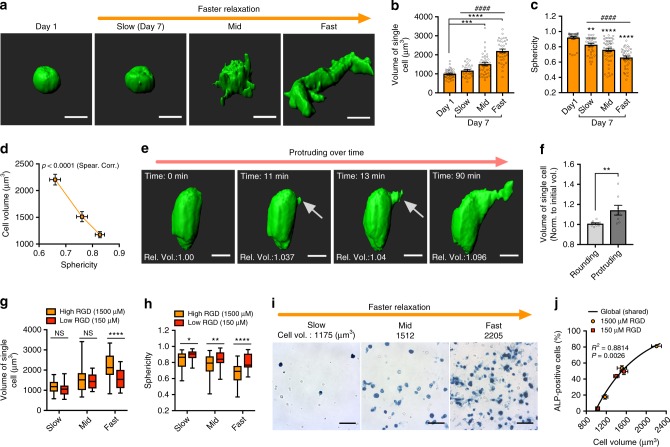
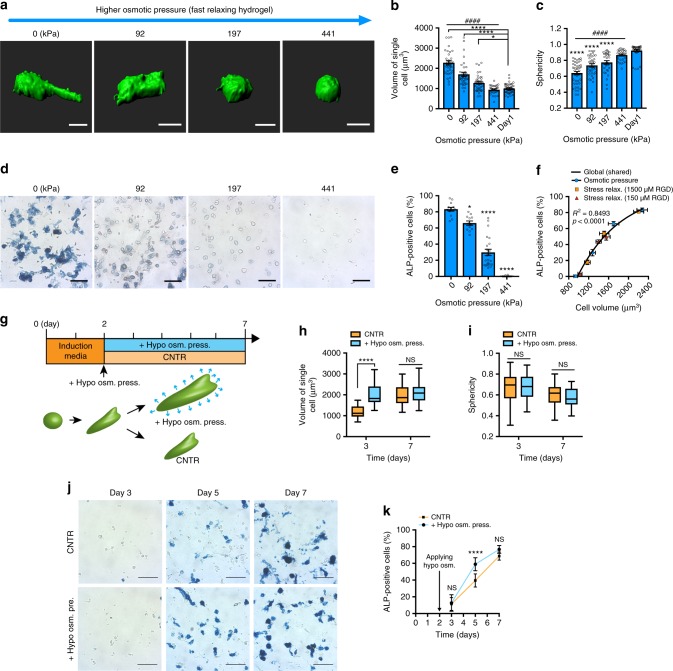
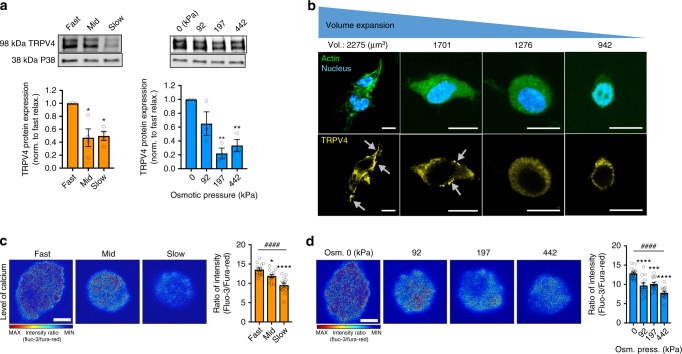
For mesenchymal stem cells (MSCs) cultured in three dimensional matrices, matrix remodeling is associated with enhanced osteogenic differentiation. However, the mechanism linking matrix remodeling in 3D to osteogenesis of MSCs remains unclear. Here, we find that MSCs in viscoelastic hydrogels exhibit volume expansion during cell spreading, and greater volume expansion is associated with enhanced osteogenesis. Restriction of expansion by either hydrogels with slow stress relaxation or increased osmotic pressure diminishes osteogenesis, independent of cell morphology. Conversely, induced expansion by hypoosmotic pressure accelerates osteogenesis. Volume expansion is mediated by activation of TRPV4 ion channels, and reciprocal feedback between TRPV4 activation and volume expansion controls nuclear localization of RUNX2, but not YAP, to promote osteogenesis. This work demonstrates the role of cell volume in regulating cell fate in 3D culture, and identifies TRPV4 as a molecular sensor of matrix viscoelasticity that regulates osteogenic differentiation.
对于在三维基质中培养的间充质干细胞 (MSCs),基质重塑与增强成骨分化有关。然而,将 3D 中的基质重塑与 MSCs 的成骨联系起来的机制尚不清楚。在这里,我们发现,在粘弹性水凝胶中的 MSCs 在细胞铺展过程中会发生体积膨胀,并且更大的体积膨胀与增强的成骨有关。通过具有缓慢应力松弛或增加渗透压的水凝胶限制膨胀会减弱成骨作用,而与细胞形态无关。相反,通过低渗压诱导的膨胀会加速成骨。体积膨胀是通过激活 TRPV4 离子通道介导的,TRPV4 激活和体积膨胀之间的反馈循环控制 RUNX2 而非 YAP 的核定位,以促进成骨。这项工作证明了细胞体积在调节 3D 培养中细胞命运的作用,并确定 TRPV4 是一种基质粘弹性的分子传感器,可调节成骨分化。