Research Division, Federal Institute for Drugs and Medical Devices (BfArM), Bonn, Germany.
Department for Dermatology and Allergy, University Hospital Aachen, Aachen, Germany.
Pharmacoepidemiol Drug Saf. 2019 Mar;28(3):377-388. doi: 10.1002/pds.4726. Epub 2019 Jan 31.
The main objective of this study was to analyze validated cases of drug-induced anaphylactic reactions in children with regard to incriminated drugs, clinical characteristics, and associated factors. A further objective was to compare differences in incriminated drugs and characteristics between validated cases and a reference excluding anaphylactic reaction cases (basic dataset).
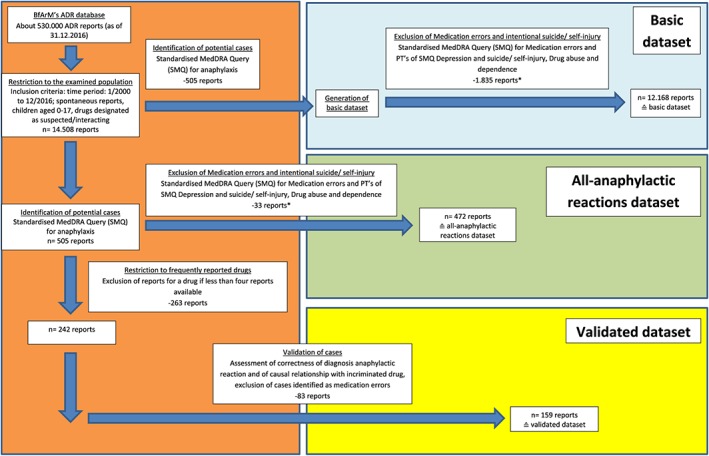
Spontaneous reports of anaphylactic reactions in children (0-17 years) registered between January 2000 to December 2016 were extracted from the adverse drug reaction database of the German Federal Institute for Drugs and Medical Devices. These reports were restricted to drugs for which at least four cases were found. After case validation, 159 reports remained (validated dataset) and were compared with the basic dataset (n = 12.168 reports) using inferential statistics.
Estimated yearly increase of reports (36.8 vs 0.1), most frequently incriminated drugs (antibiotics 30.2% vs 11%, analgesics/antipyretics 22.0% vs 5.6%; P values less than 0.001) and route of administration (38.4% vs 6.7%) differed between the validated dataset and the basic dataset. Validated cases differed in severity (higher with atracurium), reported symptoms (urticaria leading with analgesics), and associated factors (atopy/allergy rarely reported with antibiotics) depending on the incriminated drug class. In 13.8% (11.3% if excluding repeated readministration in one person) of the cases, the drug had not been tolerated before.
A heterogeneous clinical phenotype with differences in associated factors was observed, suggesting different underlying mechanisms triggered by the different drug groups. Occurrence of serious drug-induced anaphylactic reactions in children could be reduced by carefully considering patient history.
本研究的主要目的是分析儿童药物诱发过敏反应的确诊病例,研究药物、临床特征和相关因素。进一步的目的是比较确诊病例和排除过敏反应病例的参考数据集(基础数据集)之间的可疑药物和特征差异。
从德国联邦药品和医疗器械研究所的药物不良反应数据库中提取了 2000 年 1 月至 2016 年 12 月期间登记的儿童(0-17 岁)过敏反应的自发报告。这些报告仅限于至少发现 4 例的药物。经过病例验证后,保留了 159 份报告(验证数据集),并使用推断统计数据与基础数据集(n=12168 份报告)进行比较。
报告的年增长率估计为 36.8%(30.2%)比 0.1%(11%),最常见的可疑药物(抗生素 30.2%比 11%,镇痛药/退烧药 22.0%比 5.6%;P 值均小于 0.001)和给药途径(38.4%比 6.7%)在验证数据集和基础数据集之间存在差异。根据可疑药物类别,验证病例的严重程度(阿曲库铵较高)、报告的症状(镇痛药首选荨麻疹)和相关因素(过敏/过敏很少与抗生素相关)有所不同。在 13.8%(如果排除一个人重复重新给药则为 11.3%)的病例中,药物以前没有被耐受过。
观察到不同可疑药物组之间存在不同的临床表型和相关因素,提示不同的药物组可能触发了不同的潜在机制。通过仔细考虑患者病史,可以减少儿童严重药物诱发过敏反应的发生。