Department of Physiology, Faculty of Medicine, Mashhad University of Medical Sciences, Mashhad, Iran.
Department of Clinical Biochemistry, Faculty of Medicine, Mashhad University of Medical Sciences, Mashhad, Iran.
Biomed J. 2018 Dec;41(6):340-347. doi: 10.1016/j.bj.2018.10.008. Epub 2019 Jan 11.
Due to antioxidant effects of Zataria multiflora (ZM) and Carvacrol (CAR) in many cases and the prominent role of reactive oxygen species (ROS) in hepatotoxicity induced by Adriamycin (ADR), the aim of this study is to investigate the effects of ZM and CAR on ADR-induced hepatotoxicity.
Twenty four male Wistar rats were randomly divided into four groups including: 1)Control, 2)Adriamycin (ADR), 3,4) ZM + ADR and CAR + ADR that received ZM and CAR for 28 consecutive days. Blood samples were collected on the days 0, 14 and 28 to determine the alkaline phosphatase (ALP), aspartate aminotransferase (AST) and alanine aminotransferase (ALT) levels. Also, the hepatic redox markers were evaluated.
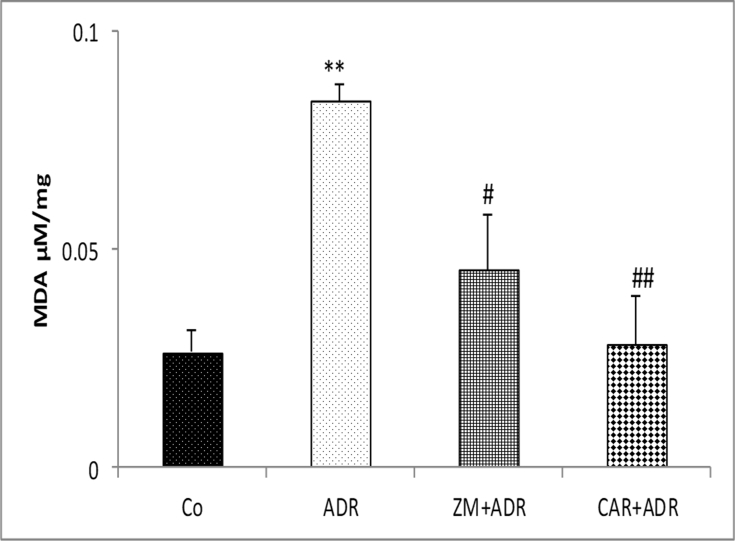
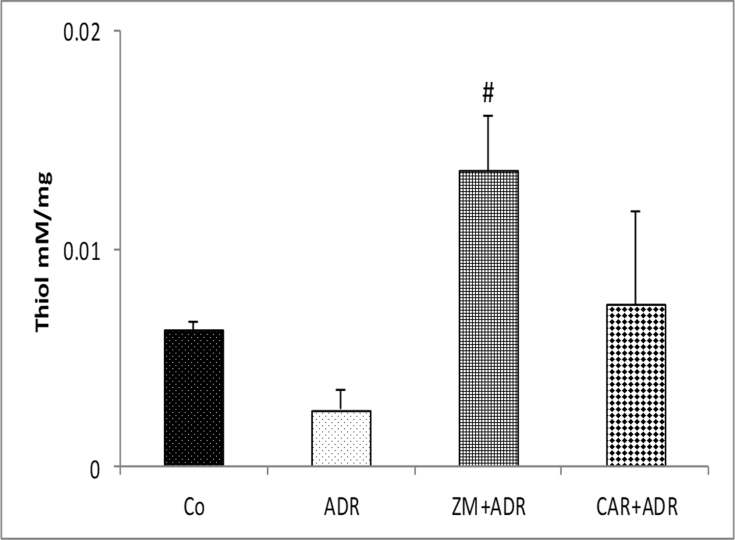
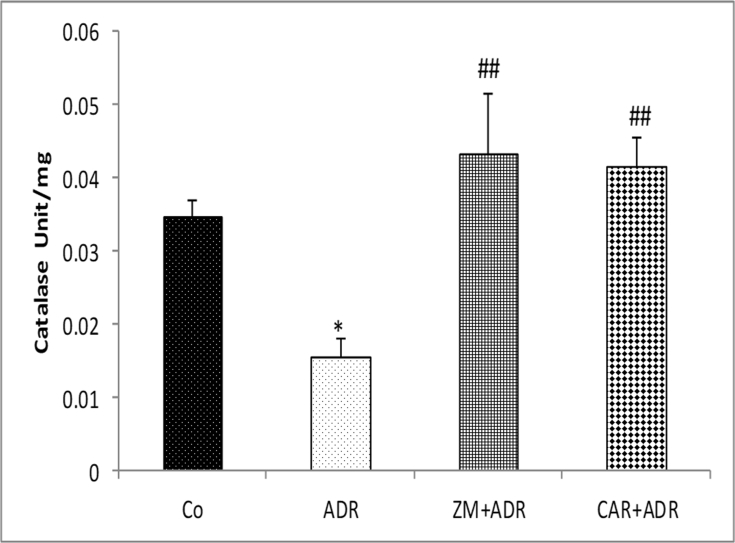
ADR significantly increased ALP, ALT and AST in comparison with the control (p < 0.05 - p < 0.001). In CAR + ADR group, the serum ALP, ALT and AST were significantly reduced compared to those of the ADR group (p < 0.01 to p < 0.001). Also, in ZM + ADR group, serum ALP and ALT compared to ADR was significantly reduced (p < 0.001). MDA level in the ADR group significantly increased compared to control (p < 0.01). The MDA level in ZM + ADR (p < 0.05) and CAR + ADR (p < 0.01) groups were significantly reduced compared to that of ADR. Thiol levels in ZM + ADR group significantly increased compared to the ADR group (p < 0.05). The activities of CAT in the ADR group was significantly reduced compared to control (p < 0.05) and increased in treatment groups in comparison with the ADR (p < 0.01).
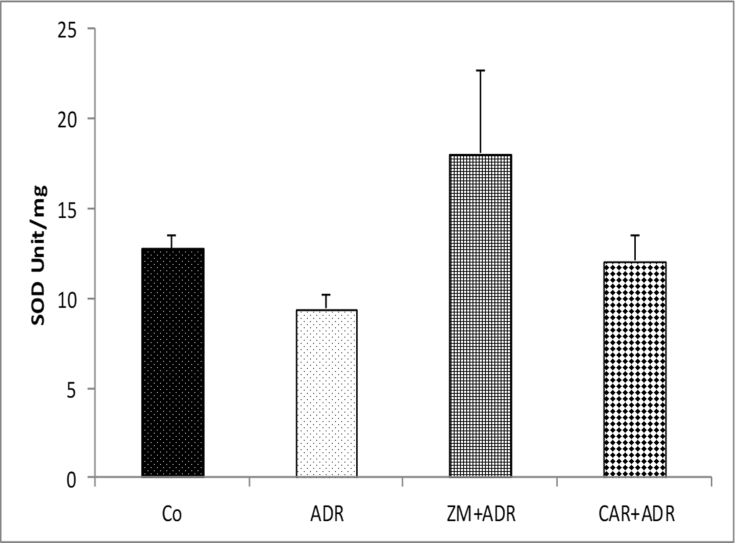
Long-term administration of ZM extract and CAR could reduce the oxidative damage in the rat liver induced by ADR through the strengthening of the antioxidant system.
由于香薷(ZM)和香芹酚(CAR)在许多情况下的抗氧化作用,以及活性氧(ROS)在阿霉素(ADR)诱导的肝毒性中的突出作用,本研究旨在研究 ZM 和 CAR 对 ADR 诱导的肝毒性的影响。
24 只雄性 Wistar 大鼠随机分为四组:1)对照组,2)阿霉素(ADR)组,3,4)ZM+ADR 和 CAR+ADR,连续 28 天接受 ZM 和 CAR 治疗。在第 0、14 和 28 天采集血样,以测定碱性磷酸酶(ALP)、天门冬氨酸氨基转移酶(AST)和丙氨酸氨基转移酶(ALT)水平。此外,还评估了肝氧化还原标志物。
与对照组相比,ADR 显著增加了 ALP、ALT 和 AST(p<0.05-p<0.001)。在 CAR+ADR 组中,与 ADR 组相比,血清 ALP、ALT 和 AST 显著降低(p<0.01 至 p<0.001)。此外,在 ZM+ADR 组中,与 ADR 相比,血清 ALP 和 ALT 显著降低(p<0.001)。与对照组相比,ADR 组 MDA 水平显著升高(p<0.01)。ZM+ADR(p<0.05)和 CAR+ADR(p<0.01)组的 MDA 水平明显低于 ADR 组。与 ADR 组相比,ZM+ADR 组的巯基水平显著升高(p<0.05)。与对照组相比,ADR 组 CAT 活性显著降低(p<0.05),而治疗组与 ADR 组相比活性增加(p<0.01)。
长期给予 ZM 提取物和 CAR 可通过增强抗氧化系统来减少 ADR 诱导的大鼠肝氧化损伤。