Zou Jianhua, Wang Peng, Wang Ya, Liu Gongyuan, Zhang Yewei, Zhang Qi, Shao Jinjun, Si Weili, Huang Wei, Dong Xiaochen
Key Laboratory of Flexible Electronics (KLOFE) , Institute of Advanced Materials (IAM) , Nanjing Tech University (Nanjing Tech) , 30 South Puzhu Road , Nanjing , 211800 , China . Email:
Department of Hepatobiliary and Pancreatic Surgery , Zhongda Hospital , Medical School , Southeast University , Nanjing 210009 , China.
Chem Sci. 2018 Oct 15;10(1):268-276. doi: 10.1039/c8sc02443j. eCollection 2019 Jan 7.
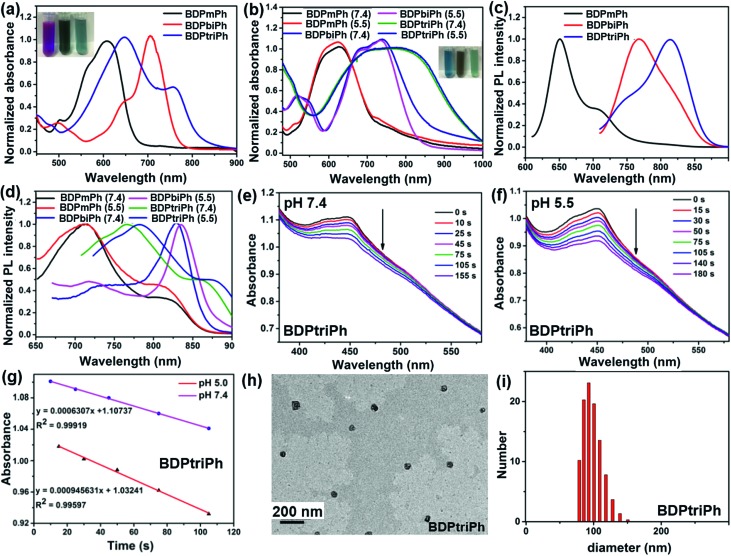
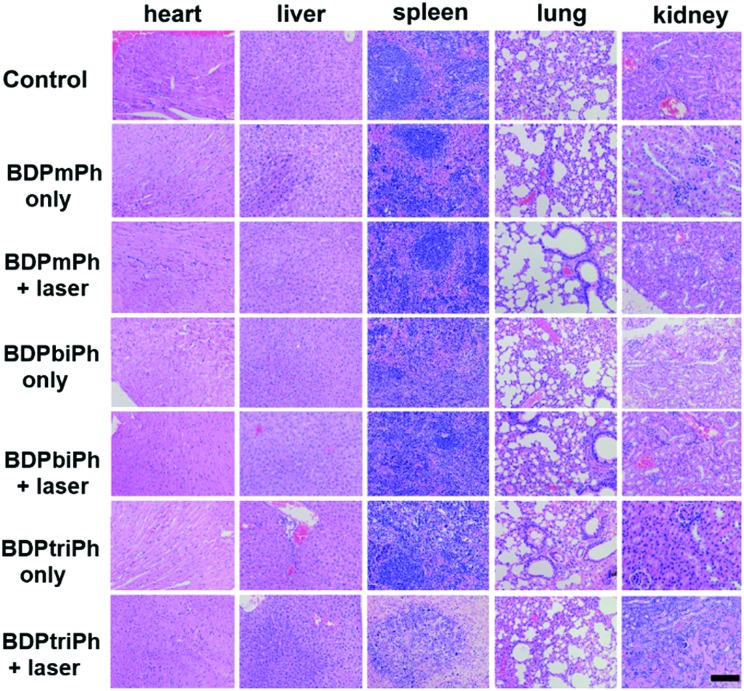
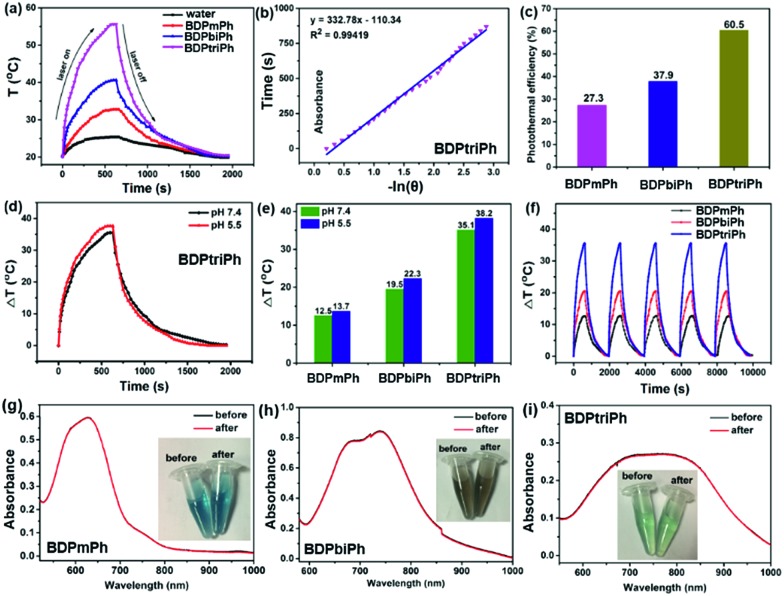
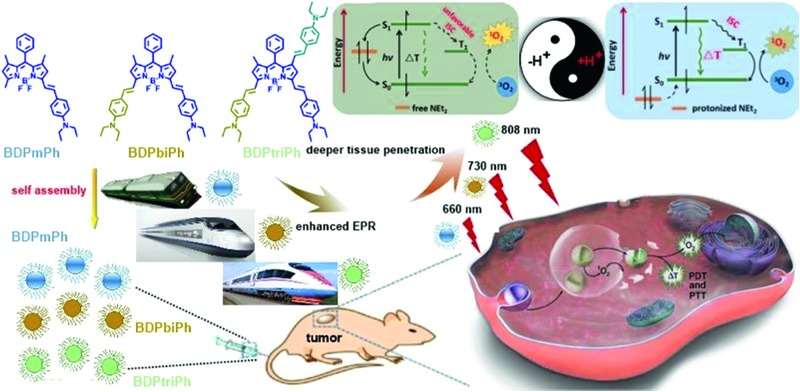
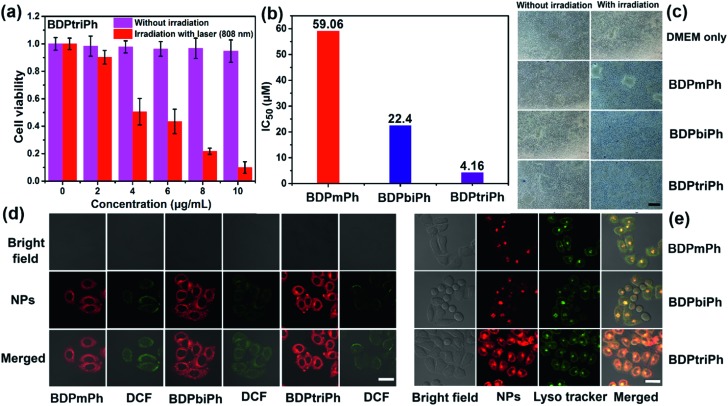
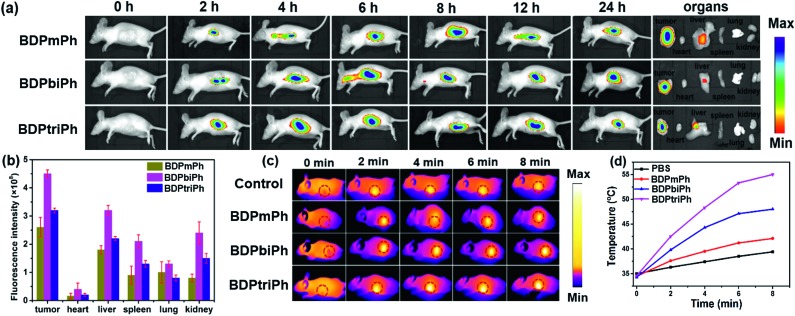
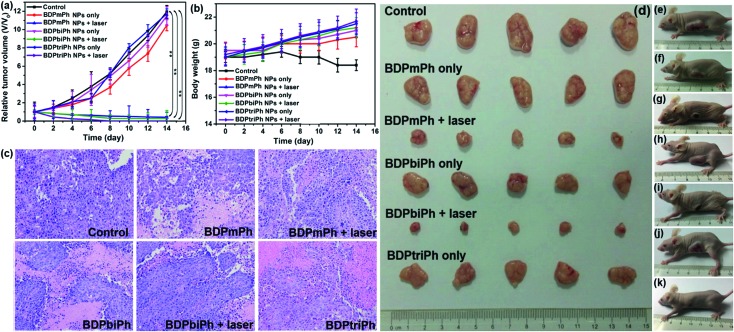
Improving the deep-tissue phototherapy (PDT) efficiency in the near-infrared (NIR) region has become one of the major challenges in clinics for cancer treatment. Developing intelligent photosensitizers (PSs) responding to tumor-specific signals sensitively to minimize side effects is another major challenge for tumor phototherapy. Herein, three phenyl-based boron dipyrromethene (BODIPY) compounds with different numbers of diethylaminophenyl groups introduced onto the BODIPY core have been designed and synthesized by the Knoevenagel condensation reaction. The absorbance of these compounds (BDPmPh, BDPbiPh, and BDPtriPh) can be controlled easily for realizing the tunable penetration depth. Moreover, the diethylamino groups in these designed PSs can serve as proton acceptors triggered by the low pH in lysosomes which can enhance the efficacy of photodynamic and photothermal therapy. The corresponding nanoparticles (NPs) of the compounds are prepared through a nanoprecipitation method and studies demonstrate that the ultra-low drug dosage of BDPtriPh NPs (half-maximal inhibitory concentration, IC = 4.16 μM) is much lower than that of BDPmPh NPs (50.09 μM) and BDPbiPh NPs (22.4 μM). fluorescence imaging shows that these NPs can be passively targeted to tumors by the enhanced permeability and retention (EPR) effect, and BDPtriPh NPs exhibit the fastest accumulation (about 4 hours). phototherapy indicates that BDPtriPh NPs with the longest NIR absorbance (813 nm) and highest photothermal conversion efficiency (60.5%) can effectively inhibit tumor growth and reduce side effects to normal tissues. This study provides a strategy to modulate the photoconversion characteristics of PSs for both penetration-depth-tunable and pH-dependent PDT/PTT synergistic cancer therapy in clinics.
提高近红外(NIR)区域的深部组织光动力疗法(PDT)效率已成为癌症治疗临床中的主要挑战之一。开发对肿瘤特异性信号敏感响应的智能光敏剂(PSs)以最小化副作用是肿瘤光动力疗法的另一个主要挑战。在此,通过克诺文纳格尔缩合反应设计并合成了三种在硼二吡咯亚甲基(BODIPY)核心上引入不同数量二乙氨基苯基的苯基硼二吡咯亚甲基化合物。这些化合物(BDPmPh、BDPbiPh和BDPtriPh)的吸光度可轻松控制,以实现可调的穿透深度。此外,这些设计的PSs中的二乙氨基可作为溶酶体中低pH触发的质子受体,可增强光动力和光热疗法的疗效。通过纳米沉淀法制备了这些化合物的相应纳米颗粒(NPs),研究表明BDPtriPh NPs的超低药物剂量(半数抑制浓度,IC = 4.16 μM)远低于BDPmPh NPs(50.09 μM)和BDPbiPh NPs(22.4 μM)。荧光成像表明,这些NPs可通过增强的渗透和滞留(EPR)效应被动靶向肿瘤,并且BDPtriPh NPs表现出最快的积累(约4小时)。光动力疗法表明,具有最长近红外吸光度(813 nm)和最高光热转换效率(60.5%)的BDPtriPh NPs可有效抑制肿瘤生长并减少对正常组织的副作用。本研究提供了一种策略,可调节PSs的光转换特性,用于临床中穿透深度可调且pH依赖的PDT/PTT协同癌症治疗。