International Health Policy Program, Ministry of Public Health, Tiwanon Road, Nonthaburi 11000, Thailand.
Department of Health, Ministry of Public Health, Tiwanon Road, Nonthaburi 11000, Thailand.
Int J Environ Res Public Health. 2019 Feb 1;16(3):430. doi: 10.3390/ijerph16030430.
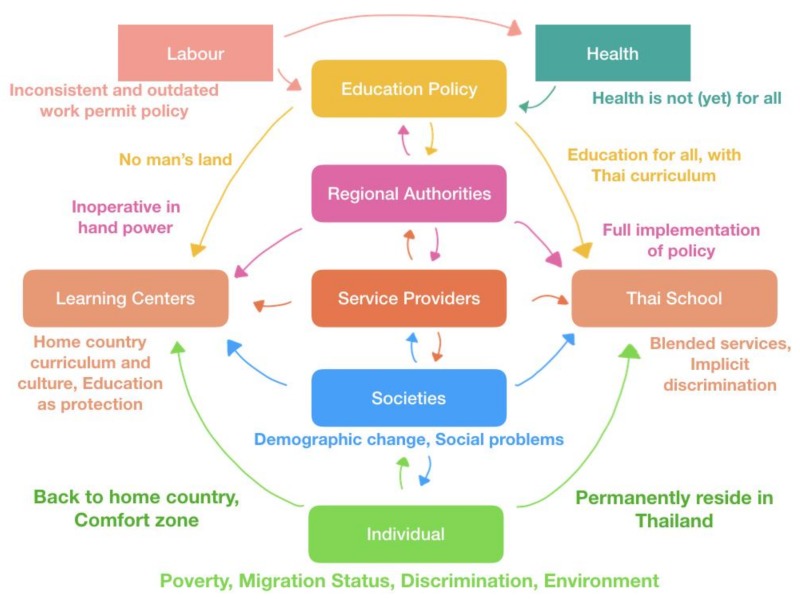
Health and education are interrelated, and it is for this reason that we studied the education of migrant children. The Thai Government has ratified 'rights' to education for all children in Thailand since 2005. However, there are gaps in knowledge concerning the implementation of education policy for migrants, such as whether and to what extent migrant children receive education services according to policy intentions. The objective of this study is to explore the implementation of education policy for migrants and the factors that determine education choices among them. A cross-sectional qualitative design was applied. The main data collection technique was in-depth interviews with 34 key informants. Thematic analysis with an intersectionality approach was used. Ranong province was selected as the main study site. Results found that Migrant Learning Centers (MLCs) were the preferable choice for most migrant children instead of Thai Public Schools (TPSs), even though MLCs were not recognized as formal education sites. The main reason for choosing MLCs was because MLCs provided a more culturally sensitive service. Teaching in MLCs was done in Myanmar's language and the MLCs offer a better chance to pursue higher education in Myanmar if migrants migrate back to their homeland. However, MLCs still face budget and human resources inadequacies. School health promotion was underserviced in MLCs compared to TPSs. Dental service was underserviced in most MLCs and TPSs. Implicit discrimination against migrant children was noted. The Thai Government should view MLCs as allies in expanding education coverage to all children in the Thai territory. A participatory public policy process that engages all stakeholders, including education officials, health care providers, Non-Governmental Organizations (NGOs), MLCs' representatives, and migrants themselves is needed to improve the education standards of MLCs, keeping their culturally-sensitive strengths.
健康和教育是相互关联的,正是出于这个原因,我们研究了移民儿童的教育问题。泰国政府自 2005 年以来批准了所有在泰儿童享有“受教育权”。然而,对于移民教育政策的实施情况,例如移民儿童是否以及在何种程度上按照政策意图接受教育服务,人们的了解存在差距。本研究的目的是探讨移民教育政策的实施情况以及决定移民教育选择的因素。采用了横断面定性设计。主要的数据收集技术是对 34 名关键信息提供者进行深入访谈。采用了带有交叉性方法的主题分析。拉廊府被选为主要的研究地点。研究结果发现,移民学习中心(MLCs)是大多数移民儿童的首选,而不是泰国公立学校(TPSs),尽管 MLCs 不被视为正规教育场所。选择 MLCs 的主要原因是因为 MLCs 提供了更具文化敏感性的服务。MLCs 以缅甸语授课,如果移民返回祖国,MLCs 提供了更好的机会接受缅甸的高等教育。然而,MLCs 仍然面临预算和人力资源不足的问题。与 TPSs 相比,MLCs 的学校健康促进服务不足。大多数 MLCs 和 TPSs 的牙科服务不足。注意到对移民儿童的隐性歧视。泰国政府应将 MLCs 视为扩大泰国领土内所有儿童教育覆盖范围的盟友。需要一个参与式的公共政策过程,让所有利益相关者参与,包括教育官员、医疗保健提供者、非政府组织(NGO)、MLCs 的代表和移民本身,以提高 MLCs 的教育标准,同时保持其文化敏感性的优势。