Dosoky Noura S, Satyal Prabodh, Setzer William N
Aromatic Plant Research Center, 230 N 1200 E, Suite 100, Lehi, UT 84043, USA.
Department of Chemistry, University of Alabama in Huntsville, Huntsville, AL 35899, USA.
Foods. 2019 Feb 2;8(2):53. doi: 10.3390/foods8020053.
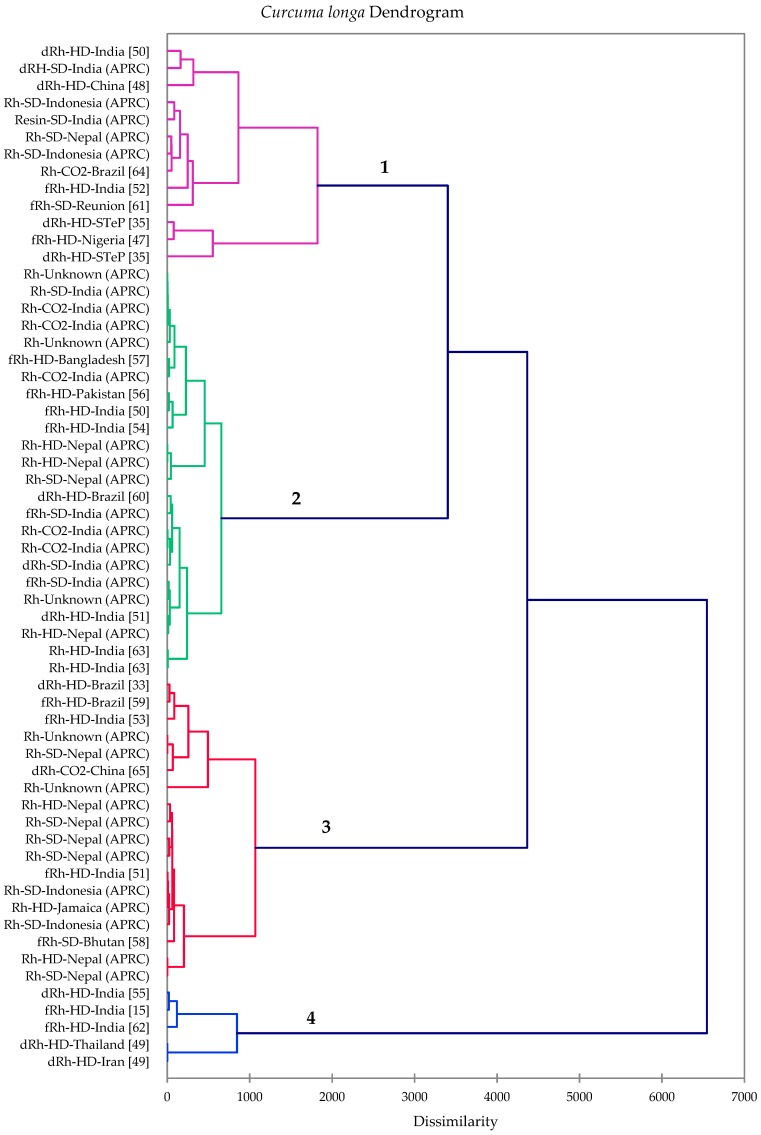
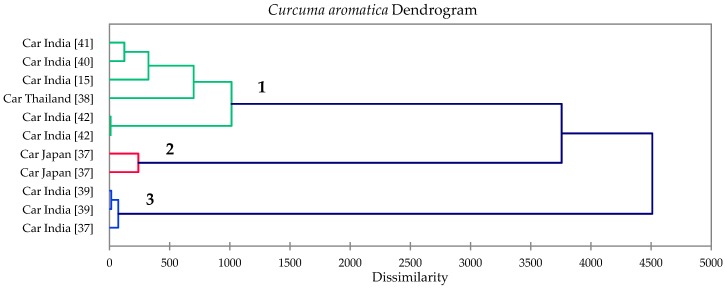
species have been cultivated in tropical and subtropical regions in Asia, Australia, and South America for culinary as well as medicinal applications. The biological activities of have been attributed to the non-volatile curcuminoids as well as to volatile terpenoids. essential oils have demonstrated a wide variety of pharmacological properties. The objective of this work was to examine the variation in the compositions of rhizome essential oils. In this work, the volatile oils from and were obtained and analyzed by gas chromatography-mass spectrometry. The chemical compositions of and essential oils, including those reported in the literature, were analyzed by hierarchical cluster analysis. In addition, cluster analyses of the chemical compositions of and from the literature were also carried out. volatiles were dominated by α-turmerone, curlone, -turmerone, β-sesquiphellandrene, α-zingiberene, germacrone, terpinolene, -curcumene, and α-phellandrene and showed four distinct chemical clusters. rhizome oil contained 1,8-cineole, curzerenone/-curzerenone, α-copaene, camphor, β-caryophyllene, elemol, germacrone, curzerene, and β-elemene and showed two different chemical types. had three clearly defined clusters, and had three types.
该物种已在亚洲、澳大利亚和南美洲的热带和亚热带地区进行种植,用于烹饪和药用。其生物活性归因于非挥发性姜黄素类化合物以及挥发性萜类化合物。姜精油已显示出多种药理特性。这项工作的目的是研究姜根茎精油成分的变化。在这项工作中,从姜和姜黄中获得挥发油,并通过气相色谱 - 质谱联用仪进行分析。通过层次聚类分析对姜和姜黄精油的化学成分(包括文献中报道的那些)进行分析。此外,还对文献中姜和姜黄的化学成分进行了聚类分析。姜挥发物以α - 姜黄酮、姜酮、β - 姜黄酮、β - 倍半水芹烯、α - 姜烯、莪术酮、萜品油烯、β - 姜黄烯和α - 水芹烯为主,并显示出四个不同的化学簇。姜根茎油含有1,8 - 桉叶素、莪术二酮/β - 莪术二酮、α - 可巴烯、樟脑、β - 石竹烯、榄香醇、莪术酮、莪术烯和β - 榄香烯,并显示出两种不同的化学类型。姜黄有三个明确的簇,姜有三种类型。