Poudel Darbin Kumar, Ojha Pawan Kumar, Rokaya Anil, Satyal Rakesh, Satyal Prabodh, Setzer William N
Analytica Research Center, Kritipur, Kathmandu 44600, Nepal.
Aromatic Plant Research Center, 230 N 1200 E, Suite 100, Lehi, UT 84043, USA.
Plants (Basel). 2022 Jul 26;11(15):1932. doi: 10.3390/plants11151932.
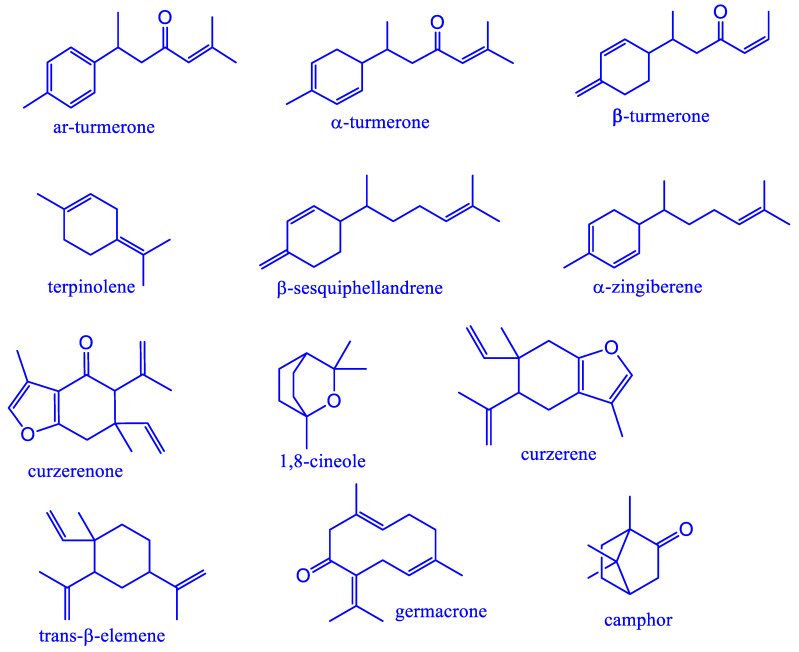
The genus Curcuma, composed of 93 species mainly originating from Asia, Australia, and South America, has been used for medicinal purposes, aromatic, and nutritional values as well as cosmetic. It plays a vital role in flavoring and coloring as well as exhibiting therapeutic agents against different diseases. Nepalese farmers are unaware of the essential oil compositions of Curcuma species, viz. C. aeruginosa, C. zedoaria, and C. longa. The investigation of these three essential oils provides insight into their potential as cash crops and earns a reasonable return from their production. The essential oils were obtained from the rhizomes of each plant by hydrodistillation and subjected to Gas Chromatography/Mass Spectrometry (GC−MS) analysis to identify its volatile chemical constituents as well as chiral GC-MS to identify the enantiomeric distribution of chiral terpenoids. The order of extraction yields were C. longa (0.89%) > C. zedoaria (0.74%) > C. aeruginosa (0.37%). In total, the presence of 65, 98, and 84 compounds were identified in C. longa, C. zedoaria, and C. aeruginosa, representing 95.82%, 81.55%, and 92.59% of the total oil, respectively. The most abundant compounds in C. longa essential oils were ar-turmerone (25.5%), α-turmerone (24.4%), β-turmerone (14.0%), terpinolene (7.2%), β-sesquiphellandrene (5.1%), α-zingiberene (4.8%), β-caryophyllene (2.9%), ar-curcumene (1.6%) and 1,8-cineole (1.3%). The most dominant compounds in C. zedoaria were curzerenone (21.5%), 1,8-cineole (19.6%), curzerene (6.2%), trans-β-Elemene (5.1%), camphor (2.6%), and germacrone (2.3%). The major components in C. aeruginosa were curzerenone (59.6%), germacrone (5.3%), curzerene (4.7%), camphor (3.6%), trans-β-Elemene (2.6%), and β-eudesmol (1.6%). C. zedoaria, and C. aeruginosa essential oil from Nepal for the very first time. This study reports for the first time chiral terpenoids from C. aeruginosa, C. zedoaria, and C. longa essential oil. A chemical blueprint of these essential oils could also be used as a tool for identification and quality assessment.
姜黄属由93个物种组成,主要原产于亚洲、澳大利亚和南美洲,已被用于药用、芳香、营养价值以及化妆品领域。它在调味、着色以及展现针对不同疾病的治疗作用方面发挥着至关重要的作用。尼泊尔农民并不了解姜黄属物种,即铜绿姜黄、莪术和姜黄的精油成分。对这三种精油的研究有助于深入了解它们作为经济作物的潜力,并从其生产中获得合理回报。通过水蒸馏法从每种植物的根茎中提取精油,并进行气相色谱/质谱(GC-MS)分析以鉴定其挥发性化学成分,同时进行手性GC-MS分析以鉴定手性萜类化合物的对映体分布。提取率顺序为:姜黄(0.89%)>莪术(0.74%)>铜绿姜黄(0.37%)。总共在姜黄、莪术和铜绿姜黄中分别鉴定出65种、98种和84种化合物,分别占总油的95.82%、81.55%和92.59%。姜黄精油中最丰富的化合物是芳姜黄酮(25.5%)、α-姜黄酮(24.4%)、β-姜黄酮(14.0%)、萜品油烯(7.2%)、β-倍半水芹烯(5.1%)、α-姜烯(4.8%)、β-石竹烯(2.9%)、芳姜黄烯(1.6%)和1,8-桉叶素(1.3%)。莪术中最主要的化合物是莪术酮(21.5%)、1,8-桉叶素(19.6%)、莪术烯(6.2%)、反式-β-榄香烯(5.1%)、樟脑(2.6%)和吉马酮(2.3%)。铜绿姜黄中的主要成分是莪术酮(59.6%)、吉马酮(5.3%)、莪术烯(4.7%)、樟脑(3.6%)、反式-β-榄香烯(2.6%)和β-桉叶醇(1.6%)。本研究首次报道了来自尼泊尔的莪术和铜绿姜黄精油。本研究首次报道了来自铜绿姜黄、莪术和姜黄精油中的手性萜类化合物。这些精油的化学蓝图也可作为鉴定和质量评估的工具。