Department of Chemistry and Chemical Biology, Harvard University, Cambridge, MA 02138.
Department of Biology, University of Konstanz, D-78457 Konstanz, Germany.
Proc Natl Acad Sci U S A. 2019 Feb 19;116(8):3171-3176. doi: 10.1073/pnas.1815661116. Epub 2019 Feb 4.
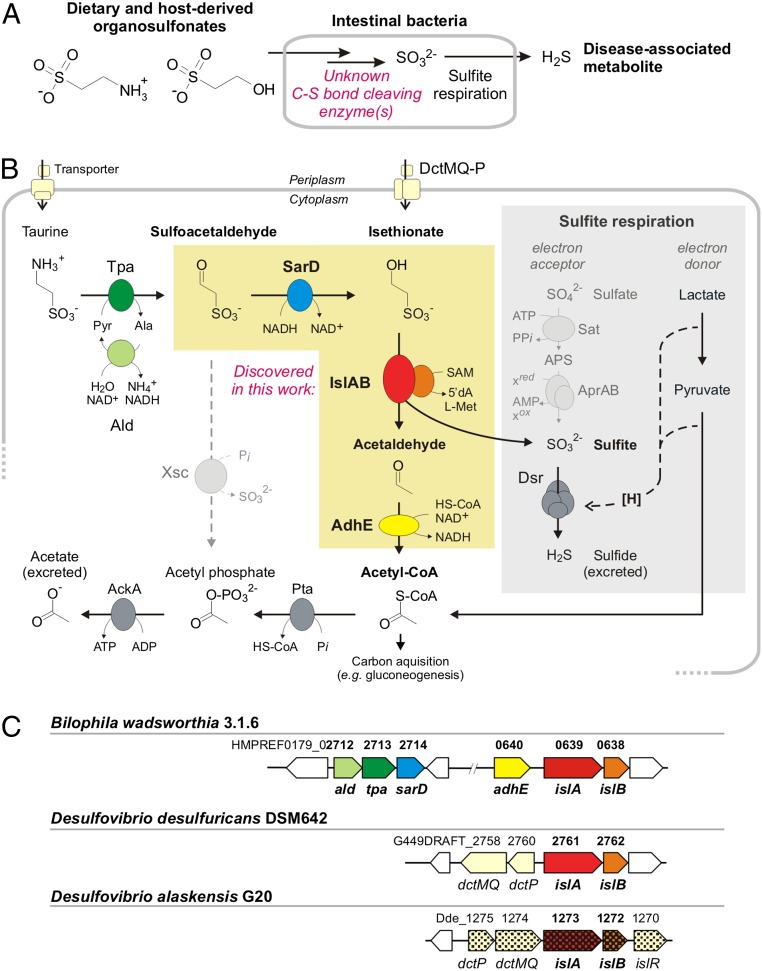
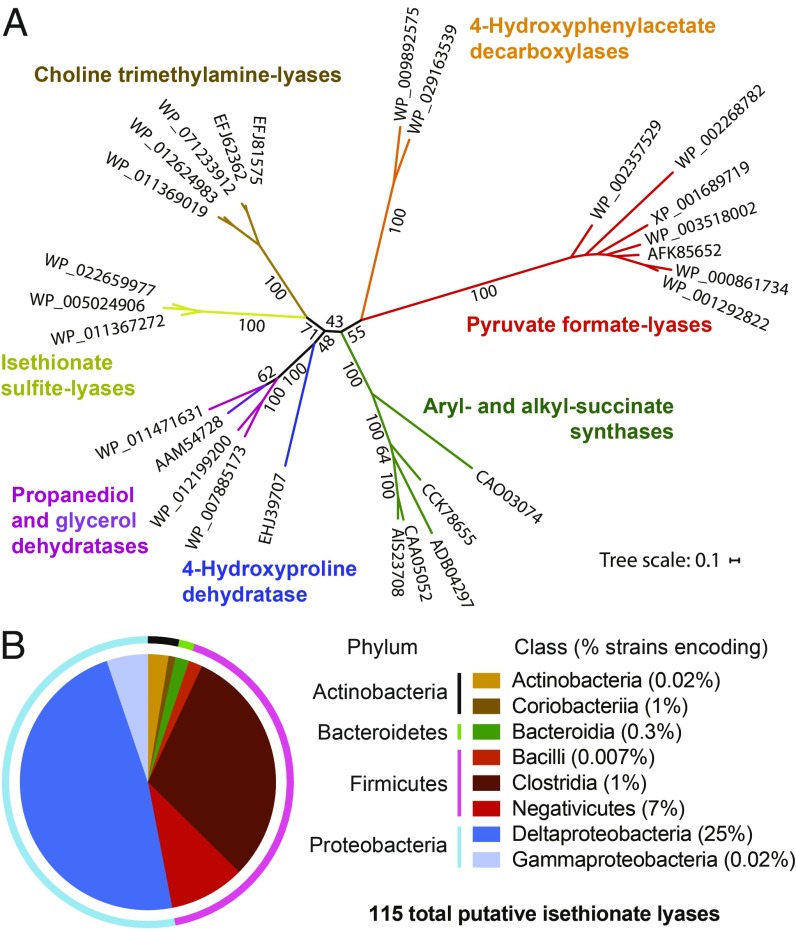
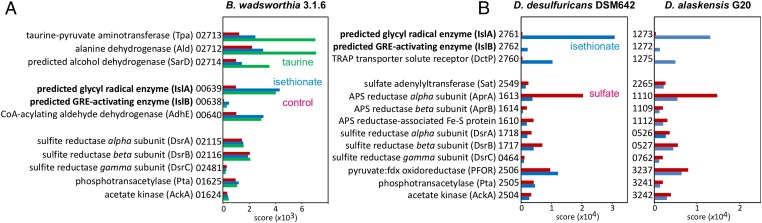
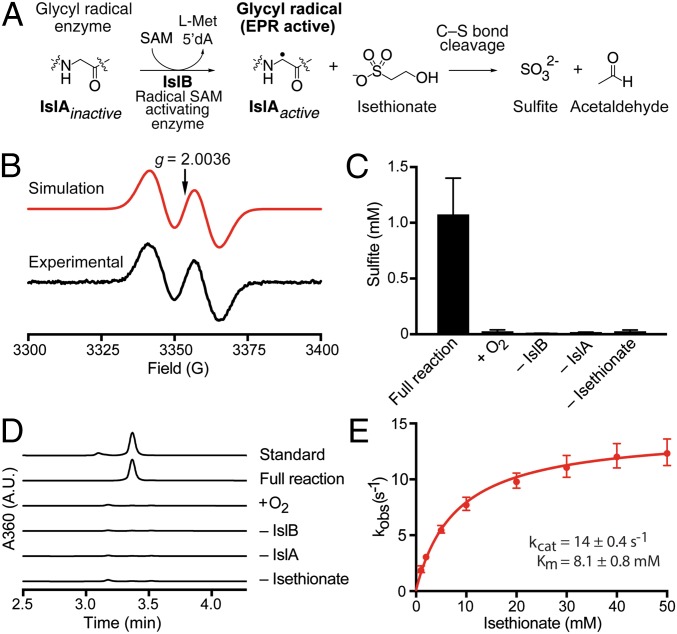
Hydrogen sulfide (HS) production in the intestinal microbiota has many contributions to human health and disease. An important source of HS in the human gut is anaerobic respiration of sulfite released from the abundant dietary and host-derived organic sulfonate substrate in the gut, taurine (2-aminoethanesulfonate). However, the enzymes that allow intestinal bacteria to access sulfite from taurine have not yet been identified. Here we decipher the complete taurine desulfonation pathway in 3.1.6 using differential proteomics, in vitro reconstruction with heterologously produced enzymes, and identification of critical intermediates. An initial deamination of taurine to sulfoacetaldehyde by a known taurine:pyruvate aminotransferase is followed, unexpectedly, by reduction of sulfoacetaldehyde to isethionate (2-hydroxyethanesulfonate) by an NADH-dependent reductase. Isethionate is then cleaved to sulfite and acetaldehyde by a previously uncharacterized glycyl radical enzyme (GRE), isethionate sulfite-lyase (IslA). The acetaldehyde produced is oxidized to acetyl-CoA by a dehydrogenase, and the sulfite is reduced to HS by dissimilatory sulfite reductase. This unique GRE is also found in DSM642 and G20, which use isethionate but not taurine; corresponding knockout mutants of G20 did not grow with isethionate as the terminal electron acceptor. In conclusion, the novel radical-based C-S bond-cleavage reaction catalyzed by IslA diversifies the known repertoire of GRE superfamily enzymes and enables the energy metabolism of This GRE is widely distributed in gut bacterial genomes and may represent a novel target for control of intestinal HS production.
肠内微生物群中的硫化氢 (HS) 产生对人类健康和疾病有许多贡献。人类肠道中 HS 的一个重要来源是从肠道中丰富的饮食和宿主来源的有机磺酸盐底物(牛磺酸)中释放的亚硫酸盐的厌氧呼吸。然而,允许肠道细菌从牛磺酸中获取亚硫酸盐的酶尚未被鉴定。在这里,我们使用差异蛋白质组学、异源生产酶的体外重建和关键中间产物的鉴定,在 3.1.6 中解码完整的牛磺酸脱硫途径。牛磺酸通过已知的牛磺酸:丙酮酸氨基转移酶初始脱氨,出乎意料的是,亚硫酸乙醛通过 NADH 依赖性还原酶还原为异丁酸盐(2-羟乙磺酸盐)。然后,异丁酸盐通过先前未表征的甘氨酰基自由基酶 (GRE)、异丁酸盐亚硫酸酯裂解酶 (IslA) 裂解为亚硫酸盐和乙醛。产生的乙醛被脱氢酶氧化为乙酰辅酶 A,亚硫酸盐被异化亚硫酸盐还原酶还原为 HS。这种独特的 GRE 也存在于 DSM642 和 G20 中,它们使用异丁酸盐而不是牛磺酸;G20 的相应敲除突变体不能以异丁酸盐作为末端电子受体生长。总之,IslA 催化的新型基于自由基的 C-S 键断裂反应使已知的 GRE 超家族酶的 repertoire 多样化,并使该 GRE 的能量代谢多样化。这种 GRE 在肠道细菌基因组中广泛分布,可能代表控制肠道 HS 产生的新靶标。