Department of Biology, Massachusetts Institute of Technology, Cambridge, MA 02139, USA.
Department of Chemistry and Chemical Biology, Harvard University, 12 Oxford Street, Cambridge, MA 02138, USA.
Cell Chem Biol. 2021 Sep 16;28(9):1333-1346.e7. doi: 10.1016/j.chembiol.2021.03.001. Epub 2021 Mar 26.
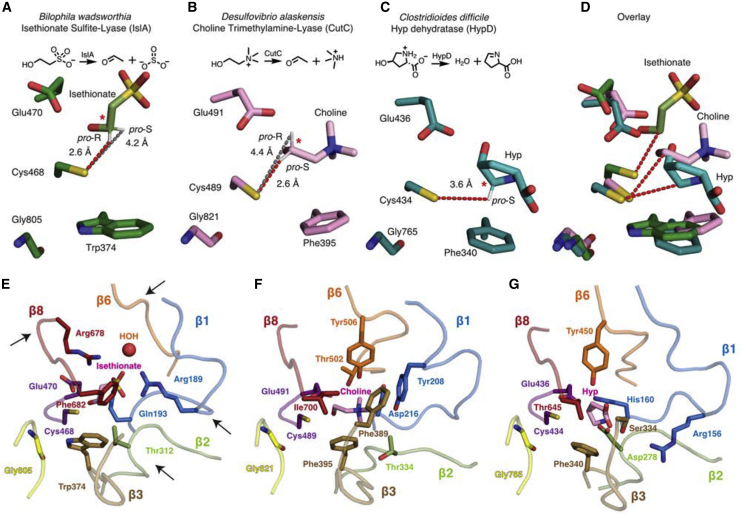
Desulfonation of isethionate by the bacterial glycyl radical enzyme (GRE) isethionate sulfite-lyase (IslA) generates sulfite, a substrate for respiration that in turn produces the disease-associated metabolite hydrogen sulfide. Here, we present a 2.7 Å resolution X-ray structure of wild-type IslA from Bilophila wadsworthia with isethionate bound. In comparison with other GREs, alternate positioning of the active site β strands allows for distinct residue positions to contribute to substrate binding. These structural differences, combined with sequence variations, create a highly tailored active site for the binding of the negatively charged isethionate substrate. Through the kinetic analysis of 14 IslA variants and computational analyses, we probe the mechanism by which radical chemistry is used for C-S bond cleavage. This work further elucidates the structural basis of chemistry within the GRE superfamily and will inform structure-based inhibitor design of IsIA and thus of microbial hydrogen sulfide production.
细菌甘氨酰基自由基酶(GRE)将异丁烯酸盐去磺化为亚硫酸盐-连硫酸盐裂解酶(IslA),产生亚硫酸盐,这是呼吸作用的底物,进而产生与疾病相关的代谢物硫化氢。在这里,我们展示了来自Bilophila wadsworthia 的野生型 IslA 与异丁烯酸盐结合的 2.7Å 分辨率 X 射线结构。与其他 GRE 相比,活性位点β链的交替定位允许不同的残基位置有助于底物结合。这些结构差异,再加上序列变异,为带负电荷的异丁烯酸盐底物的结合创造了一个高度定制的活性位点。通过对 14 种 IslA 变体的动力学分析和计算分析,我们探究了自由基化学用于 C-S 键断裂的机制。这项工作进一步阐明了 GRE 超家族内化学的结构基础,并将为基于结构的 IslA 抑制剂设计提供信息,从而为微生物硫化氢的产生提供信息。