SUPA, School of Physics and Astronomy, University of Edinburgh, Peter Guthrie Tait Road, Edinburgh, EH9 3FD, UK.
Department of Infectious Diseases, Integrative Virology, Heidelberg University Hospital and German Center for Infection Research, Im Neuenheimer Feld 344, 69120, Heidelberg, Germany.
Nat Commun. 2019 Feb 4;10(1):575. doi: 10.1038/s41467-019-08333-8.
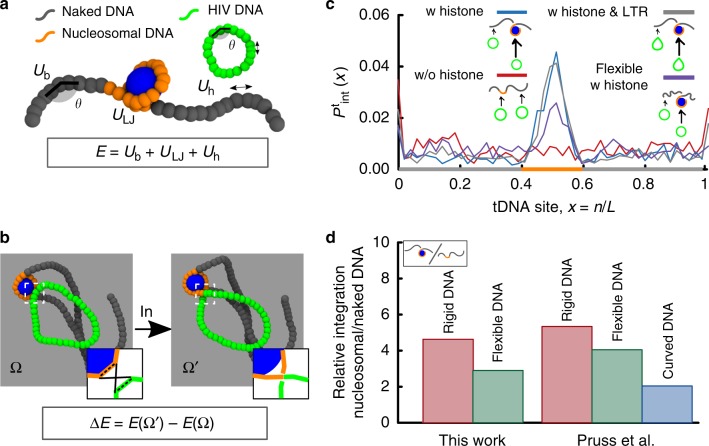
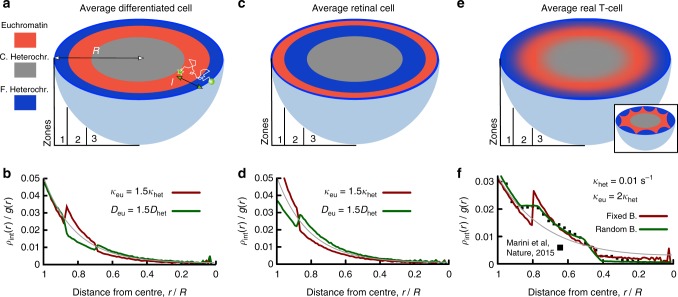
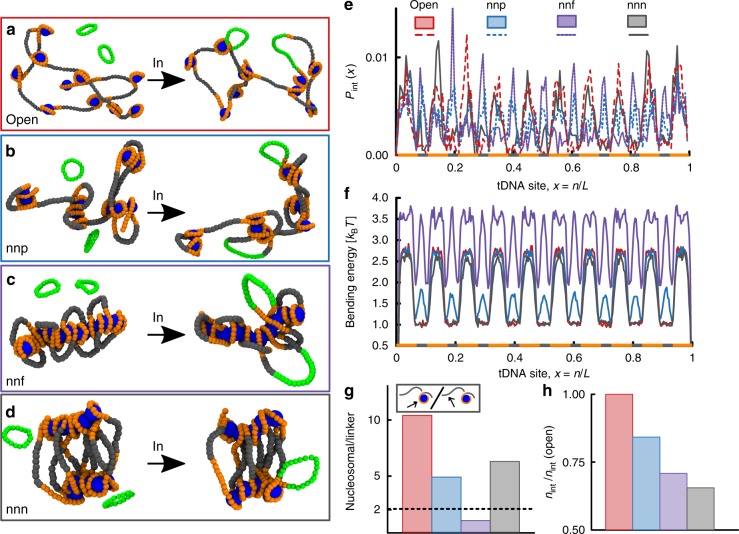
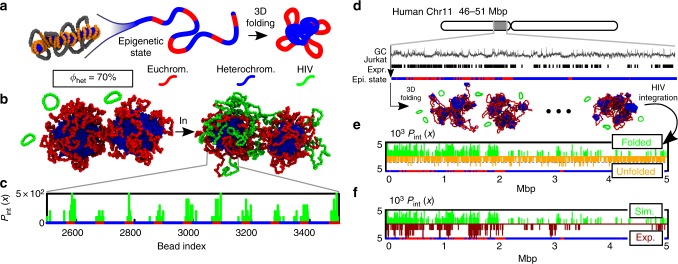
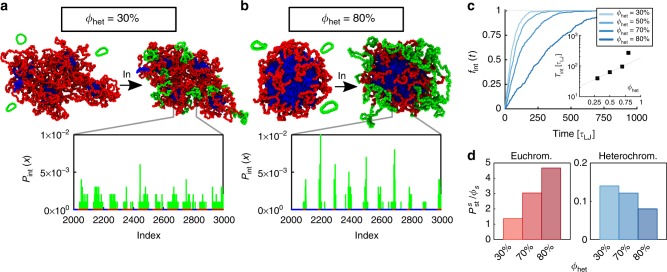
Certain retroviruses, including HIV, insert their DNA in a non-random fraction of the host genome via poorly understood selection mechanisms. Here, we develop a biophysical model for retroviral integration as stochastic and quasi-equilibrium topological reconnections between polymers. We discover that physical effects, such as DNA accessibility and elasticity, play important and universal roles in this process. Our simulations predict that integration is favoured within nucleosomal and flexible DNA, in line with experiments, and that these biases arise due to competing energy barriers associated with DNA deformations. By considering a long chromosomal region in human T-cells during interphase, we discover that at these larger scales integration sites are predominantly determined by chromatin accessibility. Finally, we propose and solve a reaction-diffusion problem that recapitulates the distribution of HIV hot-spots within T-cells. With few generic assumptions, our model can rationalise experimental observations and identifies previously unappreciated physical contributions to retroviral integration site selection.
某些逆转录病毒,包括 HIV,通过人们知之甚少的选择机制,将其 DNA 插入宿主基因组的非随机部分。在这里,我们通过聚合物之间的随机和准平衡拓扑重连,开发了一种逆转录病毒整合的生物物理模型。我们发现,物理效应,如 DNA 的可及性和弹性,在这个过程中起着重要和普遍的作用。我们的模拟预测,整合在核小体和灵活的 DNA 内是有利的,这与实验结果一致,并且这些偏差是由于与 DNA 变形相关的竞争能垒引起的。通过在人 T 细胞的有丝分裂期考虑一个长的染色体区域,我们发现,在这些更大的尺度上,整合位点主要由染色质的可及性决定。最后,我们提出并解决了一个可以重现 HIV 热点在 T 细胞内分布的反应扩散问题。我们的模型只做了一些通用的假设,可以使实验观察合理化,并确定了以前未被重视的物理效应对逆转录病毒整合位点选择的贡献。