• 文献检索
  • 文档翻译
  • 深度研究
  • 学术资讯
  • Suppr Zotero 插件Zotero 插件
  • 邀请有礼
  • 套餐&价格
  • 历史记录
应用&插件
Suppr Zotero 插件Zotero 插件浏览器插件Mac 客户端Windows 客户端微信小程序
定价
高级版会员购买积分包购买API积分包
服务
文献检索文档翻译深度研究API 文档MCP 服务
关于我们
关于 Suppr公司介绍联系我们用户协议隐私条款
关注我们

Suppr 超能文献

核心技术专利:CN118964589B侵权必究
粤ICP备2023148730 号-1Suppr @ 2026

文献检索

告别复杂PubMed语法,用中文像聊天一样搜索,搜遍4000万医学文献。AI智能推荐,让科研检索更轻松。

立即免费搜索

文件翻译

保留排版,准确专业,支持PDF/Word/PPT等文件格式,支持 12+语言互译。

免费翻译文档

深度研究

AI帮你快速写综述,25分钟生成高质量综述,智能提取关键信息,辅助科研写作。

立即免费体验

诱导的积极和消极情绪对认知灵活性的可分离影响。

The Dissociable Effects of Induced Positive and Negative Moods on Cognitive Flexibility.

机构信息

Department of Psychology, National Cheng Kung University, Tainan City, Taiwan.

Institute of Allied Health Sciences, National Cheng Kung University, Tainan City, Taiwan.

出版信息

Sci Rep. 2019 Feb 4;9(1):1126. doi: 10.1038/s41598-018-37683-4.

DOI:10.1038/s41598-018-37683-4
PMID:30718767
原文链接:https://pmc.ncbi.nlm.nih.gov/articles/PMC6362281/
Abstract

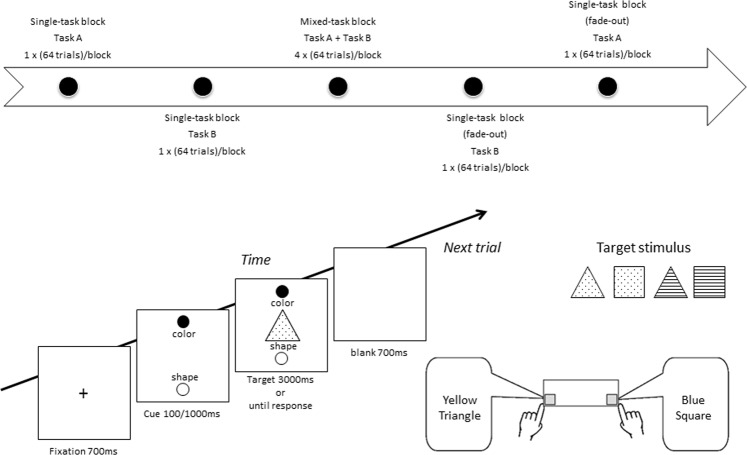
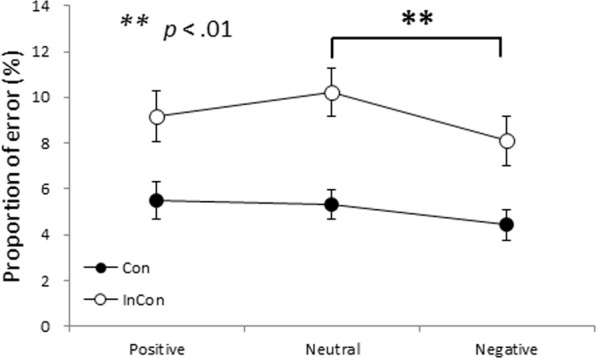
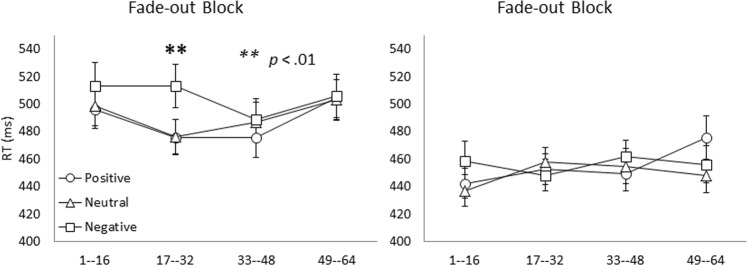
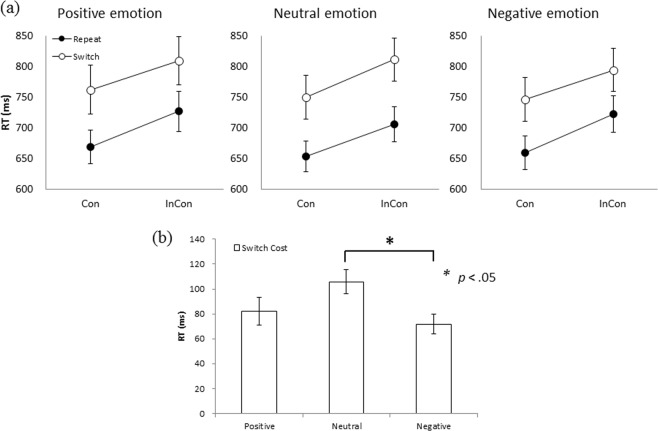
This study investigates how different valences of induced moods modulate cognitive flexibility in a task-switching paradigm. Forty-eight participants aged 19-25 years performed task switching after watching emotional film clips to induce an emotion (neutral, positive, or negative emotions). Two indicators of flexibility were evaluated: (1) the performance decrement reflected by increased reaction time (RT) or errors on the task-switch trial relative to a task-repetition trial, which is known as the "switching cost," and (2) the performance improvement reflected by decreased RT or errors when switching from a task-switching context to a single-task context, which is known as the "fade-out" effect. These indicators reflect cognitive flexibility on short and long time scales, respectively. The results show that negative moods reduced switching costs, particularly in incongruent trials. In addition, negative moods were found to cause a prolonged fade-out effect compared with neutral and positive moods, indicating that participants required more trials to adjust to the single-task condition after experiencing the task-switching context. The result suggests that only negative moods and not positive moods modulated both the short and long time scales of cognitive flexibility but with dissociable effects. Possible explanations are discussed.

摘要

本研究旨在探讨不同效价的诱发情绪如何在任务转换范式中调节认知灵活性。48 名年龄在 19-25 岁的参与者观看情绪电影片段后诱发情绪(中性、积极或消极情绪),然后进行任务转换。评估了两种灵活性指标:(1)任务切换试次相对于任务重复试次的反应时(RT)或错误增加所反映的表现下降,即“转换代价”,以及(2)从任务转换情境切换到单一任务情境时 RT 或错误减少所反映的表现改善,即“淡出”效应。这些指标分别反映了短时间和长时间尺度上的认知灵活性。结果表明,消极情绪降低了转换代价,尤其是在不一致的试次中。此外,与中性和积极情绪相比,消极情绪导致了更长的淡出效应,表明参与者在经历任务转换情境后需要更多的试次来适应单一任务条件。结果表明,只有消极情绪而不是积极情绪调节了认知灵活性的短时间和长时间尺度,但具有可分离的效应。讨论了可能的解释。
https://cdn.ncbi.nlm.nih.gov/pmc/blobs/8ae1/6362281/3d401e8c073b/41598_2018_37683_Fig4_HTML.jpg
https://cdn.ncbi.nlm.nih.gov/pmc/blobs/8ae1/6362281/64ede273af7b/41598_2018_37683_Fig1_HTML.jpg
https://cdn.ncbi.nlm.nih.gov/pmc/blobs/8ae1/6362281/6bc8de2ab9a3/41598_2018_37683_Fig2_HTML.jpg
https://cdn.ncbi.nlm.nih.gov/pmc/blobs/8ae1/6362281/4143d91ef6d2/41598_2018_37683_Fig3_HTML.jpg
https://cdn.ncbi.nlm.nih.gov/pmc/blobs/8ae1/6362281/3d401e8c073b/41598_2018_37683_Fig4_HTML.jpg
https://cdn.ncbi.nlm.nih.gov/pmc/blobs/8ae1/6362281/64ede273af7b/41598_2018_37683_Fig1_HTML.jpg
https://cdn.ncbi.nlm.nih.gov/pmc/blobs/8ae1/6362281/6bc8de2ab9a3/41598_2018_37683_Fig2_HTML.jpg
https://cdn.ncbi.nlm.nih.gov/pmc/blobs/8ae1/6362281/4143d91ef6d2/41598_2018_37683_Fig3_HTML.jpg
https://cdn.ncbi.nlm.nih.gov/pmc/blobs/8ae1/6362281/3d401e8c073b/41598_2018_37683_Fig4_HTML.jpg

相似文献

1
The Dissociable Effects of Induced Positive and Negative Moods on Cognitive Flexibility.诱导的积极和消极情绪对认知灵活性的可分离影响。
Sci Rep. 2019 Feb 4;9(1):1126. doi: 10.1038/s41598-018-37683-4.
2
No role of beta receptors in cognitive flexibility: Evidence from a task-switching paradigm in a randomized controlled trial.β受体在认知灵活性中无作用:来自一项随机对照试验中任务转换范式的证据。
Neuroscience. 2015 Jun 4;295:237-42. doi: 10.1016/j.neuroscience.2015.03.049. Epub 2015 Mar 27.
3
Prefrontal transcranial direct current stimulation facilitates affective flexibility.前额叶经颅直流电刺激促进情感灵活性。
Neuropsychologia. 2016 Jun;86:13-8. doi: 10.1016/j.neuropsychologia.2016.03.030. Epub 2016 Mar 30.
4
Turning down the heat: Neural mechanisms of cognitive control for inhibiting task-irrelevant emotional information during adolescence.降低热度:青少年抑制无关情绪信息的认知控制的神经机制。
Neuropsychologia. 2019 Mar 4;125:93-108. doi: 10.1016/j.neuropsychologia.2018.12.006. Epub 2019 Jan 4.
5
Positive Emotion Facilitates Cognitive Flexibility: An fMRI Study.积极情绪促进认知灵活性:一项功能磁共振成像研究。
Front Psychol. 2017 Oct 31;8:1832. doi: 10.3389/fpsyg.2017.01832. eCollection 2017.
6
Task switching costs in preschool children and adults.学龄前儿童和成人的任务转换成本。
J Exp Child Psychol. 2018 Aug;172:59-72. doi: 10.1016/j.jecp.2018.01.019. Epub 2018 Mar 26.
7
Effects of basal and acute cortisol on cognitive flexibility in an emotional task switching paradigm in men.基础皮质醇和急性皮质醇对男性情绪任务转换范式中认知灵活性的影响。
Horm Behav. 2016 May;81:12-9. doi: 10.1016/j.yhbeh.2016.02.002. Epub 2016 Mar 2.
8
Intentional switching of auditory attention between long and short sequential tone patterns.在长序列和短序列音调模式之间有意切换听觉注意力。
Atten Percept Psychophys. 2017 May;79(4):1132-1146. doi: 10.3758/s13414-017-1298-5.
9
Electrophysiological correlates of residual switch costs.残留转换代价的电生理相关性。
Cortex. 2010 Oct;46(9):1138-48. doi: 10.1016/j.cortex.2009.07.014. Epub 2009 Aug 5.
10
Valence and arousal of emotional stimuli impact cognitive-motor performance in an oddball task.情绪刺激的效价和唤醒水平会影响奇偶数任务中的认知运动表现。
Biol Psychol. 2017 Apr;125:105-114. doi: 10.1016/j.biopsycho.2017.02.010. Epub 2017 Mar 2.

引用本文的文献

1
The Influence of Negative Affect and Food Stimuli on Cognitive Flexibility in Adolescents With Anorexia Nervosa.消极情绪和食物刺激对神经性厌食症青少年认知灵活性的影响。
Eur Eat Disord Rev. 2025 May;33(3):480-489. doi: 10.1002/erv.3159. Epub 2024 Nov 28.
2
Effects of Online Game and Short Video Behavior on Academic Delay of Gratification - Mediating Effects of Anxiety, Depression and Retrospective Memory.网络游戏和短视频行为对学业延迟满足的影响——焦虑、抑郁及回溯记忆的中介作用
Psychol Res Behav Manag. 2023 Oct 26;16:4353-4365. doi: 10.2147/PRBM.S432196. eCollection 2023.
3
Neural correlates and effect of jealousy on cognitive flexibility in the female titi monkey (Plecturocebus cupreus).

本文引用的文献

1
The Influence of Negative Emotion on Cognitive and Emotional Control Remains Intact in Aging.消极情绪对认知和情绪控制的影响在衰老过程中依然存在。
Front Aging Neurosci. 2017 Nov 1;9:349. doi: 10.3389/fnagi.2017.00349. eCollection 2017.
2
Picture Novelty Influences Response Selection and Inhibition: The Role of the In-Group Bias and Task-Difficulty.图片新颖性影响反应选择和抑制:内群体偏见和任务难度的作用。
PLoS One. 2016 Oct 27;11(10):e0165470. doi: 10.1371/journal.pone.0165470. eCollection 2016.
3
Emotion and goal-directed behavior: ERP evidence on cognitive and emotional conflict.
女性黑掌蜘蛛猴(Plecturocebus cupreus)嫉妒对认知灵活性的神经相关性及影响。
Horm Behav. 2023 Jun;152:105352. doi: 10.1016/j.yhbeh.2023.105352. Epub 2023 Apr 3.
4
The chain-mediation pathway of gender regarding academic delay of gratification in college students is regulated by anxiety/depressive mood and prospective memory.大学生学业延迟满足中性别因素的链式中介路径受焦虑/抑郁情绪和前瞻记忆调节。
Front Psychol. 2022 Dec 8;13:1015331. doi: 10.3389/fpsyg.2022.1015331. eCollection 2022.
5
Mood-congruent memory revisited.再探心境一致性记忆。
Psychol Rev. 2023 Nov;130(6):1421-1456. doi: 10.1037/rev0000394. Epub 2022 Oct 6.
6
Age Differences in the Tradeoff between Proactive and Reactive Cognitive Control in Emotional Information Processing.情绪信息处理中主动与反应性认知控制权衡的年龄差异
Brain Sci. 2022 Aug 5;12(8):1043. doi: 10.3390/brainsci12081043.
7
Cognitive Control in Young and Older Adults: Does Mood Matter?年轻人和老年人的认知控制:情绪有影响吗?
Brain Sci. 2021 Dec 30;12(1):50. doi: 10.3390/brainsci12010050.
情绪与目标导向行为:关于认知和情绪冲突的事件相关电位证据
Soc Cogn Affect Neurosci. 2015 Nov;10(11):1577-87. doi: 10.1093/scan/nsv050. Epub 2015 Apr 28.
4
Hedonic Hotspots Regulate Cingulate-driven Adaptation to Cognitive Demands.享乐热点调节扣带回驱动的对认知需求的适应。
Cereb Cortex. 2015 Jul;25(7):1746-56. doi: 10.1093/cercor/bht416. Epub 2014 Jan 22.
5
Valence, arousal, and cognitive control: a voluntary task-switching study.效价、唤醒与认知控制:一项自愿任务切换研究。
Front Psychol. 2011 Nov 24;2:336. doi: 10.3389/fpsyg.2011.00336. eCollection 2011.
6
Positive emotions broaden the scope of attention and thought-action repertoires.积极情绪拓宽了注意力的范围以及思维行动指令系统。
Cogn Emot. 2005 May 1;19(3):313-332. doi: 10.1080/02699930441000238.
7
Positive emotion speeds up conflict processing: ERP responses in an auditory Simon task.积极情绪能加速冲突处理:听觉 Simon 任务中的 ERP 反应。
Biol Psychol. 2011 Apr;87(1):122-7. doi: 10.1016/j.biopsycho.2011.02.018. Epub 2011 Mar 4.
8
Aging and task switching: a meta-analysis.衰老与任务转换:一项元分析。
Psychol Aging. 2011 Mar;26(1):15-20. doi: 10.1037/a0020912.
9
Control and interference in task switching--a review.任务转换的控制与干扰——综述。
Psychol Bull. 2010 Sep;136(5):849-74. doi: 10.1037/a0019842.
10
Cognitive rigidity in unipolar depression and obsessive compulsive disorder: examination of task switching, Stroop, working memory updating and post-conflict adaptation.单相抑郁和强迫症中的认知僵化:任务转换、Stroop、工作记忆更新和冲突后适应的研究。
Psychiatry Res. 2011 Jan 30;185(1-2):149-56. doi: 10.1016/j.psychres.2010.04.044. Epub 2010 May 23.