Greinacher Anja, Derezza-Greeven Cassandra, Herzog Wolfgang, Nikendei Christoph
Department of General Internal Medicine and Psychosomatics, University Hospital Heidelberg, Heidelberg, Germany.
Eur J Psychotraumatol. 2019 Jan 22;10(1):1562840. doi: 10.1080/20008198.2018.1562840. eCollection 2019.
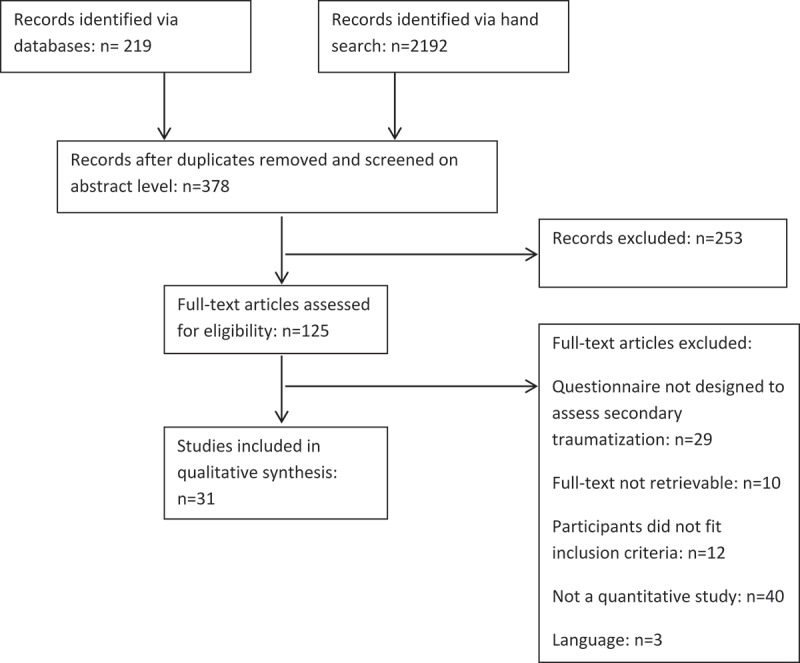
: Finding precise definitions of secondary traumatic stress, vicarious traumatization, and compassion fatigue is not easy. While some researchers define these terms differentially, others use them interchangeably. In the present review, we refer to all three phenomena as secondary traumatization. : This systematic review aims to provide an overview of prevalence rates of secondary traumatization in first responders and to shed light on corresponding resilience and risk factors. : After identifying 219 studies within the searched databases and 2192 references via hand searching, 31 studies were included in this review. We systematically searched the electronic databases PubMed, PsychINFO, and PSYNDEX (German database). The following inclusion criteria were applied: (1) participants had to be first responders working on-site: police officers, firefighters, search and rescue personnel, or emergency and paramedic team members; (2) secondary traumatization (secondary traumatic stress/vicarious traumatization/compassion fatigue) was assessed quantitatively with a validated questionnaire or subscale explicitly measuring secondary traumatization; and (3) English or German language original papers. : We found low levels of secondary traumatization in first responders. Several studies describe protective and risk factors for secondary traumatization, including pretraumatic (e.g. age, gender), peritraumatic (e.g. exposure, emotional exhaustion), and post-traumatic factors (e.g. social support, alcohol and tobacco use). : Next to an immunizing effect, the low prevalence of secondary traumatization in first responders could be explained by social desirability and job-loss concerns. Therefore, we may be underestimating the prevalence of secondary traumatization in first responders. Some resilience (social support) and risk factors (female gender) are consistent with previous research in other populations. However, owing to the cross-sectional study designs, we must interpret resilience and risk factors with caution. Future research should focus on longitudinal study designs and preventive as well as curative interventions.
找到继发性创伤应激、替代性创伤和同情疲劳的确切定义并非易事。虽然一些研究人员对这些术语的定义有所不同,但另一些人则交替使用它们。在本综述中,我们将这三种现象统称为继发性创伤。
本系统综述旨在概述急救人员继发性创伤的患病率,并阐明相应的恢复力和风险因素。
在检索的数据库中识别出219项研究,并通过手工检索找到2192篇参考文献后,本综述纳入了31项研究。我们系统地检索了电子数据库PubMed、PsychINFO和PSYNDEX(德国数据库)。应用了以下纳入标准:(1)参与者必须是现场工作的急救人员:警察、消防员、搜救人员或急救和护理团队成员;(2)使用经过验证的问卷或明确测量继发性创伤的子量表对继发性创伤(继发性创伤应激/替代性创伤/同情疲劳)进行定量评估;(3)英文或德文原文。
我们发现急救人员的继发性创伤水平较低。几项研究描述了继发性创伤的保护因素和风险因素,包括创伤前因素(如年龄、性别)、创伤期间因素(如暴露、情绪耗竭)和创伤后因素(如社会支持、烟酒使用)。
除了免疫作用外,急救人员继发性创伤患病率较低可能是由于社会期望和对失业的担忧。因此,我们可能低估了急救人员继发性创伤的患病率。一些恢复力因素(社会支持)和风险因素(女性)与之前对其他人群的研究一致。然而,由于横断面研究设计,我们必须谨慎解释恢复力和风险因素。未来的研究应侧重于纵向研究设计以及预防和治疗干预措施。