Bogaert Kyle, Leider Jonathon P, Castrucci Brian C, Sellers Katie, Whang Christina
Association of State and Territorial Health Officials, Bethesda, Maryland (Mss Bogaert and Whang); Division of Health Policy and Management, School of Public Health, University of Minnesota, Minneapolis, Minnesota (Dr Leider); and de Beaumont Foundation, Bethesda, Maryland (Drs Castrucci and Sellers).
J Public Health Manag Pract. 2019 Mar/Apr;25 Suppl 2, Public Health Workforce Interests and Needs Survey 2017(2 Suppl):S78-S86. doi: 10.1097/PHH.0000000000000928.
Public health has been hit by the first wave of the "silver tsunami"-baby boomers retiring en masse. However, thousands of staff members say they are considering voluntarily leaving for other reasons as well.
To identify characteristics of staff who said they were planning on leaving in 2014 but stayed at their organizations through 2017.
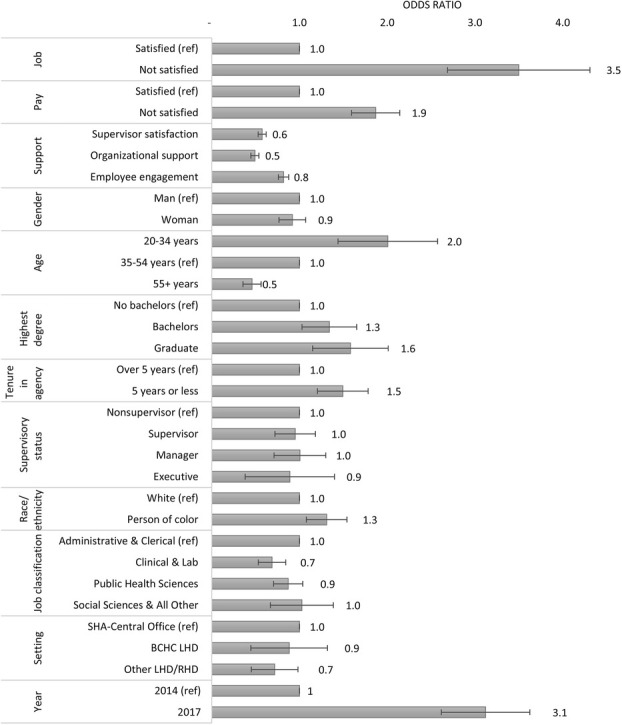
Data from the 2014 and 2017 Public Health Workforce Interests and Needs Survey (PH WINS) were linked by respondent, and characteristics associated with intent to leave were analyzed. Longitudinal logistic models were fit to examine correlates of intent to leave, with job and pay satisfaction, demographic variables, and workplace engagement perceptions as independent variables.
Respondents from state health agency-central offices and local health departments that participated in the PH WINS in 2014 and 2017.
Intent to leave (excluding retirement), demographic measures, and changes in the perceptions of workplace engagement.
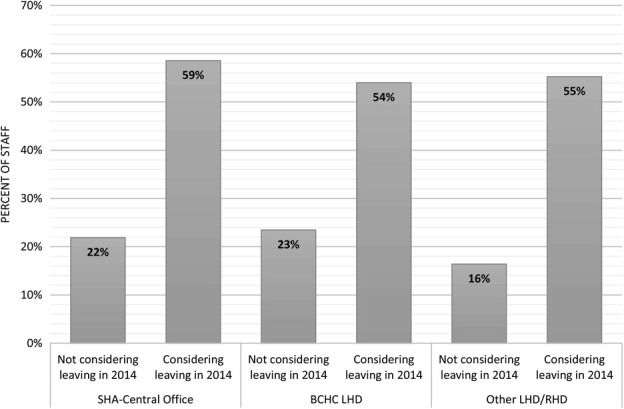
Among all staff members responding in 2014 and 2017, 15% said they were considering leaving in 2014, excluding retirement, compared with 26% in 2017 (P < .001). Overall, 21% of those who were not considering leaving in 2014 indicated they were doing so in 2017. Comparatively, 57% of those considering leaving in 2014 said they were still considering it in 2017. The regressions showed those who were somewhat or very satisfied were significantly more likely to indicate they were not (or were no longer) considering leaving.
Among staff members who have been considering leaving but have not yet left their organization, improvements to workplace engagement perceptions and job satisfaction were highly associated with not considering leaving their job.
公共卫生领域受到了“银色海啸”第一波冲击——婴儿潮一代大规模退休。然而,数千名工作人员表示,他们也因其他原因考虑自愿离职。
确定那些在2014年表示计划离职但到2017年仍留在原机构的工作人员的特征。
通过受访者将2014年和2017年公共卫生劳动力兴趣与需求调查(PH WINS)的数据进行关联,并分析与离职意愿相关的特征。采用纵向逻辑模型来检验离职意愿的相关因素,将工作和薪酬满意度、人口统计学变量以及工作场所参与度认知作为自变量。
2014年和2017年参与PH WINS的州卫生机构中央办公室和地方卫生部门的受访者。
离职意愿(不包括退休)、人口统计学指标以及工作场所参与度认知的变化。
在2014年和2017年做出回应的所有工作人员中,15%表示在2014年(不包括退休)考虑离职,而2017年这一比例为26%(P <.001)。总体而言,2014年不考虑离职的人员中有21%表示在2017年打算离职。相比之下,2014年考虑离职的人员中有57%表示在2017年仍在考虑离职。回归分析显示,那些对工作 somewhat 或非常满意的人更有可能表示他们没有(或不再)考虑离职。
在那些一直考虑离职但尚未离开原机构的工作人员中,工作场所参与度认知和工作满意度的提高与不考虑离职密切相关。