Leider Jonathon P, Pineau Vicki, Bogaert Kyle, Ma Qiao, Sellers Katie
Division of Health Policy and Management, School of Public Health, University of Minnesota, Minneapolis, Minnesota (Dr Leider); NORC at the University of Chicago, Bethesda, Maryland (Mss Pineau and Ma); Association of State and Territorial Health Officials, Arlington, Virginia (Ms Bogaert); and de Beaumont Foundation, Bethesda, Maryland (Dr Sellers).
J Public Health Manag Pract. 2019 Mar/Apr;25 Suppl 2, Public Health Workforce Interests and Needs Survey 2017(2 Suppl):S49-S57. doi: 10.1097/PHH.0000000000000900.
The Public Health Workforce Interests and Needs Survey (PH WINS) was first fielded in 2014 and is the largest public health workforce survey in the nation. This article elucidates the methods used for the 2017 PH WINS fielding.
PH WINS was fielded to a nationally representative sample of State Health Agency Central Office (SHA-CO) staff, as well as local health department (LHD) staff. The instrument largely mirrored 2014, though the training needs section was revised, and a validated item measuring burnout in staff was added.
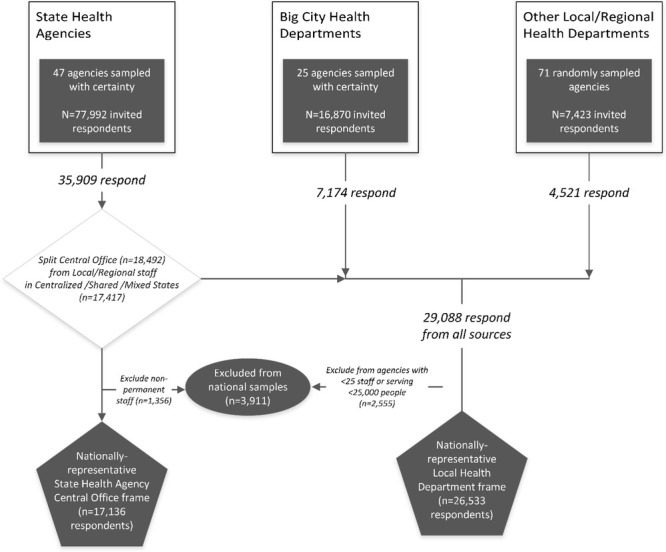
Staff lists were collected directly from all participating state and local agencies. Forty-seven state health agencies (SHAs), 26 large LHDs, and 71 midsize LHDs participated. All SHAs were surveyed using a census approach. The nationally representative SHA-CO frame is representative of all central office staff members. The nationally representative local frame was a complex survey design, wherein staff from LHDs were randomly sampled across 20 strata, based on agency size and geographic region. Staff were also contributed with certainty from large LHDs in nondecentralized states. The frame is representative of staff at LHDs serving more than 25 000 people and with 25 or more staff members. Other LHDs are excluded, and so PH WINS is not representative of smaller LHDs. Balanced repeated replication weights were used to adjust variance estimates for the complex design.
Overall, 47 604 people responded to PH WINS in 2017 across all frames. PH WINS 2017 achieved a response rate of 48%. The design effect for the SHA-CO frame was 1.46 and was 16.42 for the local frame.
PH WINS now offers a nationally representative sample of both SHA-CO and LHD staff across 4 major domains: workplace environment, training needs, emerging concepts in public health, and demographics. Both practice and academia can use PH WINS to better understand the perceptions and needs of staff, address training gaps, and work to recruit and retain quality staff.
公共卫生劳动力兴趣与需求调查(PH WINS)于2014年首次开展,是美国规模最大的公共卫生劳动力调查。本文阐述了2017年PH WINS调查所采用的方法。
PH WINS的调查对象是州卫生机构中央办公室(SHA-CO)工作人员以及地方卫生部门(LHD)工作人员的全国代表性样本。该调查工具在很大程度上沿用了2014年的版本,不过对培训需求部分进行了修订,并增加了一项用于衡量工作人员职业倦怠的有效项目。
工作人员名单直接从所有参与调查的州和地方机构收集。47个州卫生机构(SHA)、26个大型LHD和71个中型LHD参与其中。所有SHA均采用普查方式进行调查。具有全国代表性的SHA-CO框架代表了所有中央办公室工作人员。具有全国代表性的地方框架采用了复杂的调查设计,即根据机构规模和地理区域,从20个层次中对LHD的工作人员进行随机抽样。非分散化州的大型LHD也确定提供了工作人员。该框架代表了服务人口超过25000人且工作人员达25名或更多的LHD的工作人员。其他LHD被排除在外,因此PH WINS不代表规模较小的LHD。平衡重复复制权重用于调整复杂设计的方差估计。
总体而言,2017年共有47604人对PH WINS各框架做出了回应。2017年PH WINS的回应率为48%。SHA-CO框架的设计效应为1.46,地方框架的设计效应为16.42。
PH WINS现在提供了一个涵盖SHA-CO和LHD工作人员的全国代表性样本,涉及4个主要领域:工作场所环境、培训需求、公共卫生新观念以及人口统计学。实践领域和学术界都可以利用PH WINS更好地了解工作人员的看法和需求,弥补培训差距,并努力招募和留住高素质工作人员。