Yang Yang, Lu Hongbin, Qu Jin
Department of Cardiovascular Disease, The Second Xiangya Hospital, Central South University, Changsha 410011, PR China.
Department of Sports Medicine, Key Laboratory of Organ Injury, Aging and Regenerative Medicine of Hunan Province, Xiangya Hospital, Central South University, Changsha 410008, PR China.
J Orthop Translat. 2018 Aug 6;16:14-22. doi: 10.1016/j.jot.2018.07.003. eCollection 2019 Jan.
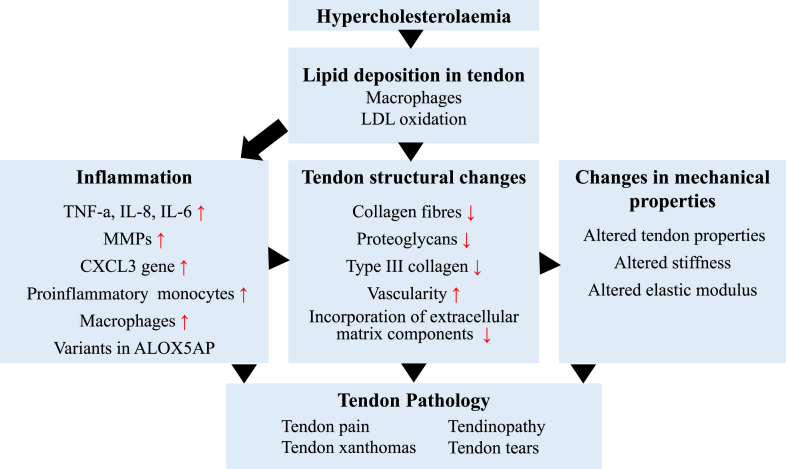
Tendon pathology is a general term used to describe a group of musculoskeletal conditions related to tendons and surrounding structures. There is only limited evidence available regarding the exact aetiology and natural history of tendon pathology. In hypercholesterolaemia environments, lipids could accumulate within the extracellular matrix of the tendon and thus affect the mechanical properties of the tendon. Current evidence suggested that hypercholesterolaemia was an important risk factor in the development and progression of tendon pathology. The severity of hypercholesterolaemia was correlated with the severity of tendon pathology. : Hypercholesterolaemia lead to the structural, inflammatory and mechanical changes in tendons, which predispose hypercholesterolaemia patients to a greater risk of tendon pathology. Measurements of serum cholesterol are suggested to be performed in patients presenting with tendon pathology. The strict control of hypercholesterolaemia would mitigate the development and progression of tendon pathology.
肌腱病变是一个通用术语,用于描述一组与肌腱及周围结构相关的肌肉骨骼疾病。关于肌腱病变的确切病因和自然病史,现有证据有限。在高胆固醇血症环境中,脂质可能在肌腱的细胞外基质中蓄积,从而影响肌腱的力学性能。目前的证据表明,高胆固醇血症是肌腱病变发生和发展的重要危险因素。高胆固醇血症的严重程度与肌腱病变的严重程度相关。高胆固醇血症会导致肌腱的结构、炎症和力学变化,这使高胆固醇血症患者更容易发生肌腱病变。建议对出现肌腱病变的患者进行血清胆固醇检测。严格控制高胆固醇血症将减轻肌腱病变的发生和发展。