• 文献检索
  • 文档翻译
  • 深度研究
  • 学术资讯
  • Suppr Zotero 插件Zotero 插件
  • 邀请有礼
  • 套餐&价格
  • 历史记录
应用&插件
Suppr Zotero 插件Zotero 插件浏览器插件Mac 客户端Windows 客户端微信小程序
定价
高级版会员购买积分包购买API积分包
服务
文献检索文档翻译深度研究API 文档MCP 服务
关于我们
关于 Suppr公司介绍联系我们用户协议隐私条款
关注我们

Suppr 超能文献

核心技术专利:CN118964589B侵权必究
粤ICP备2023148730 号-1Suppr @ 2026

文献检索

告别复杂PubMed语法,用中文像聊天一样搜索,搜遍4000万医学文献。AI智能推荐,让科研检索更轻松。

立即免费搜索

文件翻译

保留排版,准确专业,支持PDF/Word/PPT等文件格式,支持 12+语言互译。

免费翻译文档

深度研究

AI帮你快速写综述,25分钟生成高质量综述,智能提取关键信息,辅助科研写作。

立即免费体验

使用深度神经网络模型检测潜在药物不良反应

Detecting Potential Adverse Drug Reactions Using a Deep Neural Network Model.

作者信息

Wang Chi-Shiang, Lin Pei-Ju, Cheng Ching-Lan, Tai Shu-Hua, Kao Yang Yea-Huei, Chiang Jung-Hsien

机构信息

Department of Computer Science and Information Engineering, National Cheng Kung University, Tainan, Taiwan.

School of Pharmacy, College of Medicine, National Cheng Kung University, Tainan, Taiwan.

出版信息

J Med Internet Res. 2019 Feb 6;21(2):e11016. doi: 10.2196/11016.

DOI:10.2196/11016
PMID:30724742
原文链接:https://pmc.ncbi.nlm.nih.gov/articles/PMC6381404/
Abstract

BACKGROUND

Adverse drug reactions (ADRs) are common and are the underlying cause of over a million serious injuries and deaths each year. The most familiar method to detect ADRs is relying on spontaneous reports. Unfortunately, the low reporting rate of spontaneous reports is a serious limitation of pharmacovigilance.

OBJECTIVE

The objective of this study was to identify a method to detect potential ADRs of drugs automatically using a deep neural network (DNN).

METHODS

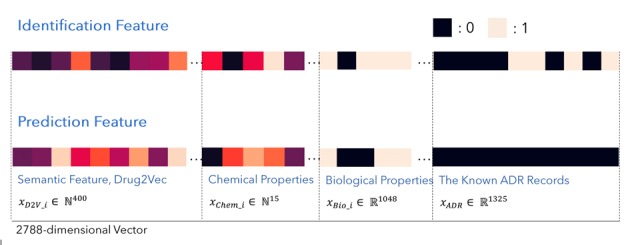
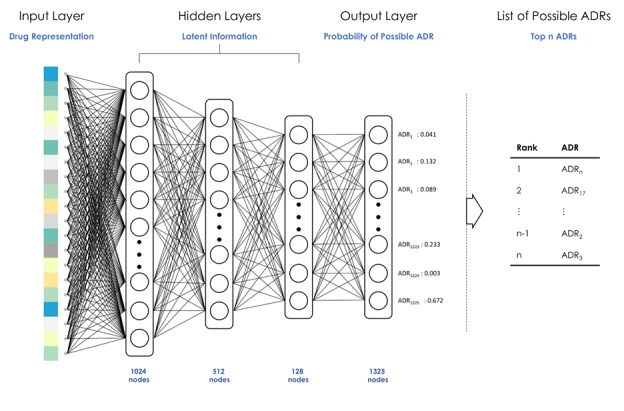
We designed a DNN model that utilizes the chemical, biological, and biomedical information of drugs to detect ADRs. This model aimed to fulfill two main purposes: identifying the potential ADRs of drugs and predicting the possible ADRs of a new drug. For improving the detection performance, we distributed representations of the target drugs in a vector space to capture the drug relationships using the word-embedding approach to process substantial biomedical literature. Moreover, we built a mapping function to address new drugs that do not appear in the dataset.

RESULTS

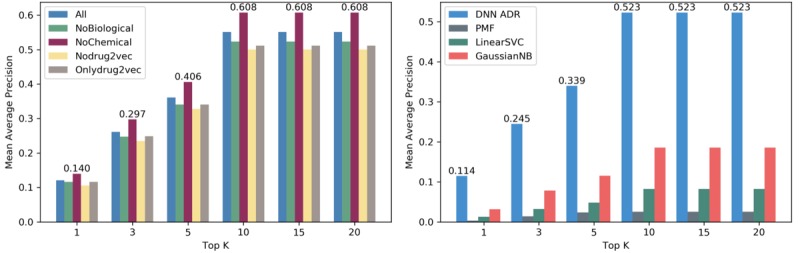
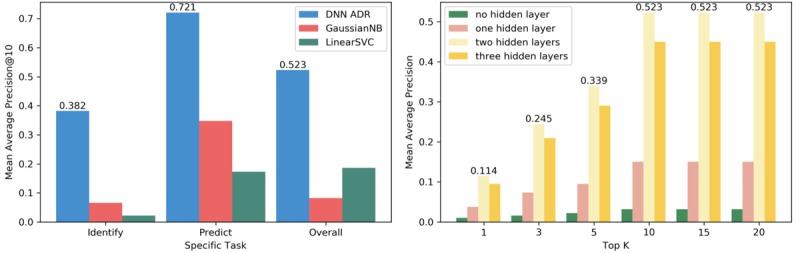
Using the drug information and the ADRs reported up to 2009, we predicted the ADRs of drugs recorded up to 2012. There were 746 drugs and 232 new drugs, which were only recorded in 2012 with 1325 ADRs. The experimental results showed that the overall performance of our model with mean average precision at top-10 achieved is 0.523 and the rea under the receiver operating characteristic curve (AUC) score achieved is 0.844 for ADR prediction on the dataset.

CONCLUSIONS

Our model is effective in identifying the potential ADRs of a drug and the possible ADRs of a new drug. Most importantly, it can detect potential ADRs irrespective of whether they have been reported in the past.

摘要

背景

药物不良反应(ADR)很常见,是每年导致超过一百万起严重伤害和死亡的根本原因。最常见的检测药物不良反应的方法是依靠自发报告。不幸的是,自发报告的低报告率是药物警戒的一个严重限制。

目的

本研究的目的是确定一种使用深度神经网络(DNN)自动检测药物潜在不良反应的方法。

方法

我们设计了一种DNN模型,该模型利用药物的化学、生物学和生物医学信息来检测不良反应。该模型旨在实现两个主要目的:识别药物的潜在不良反应和预测新药可能的不良反应。为了提高检测性能,我们使用词嵌入方法处理大量生物医学文献,将目标药物的表示分布在向量空间中以捕捉药物关系。此外,我们构建了一个映射函数来处理数据集中未出现的新药。

结果

利用截至2009年报告的药物信息和不良反应,我们预测了截至2012年记录的药物的不良反应。有746种药物和232种新药,这些新药仅在2012年有记录,共有1325种不良反应。实验结果表明,我们的模型在数据集上进行不良反应预测时,前10名的平均平均精度的整体性能为0.523,接收器操作特征曲线(AUC)得分下的面积为0.844。

结论

我们的模型在识别药物的潜在不良反应和新药可能的不良反应方面是有效的。最重要的是,它可以检测潜在的不良反应,无论它们过去是否已被报告。
https://cdn.ncbi.nlm.nih.gov/pmc/blobs/ae07/6381404/9ff81fbea8fd/jmir_v21i2e11016_fig5.jpg
https://cdn.ncbi.nlm.nih.gov/pmc/blobs/ae07/6381404/37abfde483e7/jmir_v21i2e11016_fig1.jpg
https://cdn.ncbi.nlm.nih.gov/pmc/blobs/ae07/6381404/ee14a39739c5/jmir_v21i2e11016_fig2.jpg
https://cdn.ncbi.nlm.nih.gov/pmc/blobs/ae07/6381404/2c5fcebc2f6e/jmir_v21i2e11016_fig3.jpg
https://cdn.ncbi.nlm.nih.gov/pmc/blobs/ae07/6381404/67c70c463d99/jmir_v21i2e11016_fig4.jpg
https://cdn.ncbi.nlm.nih.gov/pmc/blobs/ae07/6381404/9ff81fbea8fd/jmir_v21i2e11016_fig5.jpg
https://cdn.ncbi.nlm.nih.gov/pmc/blobs/ae07/6381404/37abfde483e7/jmir_v21i2e11016_fig1.jpg
https://cdn.ncbi.nlm.nih.gov/pmc/blobs/ae07/6381404/ee14a39739c5/jmir_v21i2e11016_fig2.jpg
https://cdn.ncbi.nlm.nih.gov/pmc/blobs/ae07/6381404/2c5fcebc2f6e/jmir_v21i2e11016_fig3.jpg
https://cdn.ncbi.nlm.nih.gov/pmc/blobs/ae07/6381404/67c70c463d99/jmir_v21i2e11016_fig4.jpg
https://cdn.ncbi.nlm.nih.gov/pmc/blobs/ae07/6381404/9ff81fbea8fd/jmir_v21i2e11016_fig5.jpg

相似文献

1
Detecting Potential Adverse Drug Reactions Using a Deep Neural Network Model.使用深度神经网络模型检测潜在药物不良反应
J Med Internet Res. 2019 Feb 6;21(2):e11016. doi: 10.2196/11016.
2
Evaluation of patient reporting of adverse drug reactions to the UK 'Yellow Card Scheme': literature review, descriptive and qualitative analyses, and questionnaire surveys.评估患者向英国“黄卡计划”报告药物不良反应的情况:文献回顾、描述性和定性分析以及问卷调查。
Health Technol Assess. 2011 May;15(20):1-234, iii-iv. doi: 10.3310/hta15200.
3
Monitoring drug safety in Astrakhan, Russia.俄罗斯阿斯特拉罕地区的药物安全监测。
Int J Risk Saf Med. 2015;27 Suppl 1:S33-4. doi: 10.3233/JRS-150680.
4
Supervised signal detection for adverse drug reactions in medication dispensing data.基于配药数据的药物不良反应的有监督信号检测。
Comput Methods Programs Biomed. 2018 Jul;161:25-38. doi: 10.1016/j.cmpb.2018.03.021. Epub 2018 Apr 14.
5
A survey of spontaneous reporting of adverse drug reactions in 10 years of activity in a pharmacovigilance centre in Portugal.葡萄牙一个药物警戒中心10年活动期间药品不良反应自发报告情况调查。
Int J Pharm Pract. 2014 Aug;22(4):275-82. doi: 10.1111/ijpp.12078. Epub 2013 Nov 5.
6
A knowledge graph embedding based approach to predict the adverse drug reactions using a deep neural network.一种基于知识图谱嵌入的方法,使用深度神经网络预测药物不良反应。
J Biomed Inform. 2022 Aug;132:104122. doi: 10.1016/j.jbi.2022.104122. Epub 2022 Jun 24.
7
Predicting adverse drug reactions of combined medication from heterogeneous pharmacologic databases.从异构药理学数据库中预测联合用药的药物不良反应。
BMC Bioinformatics. 2018 Dec 31;19(Suppl 19):517. doi: 10.1186/s12859-018-2520-8.
8
The Social Impact of Suspected Adverse Drug Reactions: An analysis of the Canada Vigilance Spontaneous Reporting Database.疑似药物不良反应的社会影响:对加拿大监测自发报告数据库的分析。
Drug Saf. 2019 Jan;42(1):27-34. doi: 10.1007/s40264-018-0713-8.
9
Artificial Intelligence for Unstructured Healthcare Data: Application to Coding of Patient Reporting of Adverse Drug Reactions.人工智能在非结构化医疗保健数据中的应用:以患者报告的药物不良反应编码为例。
Clin Pharmacol Ther. 2021 Aug;110(2):392-400. doi: 10.1002/cpt.2266. Epub 2021 May 8.
10
Characteristics and quality of adverse drug reaction reports by pharmacists in Norway.挪威药剂师提交的药品不良反应报告的特点与质量
Pharmacoepidemiol Drug Saf. 2007 Sep;16(9):999-1005. doi: 10.1002/pds.1400.

引用本文的文献

1
AGRL-DSE: Adaptive Graph Representation Learning on a Heterogeneous Graph for Drug Side Effect Prediction.AGRL-DSE:基于异构图的自适应图表示学习用于药物副作用预测
ACS Omega. 2025 Aug 18;10(34):38753-38765. doi: 10.1021/acsomega.5c04006. eCollection 2025 Sep 2.
2
Drug-drug interaction analysis based on information bottleneck graph neural network: A review.基于信息瓶颈图神经网络的药物-药物相互作用分析:综述
Medicine (Baltimore). 2025 Jun 20;104(25):e42904. doi: 10.1097/MD.0000000000042904.
3
Precision Adverse Drug Reactions Prediction with Heterogeneous Graph Neural Network.

本文引用的文献

1
DrugBank 5.0: a major update to the DrugBank database for 2018.DrugBank 5.0:2018 年 DrugBank 数据库的重大更新。
Nucleic Acids Res. 2018 Jan 4;46(D1):D1074-D1082. doi: 10.1093/nar/gkx1037.
2
Adverse drug reactions.药物不良反应
Clin Med (Lond). 2016 Oct;16(5):481-485. doi: 10.7861/clinmedicine.16-5-481.
3
Automated Summarization of Publications Associated with Adverse Drug Reactions from PubMed.来自PubMed的药物不良反应相关出版物的自动摘要
基于异构图神经网络的精准药物不良反应预测
Adv Sci (Weinh). 2024 Dec 4;12(4):e2404671. doi: 10.1002/advs.202404671.
4
Prediction of adverse drug reactions using demographic and non-clinical drug characteristics in FAERS data.利用 FAERS 数据中的人口统计学和非临床药物特征预测药物不良反应。
Sci Rep. 2024 Oct 9;14(1):23636. doi: 10.1038/s41598-024-74505-2.
5
Graph reasoning method enhanced by relational transformers and knowledge distillation for drug-related side effect prediction.基于关系变换器和知识蒸馏增强的图推理方法用于药物相关副作用预测
iScience. 2024 Mar 26;27(6):109571. doi: 10.1016/j.isci.2024.109571. eCollection 2024 Jun 21.
6
pADR: Towards Personalized Adverse Drug Reaction Prediction by Modeling Multi-sourced Data.pADR:通过对多源数据建模实现个性化药物不良反应预测
Proc ACM Int Conf Inf Knowl Manag. 2023 Oct;2023:4724-4730. doi: 10.1145/3583780.3615490. Epub 2023 Oct 21.
7
Evaluation of four machine learning models for signal detection.四种用于信号检测的机器学习模型的评估
Ther Adv Drug Saf. 2023 Dec 25;14:20420986231219472. doi: 10.1177/20420986231219472. eCollection 2023.
8
Patient Preferences and Their Influence on Chronic Hepatitis B-A Review.患者偏好及其对慢性乙型肝炎的影响——综述
Patient Prefer Adherence. 2023 Nov 30;17:3119-3124. doi: 10.2147/PPA.S433283. eCollection 2023.
9
Identifying the serious clinical outcomes of adverse reactions to drugs by a multi-task deep learning framework.利用多任务深度学习框架识别药物不良反应的严重临床结局。
Commun Biol. 2023 Aug 24;6(1):870. doi: 10.1038/s42003-023-05243-w.
10
An extensive survey on the use of supervised machine learning techniques in the past two decades for prediction of drug side effects.对过去二十年中使用监督式机器学习技术预测药物副作用的情况进行的一项广泛调查。
Artif Intell Rev. 2023 Feb 15:1-28. doi: 10.1007/s10462-023-10413-7.
AMIA Jt Summits Transl Sci Proc. 2016 Jul 20;2016:68-77. eCollection 2016.
4
Text mining for precision medicine: automating disease-mutation relationship extraction from biomedical literature.精准医学的文本挖掘:从生物医学文献中自动提取疾病-突变关系
J Am Med Inform Assoc. 2016 Jul;23(4):766-72. doi: 10.1093/jamia/ocw041. Epub 2016 Apr 27.
5
The SIDER database of drugs and side effects.药物与副作用的SIDER数据库。
Nucleic Acids Res. 2016 Jan 4;44(D1):D1075-9. doi: 10.1093/nar/gkv1075. Epub 2015 Oct 19.
6
A method for systematic discovery of adverse drug events from clinical notes.一种从临床记录中系统发现药物不良事件的方法。
J Am Med Inform Assoc. 2015 Nov;22(6):1196-204. doi: 10.1093/jamia/ocv102. Epub 2015 Jul 31.
7
Pharmacovigilance from social media: mining adverse drug reaction mentions using sequence labeling with word embedding cluster features.社交媒体中的药物警戒:使用带有词嵌入聚类特征的序列标注挖掘药物不良反应提及信息。
J Am Med Inform Assoc. 2015 May;22(3):671-81. doi: 10.1093/jamia/ocu041. Epub 2015 Mar 9.
8
Filtering big data from social media--Building an early warning system for adverse drug reactions.从社交媒体中筛选大数据——构建药物不良反应预警系统。
J Biomed Inform. 2015 Apr;54:230-40. doi: 10.1016/j.jbi.2015.01.011. Epub 2015 Feb 14.
9
Systems pharmacology augments drug safety surveillance.系统药理学增强了药物安全性监测。
Clin Pharmacol Ther. 2015 Feb;97(2):151-8. doi: 10.1002/cpt.2. Epub 2014 Dec 20.
10
Properties of AdeABC and AdeIJK efflux systems of Acinetobacter baumannii compared with those of the AcrAB-TolC system of Escherichia coli.鲍曼不动杆菌AdeABC和AdeIJK外排系统的特性与大肠杆菌AcrAB-TolC系统特性的比较。
Antimicrob Agents Chemother. 2014 Dec;58(12):7250-7. doi: 10.1128/AAC.03728-14. Epub 2014 Sep 22.