• 文献检索
  • 文档翻译
  • 深度研究
  • 学术资讯
  • Suppr Zotero 插件Zotero 插件
  • 邀请有礼
  • 套餐&价格
  • 历史记录
应用&插件
Suppr Zotero 插件Zotero 插件浏览器插件Mac 客户端Windows 客户端微信小程序
定价
高级版会员购买积分包购买API积分包
服务
文献检索文档翻译深度研究API 文档MCP 服务
关于我们
关于 Suppr公司介绍联系我们用户协议隐私条款
关注我们

Suppr 超能文献

核心技术专利:CN118964589B侵权必究
粤ICP备2023148730 号-1Suppr @ 2026

文献检索

告别复杂PubMed语法,用中文像聊天一样搜索,搜遍4000万医学文献。AI智能推荐,让科研检索更轻松。

立即免费搜索

文件翻译

保留排版,准确专业,支持PDF/Word/PPT等文件格式,支持 12+语言互译。

免费翻译文档

深度研究

AI帮你快速写综述,25分钟生成高质量综述,智能提取关键信息,辅助科研写作。

立即免费体验

从异构药理学数据库中预测联合用药的药物不良反应。

Predicting adverse drug reactions of combined medication from heterogeneous pharmacologic databases.

机构信息

Advanced Analytics Institute, Faculty of Engineering and Information Technology, University of Technology Sydney, 15 Broadway Ultimo, Sydney, 2007, Australia.

Discipline of Business Analytics, The University of Sydney, Darlington, Sydney, 2006, Australia.

出版信息

BMC Bioinformatics. 2018 Dec 31;19(Suppl 19):517. doi: 10.1186/s12859-018-2520-8.

DOI:10.1186/s12859-018-2520-8
PMID:30598065
原文链接:https://pmc.ncbi.nlm.nih.gov/articles/PMC6311930/
Abstract

BACKGROUND

Early and accurate identification of potential adverse drug reactions (ADRs) for combined medication is vital for public health. Existing methods either rely on expensive wet-lab experiments or detecting existing associations from related records. Thus, they inevitably suffer under-reporting, delays in reporting, and inability to detect ADRs for new and rare drugs. The current application of machine learning methods is severely impeded by the lack of proper drug representation and credible negative samples. Therefore, a method to represent drugs properly and to select credible negative samples becomes vital in applying machine learning methods to this problem.

RESULTS

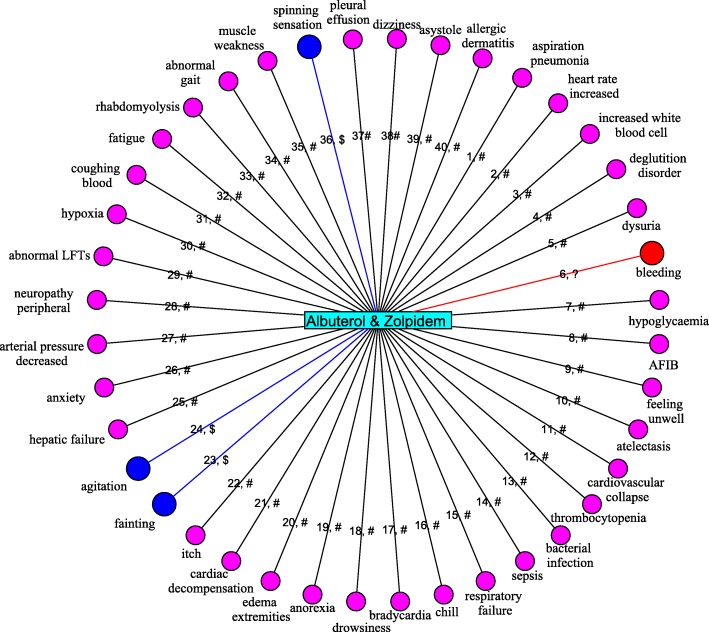
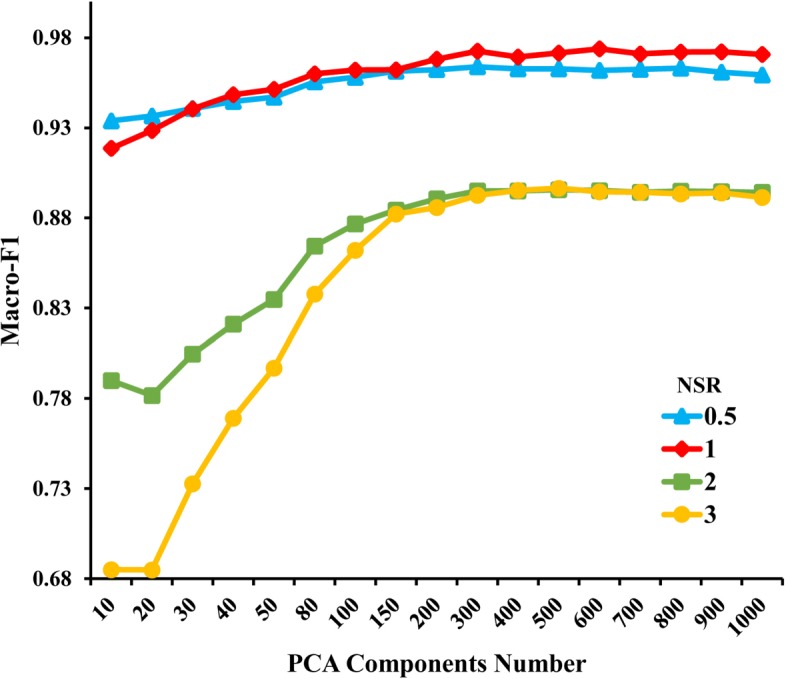
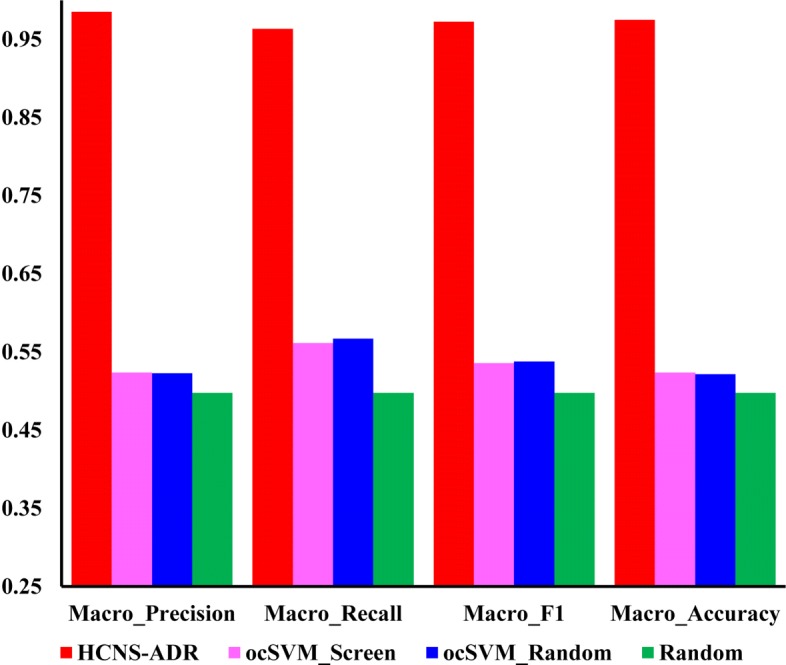
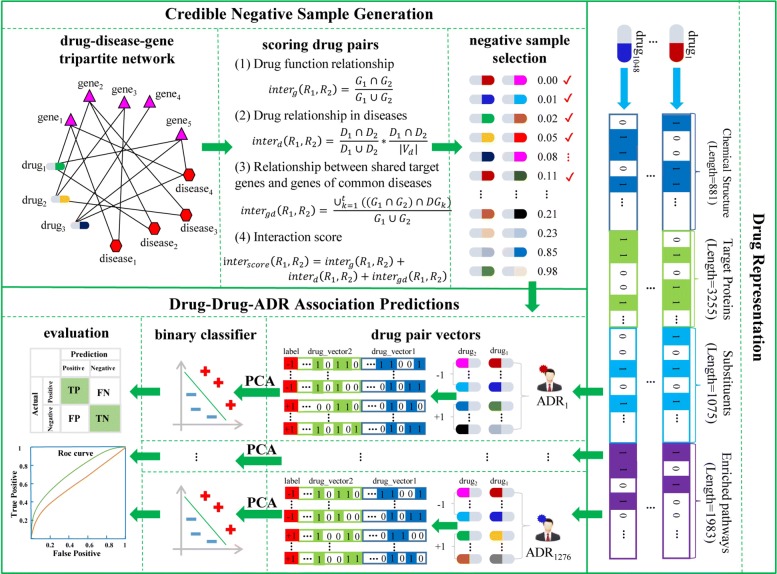
In this work, we propose a machine learning method to predict ADRs of combined medication from pharmacologic databases by building up highly-credible negative samples (HCNS-ADR). Specifically, we fuse heterogeneous information from different databases and represent each drug as a multi-dimensional vector according to its chemical substructures, target proteins, substituents, and related pathways first. Then, a drug-pair vector is obtained by appending the vector of one drug to the other. Next, we construct a drug-disease-gene network and devise a scoring method to measure the interaction probability of every drug pair via network analysis. Drug pairs with lower interaction probability are preferentially selected as negative samples. Following that, the validated positive samples and the selected credible negative samples are projected into a lower-dimensional space using the principal component analysis. Finally, a classifier is built for each ADR using its positive and negative samples with reduced dimensions. The performance of the proposed method is evaluated on simulative prediction for 1276 ADRs and 1048 drugs, comparing using four machine learning algorithms and with two baseline approaches. Extensive experiments show that the proposed way to represent drugs characterizes drugs accurately. With highly-credible negative samples selected by HCNS-ADR, the four machine learning algorithms achieve significant performance improvements. HCNS-ADR is also shown to be able to predict both known and novel drug-drug-ADR associations, outperforming two other baseline approaches significantly.

CONCLUSIONS

The results demonstrate that integration of different drug properties to represent drugs are valuable for ADR prediction of combined medication and the selection of highly-credible negative samples can significantly improve the prediction performance.

摘要

背景

早期准确识别联合用药的潜在药物不良反应(ADR)对公共健康至关重要。现有的方法要么依赖昂贵的湿实验室实验,要么从相关记录中检测现有关联。因此,它们不可避免地存在报告不足、报告延迟以及无法检测新的和罕见药物的 ADR 的问题。由于缺乏适当的药物表示和可靠的负样本,当前机器学习方法的应用受到严重阻碍。因此,在将机器学习方法应用于该问题时,一种适当表示药物和选择可靠负样本的方法变得至关重要。

结果

在这项工作中,我们提出了一种通过构建高度可信的负样本(HCNS-ADR)从药理学数据库中预测联合用药 ADR 的机器学习方法。具体来说,我们首先融合来自不同数据库的异质信息,并根据药物的化学结构、靶蛋白、取代基和相关途径将每种药物表示为多维向量。然后,通过将一种药物的向量附加到另一种药物的向量上来获得药物对向量。接下来,我们构建了一个药物-疾病-基因网络,并设计了一种评分方法通过网络分析来测量每对药物的相互作用概率。相互作用概率较低的药物对被优先选为负样本。之后,使用主成分分析将验证的阳性样本和选择的可信负样本投影到低维空间中。最后,使用降维后的阳性和阴性样本为每个 ADR 构建一个分类器。使用四种机器学习算法和两种基线方法对 1276 种 ADR 和 1048 种药物进行模拟预测,评估了所提出方法的性能。

结论

实验结果表明,通过整合不同的药物特性来表示药物,对联合用药的 ADR 预测具有重要价值,而选择高度可信的负样本可以显著提高预测性能。
https://cdn.ncbi.nlm.nih.gov/pmc/blobs/9ff2/6311930/91913d89983f/12859_2018_2520_Fig4_HTML.jpg
https://cdn.ncbi.nlm.nih.gov/pmc/blobs/9ff2/6311930/13f7467277cd/12859_2018_2520_Fig1_HTML.jpg
https://cdn.ncbi.nlm.nih.gov/pmc/blobs/9ff2/6311930/fd9c4f5f0849/12859_2018_2520_Fig2_HTML.jpg
https://cdn.ncbi.nlm.nih.gov/pmc/blobs/9ff2/6311930/fbddefb82dc9/12859_2018_2520_Fig3_HTML.jpg
https://cdn.ncbi.nlm.nih.gov/pmc/blobs/9ff2/6311930/91913d89983f/12859_2018_2520_Fig4_HTML.jpg
https://cdn.ncbi.nlm.nih.gov/pmc/blobs/9ff2/6311930/13f7467277cd/12859_2018_2520_Fig1_HTML.jpg
https://cdn.ncbi.nlm.nih.gov/pmc/blobs/9ff2/6311930/fd9c4f5f0849/12859_2018_2520_Fig2_HTML.jpg
https://cdn.ncbi.nlm.nih.gov/pmc/blobs/9ff2/6311930/fbddefb82dc9/12859_2018_2520_Fig3_HTML.jpg
https://cdn.ncbi.nlm.nih.gov/pmc/blobs/9ff2/6311930/91913d89983f/12859_2018_2520_Fig4_HTML.jpg

相似文献

1
Predicting adverse drug reactions of combined medication from heterogeneous pharmacologic databases.从异构药理学数据库中预测联合用药的药物不良反应。
BMC Bioinformatics. 2018 Dec 31;19(Suppl 19):517. doi: 10.1186/s12859-018-2520-8.
2
Supervised signal detection for adverse drug reactions in medication dispensing data.基于配药数据的药物不良反应的有监督信号检测。
Comput Methods Programs Biomed. 2018 Jul;161:25-38. doi: 10.1016/j.cmpb.2018.03.021. Epub 2018 Apr 14.
3
Inverse similarity and reliable negative samples for drug side-effect prediction.用于药物副作用预测的反相似性和可靠负样本。
BMC Bioinformatics. 2019 Feb 4;19(Suppl 13):554. doi: 10.1186/s12859-018-2563-x.
4
Data-driven prediction of adverse drug reactions induced by drug-drug interactions.药物相互作用引起的药物不良反应的数据驱动预测。
BMC Pharmacol Toxicol. 2017 Jun 8;18(1):44. doi: 10.1186/s40360-017-0153-6.
5
Large-scale prediction of adverse drug reactions using chemical, biological, and phenotypic properties of drugs.利用药物的化学、生物和表型特性进行大规模药物不良反应预测。
J Am Med Inform Assoc. 2012 Jun;19(e1):e28-35. doi: 10.1136/amiajnl-2011-000699.
6
Facilitating prediction of adverse drug reactions by using knowledge graphs and multi-label learning models.利用知识图谱和多标签学习模型促进药物不良反应预测。
Brief Bioinform. 2019 Jan 18;20(1):190-202. doi: 10.1093/bib/bbx099.
7
Identifying the common genetic networks of ADR (adverse drug reaction) clusters and developing an ADR classification model.识别药物不良反应(ADR)簇的常见遗传网络并开发药物不良反应分类模型。
Mol Biosyst. 2017 Aug 22;13(9):1788-1796. doi: 10.1039/c7mb00059f.
8
Large-scale identification of adverse drug reaction-related proteins through a random walk model.通过随机游走模型大规模识别药物不良反应相关蛋白。
Sci Rep. 2016 Nov 2;6:36325. doi: 10.1038/srep36325.
9
Prediction of adverse drug reactions using demographic and non-clinical drug characteristics in FAERS data.利用 FAERS 数据中的人口统计学和非临床药物特征预测药物不良反应。
Sci Rep. 2024 Oct 9;14(1):23636. doi: 10.1038/s41598-024-74505-2.
10
Prediction of adverse drug reactions using drug convolutional neural networks.利用药物卷积神经网络预测药物不良反应。
J Bioinform Comput Biol. 2021 Feb;19(1):2050046. doi: 10.1142/S0219720020500468. Epub 2021 Jan 20.

引用本文的文献

1
Safety profile of ramelteon from the perspective of physicians and pharmacists: a 20-year real-world pharmacovigilance analysis based on the FAERS database.从医生和药剂师角度看雷美替胺的安全性:基于FAERS数据库的20年真实世界药物警戒分析
BMC Psychiatry. 2025 Jul 7;25(1):683. doi: 10.1186/s12888-025-07127-1.
2
Beyond traditional orthopaedic data analysis: AI, multimodal models and continuous monitoring.超越传统骨科数据分析:人工智能、多模态模型与持续监测
Knee Surg Sports Traumatol Arthrosc. 2025 Jun;33(6):2269-2275. doi: 10.1002/ksa.12657. Epub 2025 Mar 22.
3
Machine learning to predict adverse drug events based on electronic health records: a systematic review and meta-analysis.

本文引用的文献

1
DrugBank 5.0: a major update to the DrugBank database for 2018.DrugBank 5.0:2018 年 DrugBank 数据库的重大更新。
Nucleic Acids Res. 2018 Jan 4;46(D1):D1074-D1082. doi: 10.1093/nar/gkx1037.
2
Using constrained information entropy to detect rare adverse drug reactions from medical forums.利用约束信息熵从医学论坛中检测罕见药物不良反应
Annu Int Conf IEEE Eng Med Biol Soc. 2016 Aug;2016:2460-2463. doi: 10.1109/EMBC.2016.7591228.
3
DrugCentral: online drug compendium.药物中枢:在线药物汇编。
基于电子健康记录的机器学习预测药物不良事件:系统评价与荟萃分析
J Int Med Res. 2024 Dec;52(12):3000605241302304. doi: 10.1177/03000605241302304.
4
An extensive survey on the use of supervised machine learning techniques in the past two decades for prediction of drug side effects.对过去二十年中使用监督式机器学习技术预测药物副作用的情况进行的一项广泛调查。
Artif Intell Rev. 2023 Feb 15:1-28. doi: 10.1007/s10462-023-10413-7.
5
Biology and medicine in the landscape of quantum advantages.生物学和医学在量子优势的领域中。
J R Soc Interface. 2022 Nov;19(196):20220541. doi: 10.1098/rsif.2022.0541. Epub 2022 Nov 30.
6
Multimodal machine learning in precision health: A scoping review.精准健康中的多模态机器学习:一项范围综述。
NPJ Digit Med. 2022 Nov 7;5(1):171. doi: 10.1038/s41746-022-00712-8.
7
Public data sources to support systems toxicology applications.支持系统毒理学应用的公共数据源。
Curr Opin Toxicol. 2019 Aug;16:17-24. doi: 10.1016/j.cotox.2019.03.002. Epub 2019 Mar 11.
8
Artificial intelligence and machine learning-aided drug discovery in central nervous system diseases: State-of-the-arts and future directions.人工智能和机器学习辅助中枢神经系统疾病药物发现:现状与未来方向。
Med Res Rev. 2021 May;41(3):1427-1473. doi: 10.1002/med.21764. Epub 2020 Dec 9.
9
Database of adverse events associated with drugs and drug combinations.药物和药物组合相关不良事件数据库。
Sci Rep. 2019 Dec 27;9(1):20025. doi: 10.1038/s41598-019-56525-5.
10
DDI-PULearn: a positive-unlabeled learning method for large-scale prediction of drug-drug interactions.DDI-PULearn:一种用于大规模药物相互作用预测的正无标签学习方法。
BMC Bioinformatics. 2019 Dec 24;20(Suppl 19):661. doi: 10.1186/s12859-019-3214-6.
Nucleic Acids Res. 2017 Jan 4;45(D1):D932-D939. doi: 10.1093/nar/gkw993. Epub 2016 Oct 26.
4
The Comparative Toxicogenomics Database: update 2017.比较毒理基因组学数据库:2017年更新版
Nucleic Acids Res. 2017 Jan 4;45(D1):D972-D978. doi: 10.1093/nar/gkw838. Epub 2016 Sep 19.
5
An ensemble method for extracting adverse drug events from social media.一种从社交媒体中提取药物不良事件的集成方法。
Artif Intell Med. 2016 Jun;70:62-76. doi: 10.1016/j.artmed.2016.05.004. Epub 2016 Jun 6.
6
Early identification of adverse drug reactions from search log data.从搜索日志数据中早期识别药物不良反应
J Biomed Inform. 2016 Feb;59:42-8. doi: 10.1016/j.jbi.2015.11.005. Epub 2015 Nov 29.
7
The SIDER database of drugs and side effects.药物与副作用的SIDER数据库。
Nucleic Acids Res. 2016 Jan 4;44(D1):D1075-9. doi: 10.1093/nar/gkv1075. Epub 2015 Oct 19.
8
Feasibility of Prioritizing Drug-Drug-Event Associations Found in Electronic Health Records.对电子健康记录中发现的药物-药物-事件关联进行优先级排序的可行性
Drug Saf. 2016 Jan;39(1):45-57. doi: 10.1007/s40264-015-0352-2.
9
DrugBank 4.0: shedding new light on drug metabolism.DrugBank 4.0:揭示药物代谢的新视角。
Nucleic Acids Res. 2014 Jan;42(Database issue):D1091-7. doi: 10.1093/nar/gkt1068. Epub 2013 Nov 6.
10
Mining clinical text for signals of adverse drug-drug interactions.从临床文本中挖掘药物-药物不良相互作用信号。
J Am Med Inform Assoc. 2014 Mar-Apr;21(2):353-62. doi: 10.1136/amiajnl-2013-001612. Epub 2013 Oct 24.