Department of Biochemistry and Molecular Pharmacology, University of Massachusetts Medical School, Worcester, MA 01605.
Mol Biol Cell. 2019 Apr 1;30(8):1037-1049. doi: 10.1091/mbc.E18-12-0793. Epub 2019 Feb 6.
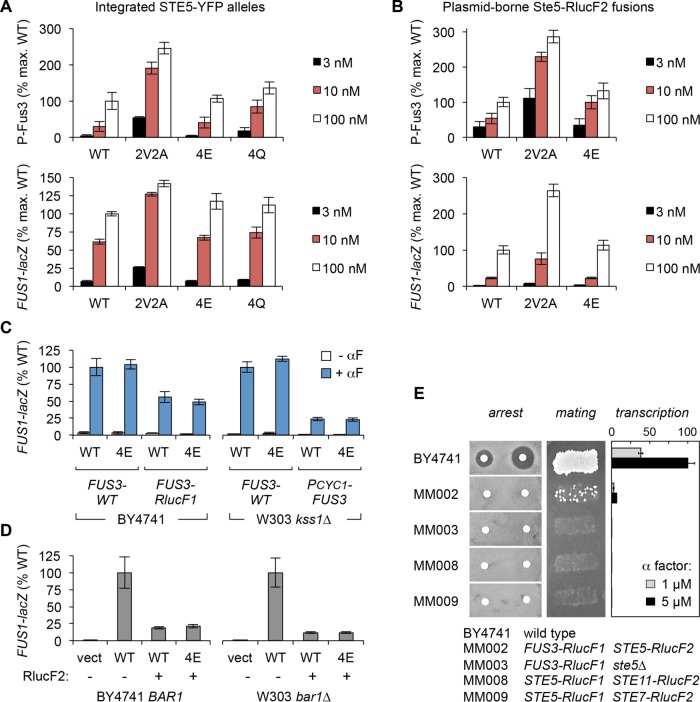
Mitogen-activated protein kinases (MAPKs) mediate numerous eukaryotic signaling responses. They also can modulate their own signaling output via positive or negative feedback loops. In the yeast pheromone response pathway, the MAPK Fus3 triggers negative feedback that dampens its own activity. One target of this feedback is Ste5, a scaffold protein that promotes Fus3 activation. Binding of Fus3 to a docking motif (D motif) in Ste5 causes signal dampening, which was proposed to involve a central cluster of phosphorylation sites in Ste5. Here, we reanalyzed the role of these central sites. Contrary to prior claims, phosphorylation-mimicking mutations at these sites did not impair signaling. Also, the hyperactive signaling previously observed when these sites were mutated to nonphosphorylatable residues arose from their replacement with valine residues and was not observed with other substitutes. Instead, a cluster of N-terminal sites in Ste5, not the central sites, is required for the rapid dampening of initial responses. Further results suggest that the role of the Fus3 D motif is most simply explained by a tethering effect that promotes Ste5 phosphorylation, rather than an allosteric effect proposed to regulate Fus3 activity. These findings substantially revise our understanding of how MAPK feedback attenuates scaffold-mediated signaling in this model pathway.
丝裂原活化蛋白激酶(MAPKs)介导了许多真核信号响应。它们还可以通过正反馈或负反馈环来调节自身的信号输出。在酵母信息素反应途径中,MAPK Fus3 触发负反馈,从而抑制其自身活性。该反馈的一个靶标是 Ste5,一种促进 Fus3 激活的支架蛋白。Fus3 与 Ste5 中的一个对接基序(D 基序)结合会导致信号减弱,这被认为涉及 Ste5 中的一个中央簇磷酸化位点。在这里,我们重新分析了这些中央位点的作用。与之前的说法相反,这些位点的磷酸化模拟突变并没有损害信号转导。此外,当这些位点突变为非磷酸化残基时,先前观察到的过度活跃的信号是由于它们被缬氨酸残基取代而不是其他取代所引起的。相反,Ste5 中的 N 端簇位点而不是中央位点,对于初始反应的快速减弱是必需的。进一步的结果表明,Fus3 D 基序的作用最容易通过促进 Ste5 磷酸化的系绳效应来解释,而不是通过提出调节 Fus3 活性的变构效应来解释。这些发现极大地改变了我们对 MAPK 反馈如何在该模型途径中减弱支架介导的信号转导的理解。