Tanguy Emeline, Wang Qili, Moine Hervé, Vitale Nicolas
Institut des Neurosciences Cellulaires et Intégratives (INCI), UPR-3212 Centre National de la Recherche Scientifique & Université de Strasbourg, Strasbourg, France.
Institut de Génétique et de Biologie Moléculaire et Cellulaire (IGBMC), CNRS UMR 7104, INSERM U964, Université de Strasbourg, Illkirch-Graffenstaden, France.
Front Cell Neurosci. 2019 Jan 23;13:2. doi: 10.3389/fncel.2019.00002. eCollection 2019.
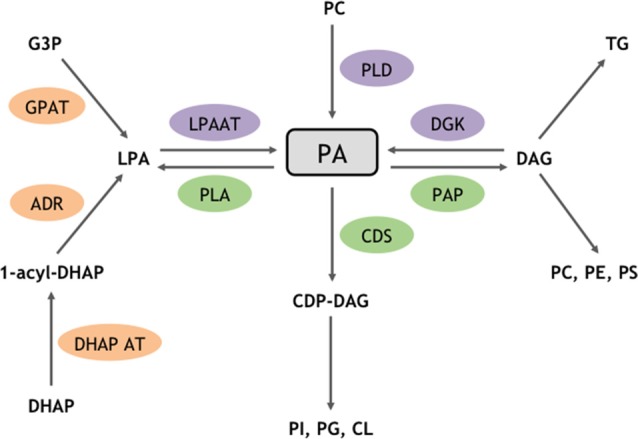
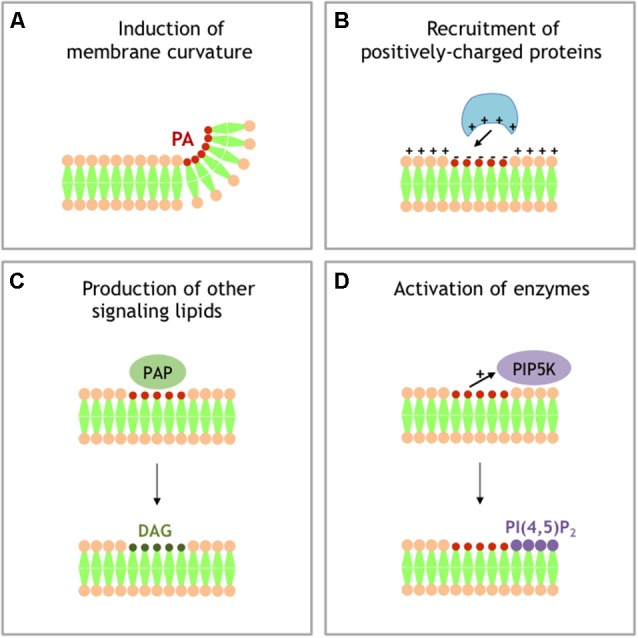
Among the cellular lipids, phosphatidic acid (PA) is a peculiar one as it is at the same time a key building block of phospholipid synthesis and a major lipid second messenger conveying signaling information. The latter is thought to largely occur through the ability of PA to recruit and/or activate specific proteins in restricted compartments and within those only at defined submembrane areas. Furthermore, with its cone-shaped geometry PA locally changes membrane topology and may thus be a key player in membrane trafficking events, especially in membrane fusion and fission steps, where lipid remodeling is believed to be crucial. These pleiotropic cellular functions of PA, including phospholipid synthesis and homeostasis together with important signaling activity, imply that perturbations of PA metabolism could lead to serious pathological conditions. In this mini-review article, after outlining the main cellular functions of PA, we highlight the different neurological diseases that could, at least in part, be attributed to an alteration in PA synthesis and/or catabolism.
在细胞脂质中,磷脂酸(PA)是一种特殊的脂质,因为它既是磷脂合成的关键组成部分,又是传递信号信息的主要脂质第二信使。人们认为,后者主要是通过PA在特定区域招募和/或激活特定蛋白质的能力来实现的,而且这种招募和/或激活仅发生在限定的亚膜区域内。此外,PA呈锥形结构,会局部改变膜拓扑结构,因此可能是膜运输事件中的关键参与者,尤其是在膜融合和裂变步骤中,脂质重塑被认为至关重要。PA的这些多效性细胞功能,包括磷脂合成和稳态以及重要的信号传导活性,意味着PA代谢的紊乱可能导致严重的病理状况。在这篇小型综述文章中,我们在概述了PA的主要细胞功能之后,重点介绍了至少部分可归因于PA合成和/或分解代谢改变的不同神经系统疾病。