Rahmati Maryam, Mozafari Masoud
Bioengineering Research Group, Nanotechnology and Advanced Materials Department, Materials and Energy Research Center, Tehran, Iran.
Cellular and Molecular Research Center, Iran University of Medical Sciences, Tehran, Iran.
Front Bioeng Biotechnol. 2019 Jan 23;7:4. doi: 10.3389/fbioe.2019.00004. eCollection 2019.
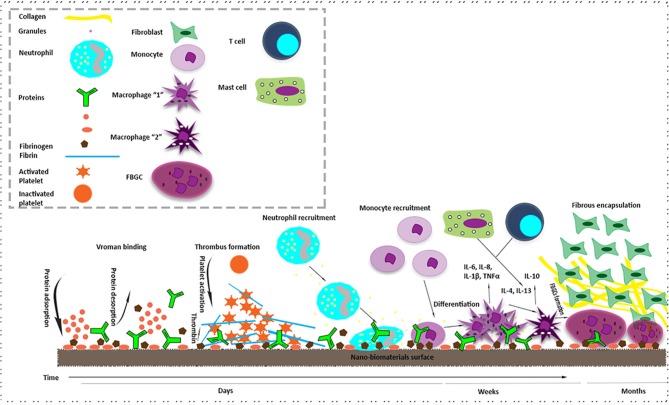
During the last few decades, several studies have suggested that carbon-based nanomaterials, owing to their unique properties, could act as promising candidates in biomedical engineering application. Wide-ranging research efforts have investigated the cellular and molecular responses to carbon-based nanomaterials at the nano-bio interfaces. In addition, a number of surface functionalization strategies have been introduced to improve their safety profile in the biological environment. The present review discusses the general principles of immunological responses to nanomaterials. Then, it explains essential physico-chemical properties of carbon-familynanomaterials, including carbon nanotubes (CNTs), graphene, fullerene, carbon quantum dots (CDs), diamond-like carbon (DLC), and mesoporous carbon biomaterials (MCNs), which significantly affect the immunological cellular and molecular responses at the nano-bio interface. The discussions also briefly highlight the recent studies that critically investigated the cellular and molecular responses to various carbon-based nanomaterials. It is expected that the most recent perspective strategies for improving the biological responses to carbon-based nanomaterials can revolutionize their functions in emerging biological applications.
在过去几十年中,多项研究表明,碳基纳米材料因其独特性能,有望成为生物医学工程应用中的候选材料。广泛的研究工作已对纳米-生物界面处碳基纳米材料的细胞和分子反应进行了调查。此外,还引入了多种表面功能化策略,以改善其在生物环境中的安全性。本综述讨论了纳米材料免疫反应的一般原则。然后,解释了碳族纳米材料(包括碳纳米管(CNT)、石墨烯、富勒烯、碳量子点(CD)、类金刚石碳(DLC)和介孔碳生物材料(MCN))的基本物理化学性质,这些性质会显著影响纳米-生物界面处的免疫细胞和分子反应。讨论还简要介绍了近期对各种碳基纳米材料的细胞和分子反应进行严格研究的相关研究。预计改善碳基纳米材料生物反应的最新前沿策略将彻底改变它们在新兴生物应用中的功能。