IDOCAL (Institut d'Investigació en Psicologia del RRHH, del Desenvolupament Organitzacional i de la Qualitat de Vida Laboral), Universitat de València & IVIE, Avda. Blasco Ibáñez 21, 46010 Valencia, Spain.
Research Group for Work, Organizational and Personnel Psychology (WOPP), Katholieke Universiteit Leuven, Dekenstraat 2, 3000 Leuven, Belgium.
Int J Environ Res Public Health. 2019 Feb 6;16(3):479. doi: 10.3390/ijerph16030479.
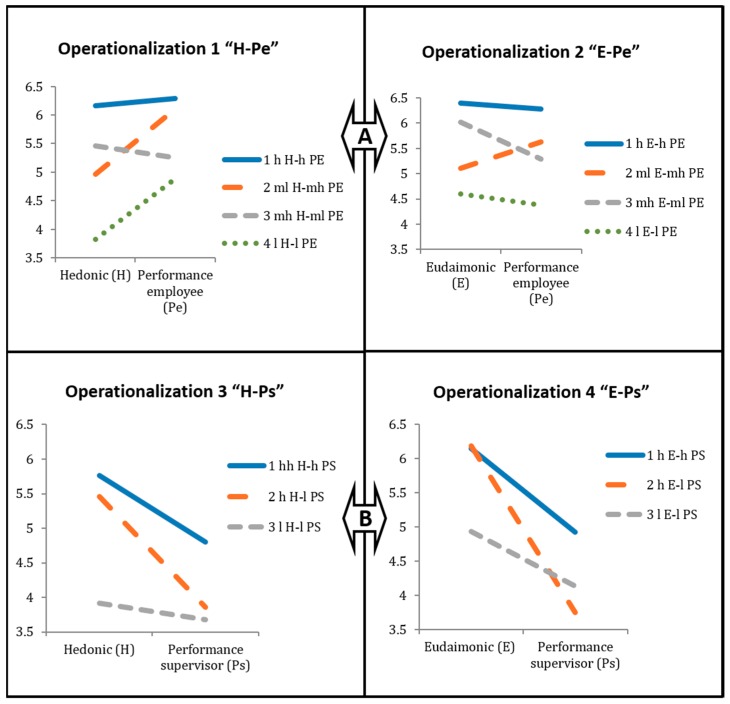
According to the happy-productive worker thesis (HPWT), "happy" workers perform better than "less happy" ones. This study aimed to explore the different patterns of relationships between performance and wellbeing, synergistic (i.e., unhappy-unproductive and happy-productive) and antagonistic (i.e., happy-unproductive and unhappy-productive), taking into account different operationalizations of wellbeing (i.e., hedonic vs. eudaimonic) and performance (i.e., self-rated vs. supervisors' ratings). It also explored different demographic variables as antecedents of these patterns. We applied two-step cluster analysis to the data of 1647 employees. The results indicate four different patterns-happy-productive, unhappy-unproductive, happy-unproductive, and unhappy-productive-when performance is self-assessed, and three when it is assessed by supervisors. On average, over half of the respondents are unhappy-productive or happy-unproductive. We used multidimensional logistic regression to explain cluster membership based on demographic covariates. This study addresses the limitations of the HPWT by including both the hedonic and eudaimonic aspects of wellbeing and considering different dimensions and sources of evaluation. The "antagonistic" patterns identify employees with profiles not explicitly considered by the HPWT.
根据快乐-生产型员工理论(HPWT),“快乐”的员工比“不快乐”的员工表现更好。本研究旨在探讨绩效和幸福感之间不同关系模式的协同作用(即不快乐-低产和快乐-高产)和拮抗作用(即快乐-低产和不快乐-高产),同时考虑到幸福感(即享乐和幸福)和绩效(即自我评估和主管评估)的不同操作化。它还探讨了不同的人口统计学变量作为这些模式的前提。我们对 1647 名员工的数据应用了两步聚类分析。结果表明,当绩效自我评估时,存在四种不同的模式——快乐-高产、不快乐-低产、快乐-低产和不快乐-高产,而当由主管评估时,则存在三种模式。平均而言,超过一半的受访者是不快乐-低产或快乐-低产。我们使用多维逻辑回归根据人口统计学协变量解释聚类成员。本研究通过包括幸福感的享乐和幸福两个方面,并考虑不同的维度和评估来源,解决了 HPWT 的局限性。“拮抗”模式确定了 HPWT 未明确考虑的具有特定特征的员工。