Division of Pulmonary and Critical Care Medicine, Sidney Kimmel Medical College at Thomas Jefferson University, Philadelphia, PA, US.
Division of Pulmonary, Critical Care, and Sleep Medicine, Icahn School of Medicine at Mount Sinai, New York, NY, US.
Ann Glob Health. 2019 Jan 22;85(1):8. doi: 10.5334/aogh.2419.
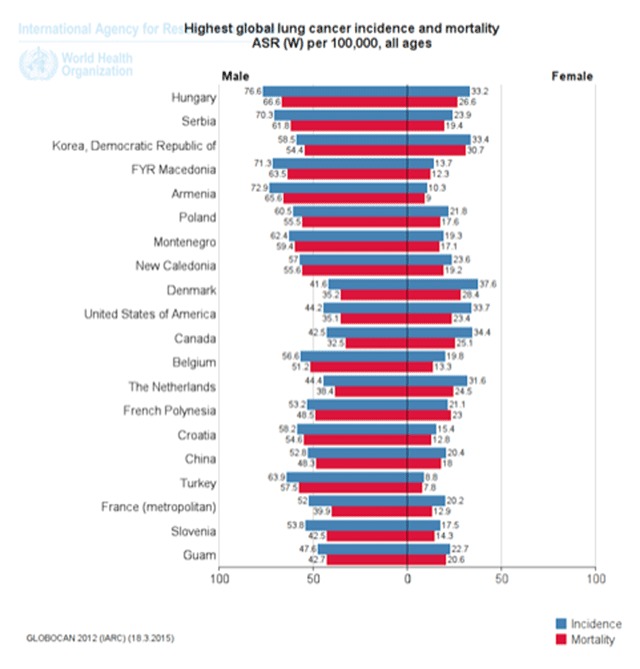
While lung cancer has been the leading cause of cancer-related deaths for many years in the United States, incidence and mortality statistics - among other measures - vary widely worldwide. The aim of this study was to review the evidence on lung cancer epidemiology, including data of international scope with comparisons of economically, socially, and biologically different patient groups. In industrialized nations, evolving social and cultural smoking patterns have led to rising or plateauing rates of lung cancer in women, lagging the long-declining smoking and cancer incidence rates in men. In contrast, emerging economies vary widely in smoking practices and cancer incidence but commonly also harbor risks from environmental exposures, particularly widespread air pollution. Recent research has also revealed clinical, radiologic, and pathologic correlates, leading to greater knowledge in molecular profiling and targeted therapeutics, as well as an emphasis on the rising incidence of adenocarcinoma histology. Furthermore, emergent evidence about the benefits of lung cancer screening has led to efforts to identify high-risk smokers and development of prediction tools. This review also includes a discussion on the epidemiologic characteristics of special groups including women and nonsmokers. Varying trends in smoking largely dictate international patterns in lung cancer incidence and mortality. With declining smoking rates in developed countries and knowledge gains made through molecular profiling of tumors, the emergence of new risk factors and disease features will lead to changes in the landscape of lung cancer epidemiology.
虽然肺癌多年来一直是美国癌症相关死亡的主要原因,但发病率和死亡率统计数据——以及其他措施——在全球范围内差异很大。本研究旨在回顾肺癌流行病学的证据,包括具有国际范围数据的证据,并对经济、社会和生物学方面不同的患者群体进行比较。在工业化国家,不断变化的社会和文化吸烟模式导致女性肺癌发病率上升或趋于平稳,而男性的吸烟和癌症发病率则长期下降。相比之下,新兴经济体的吸烟行为和癌症发病率差异很大,但通常也存在环境暴露的风险,特别是广泛的空气污染。最近的研究还揭示了临床、影像学和病理学相关性,从而使人们对分子谱分析和靶向治疗有了更多的了解,并强调了腺癌组织学发病率的上升。此外,关于肺癌筛查益处的新证据也促使人们努力确定高危吸烟者并开发预测工具。本文还讨论了包括女性和不吸烟者在内的特殊人群的流行病学特征。吸烟趋势的差异在很大程度上决定了国际肺癌发病率和死亡率的模式。随着发达国家吸烟率的下降以及通过肿瘤分子谱分析获得的知识,新的风险因素和疾病特征的出现将导致肺癌流行病学格局的变化。