Department of Software and Computer Engineering, Ajou University, Suwon, South Korea.
Biomedical & Translational Informatics Institute, Geisinger, Danville, USA.
Sci Rep. 2019 Feb 13;9(1):1952. doi: 10.1038/s41598-018-37769-z.
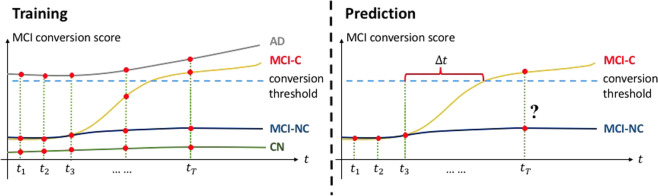
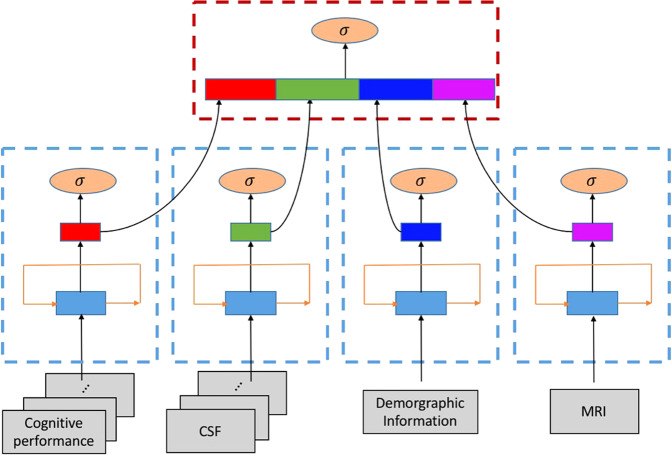
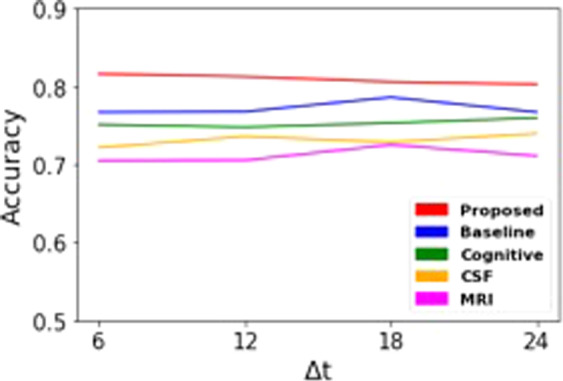
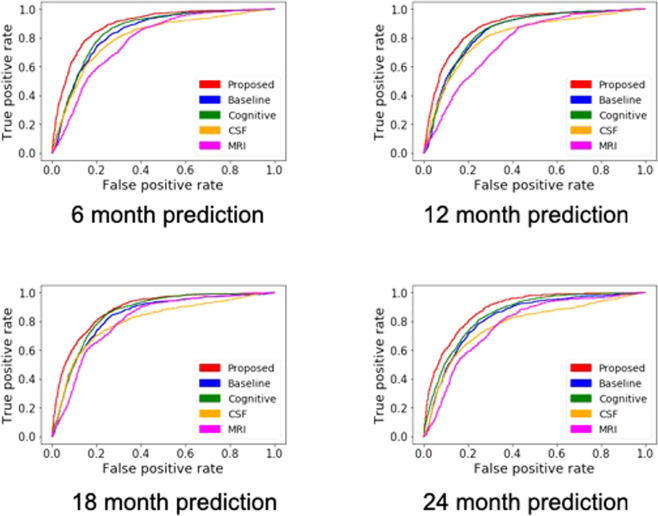
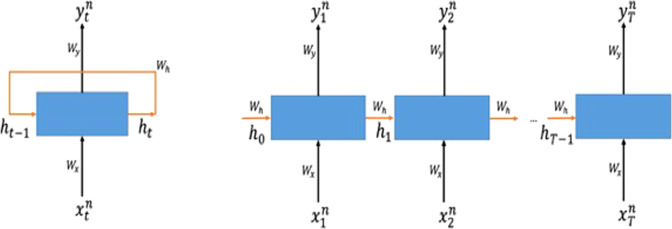
Alzheimer's disease (AD) is a progressive neurodegenerative condition marked by a decline in cognitive functions with no validated disease modifying treatment. It is critical for timely treatment to detect AD in its earlier stage before clinical manifestation. Mild cognitive impairment (MCI) is an intermediate stage between cognitively normal older adults and AD. To predict conversion from MCI to probable AD, we applied a deep learning approach, multimodal recurrent neural network. We developed an integrative framework that combines not only cross-sectional neuroimaging biomarkers at baseline but also longitudinal cerebrospinal fluid (CSF) and cognitive performance biomarkers obtained from the Alzheimer's Disease Neuroimaging Initiative cohort (ADNI). The proposed framework integrated longitudinal multi-domain data. Our results showed that 1) our prediction model for MCI conversion to AD yielded up to 75% accuracy (area under the curve (AUC) = 0.83) when using only single modality of data separately; and 2) our prediction model achieved the best performance with 81% accuracy (AUC = 0.86) when incorporating longitudinal multi-domain data. A multi-modal deep learning approach has potential to identify persons at risk of developing AD who might benefit most from a clinical trial or as a stratification approach within clinical trials.
阿尔茨海默病(AD)是一种进行性神经退行性疾病,其特征是认知功能下降,目前尚无经过验证的疾病修正治疗方法。及时治疗对于在临床症状出现之前尽早发现 AD 非常重要。轻度认知障碍(MCI)是认知正常老年人和 AD 之间的中间阶段。为了预测从 MCI 向可能的 AD 的转变,我们应用了深度学习方法,多模态递归神经网络。我们开发了一个综合框架,该框架不仅结合了基线时的横断面神经影像学生物标志物,还结合了来自阿尔茨海默病神经影像学倡议队列(ADNI)的纵向脑脊液(CSF)和认知表现生物标志物。所提出的框架整合了纵向多领域数据。我们的研究结果表明:1)我们的 MCI 向 AD 转化预测模型在分别单独使用单一模态数据时,准确率高达 75%(曲线下面积(AUC)= 0.83);2)当纳入纵向多领域数据时,我们的预测模型的性能最佳,准确率为 81%(AUC = 0.86)。多模态深度学习方法有可能识别出有发展为 AD 风险的人群,他们可能最受益于临床试验或临床试验中的分层方法。