Mancuso Patrizio, Raman Swarna, Glynn Aoife, Barry Frank, Murphy J Mary
Regenerative Medicine Institute (REMEDI), Biosciences, National University of Ireland Galway, Galway, Ireland.
Centre for Research in Medical Devices (CÚRAM), Biosciences, National University of Ireland Galway, Galway, Ireland.
Front Bioeng Biotechnol. 2019 Jan 29;7:9. doi: 10.3389/fbioe.2019.00009. eCollection 2019.
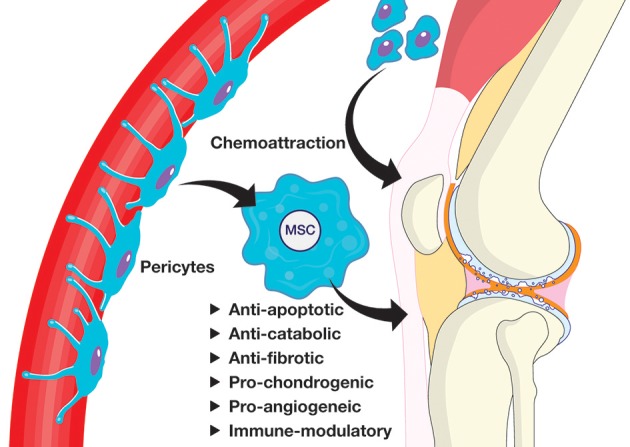
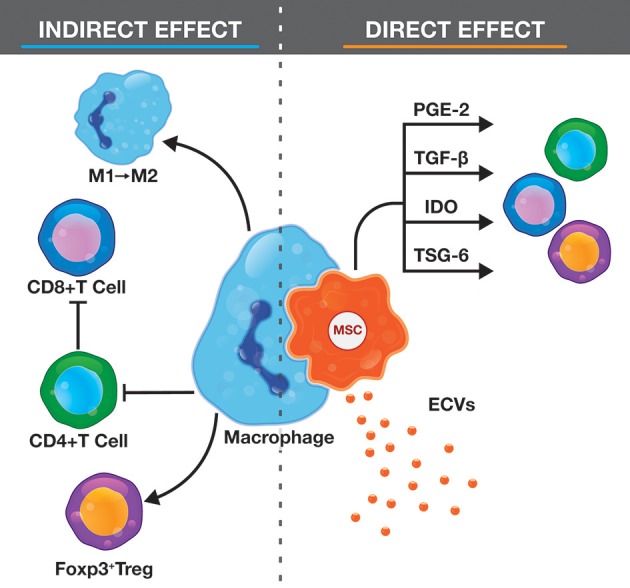
Osteoarthritis (OA) is an inflammatory condition still lacking effective treatments. Mesenchymal stem/stromal cells (MSCs) have been successfully employed in pre-clinical models aiming to resurface the degenerated cartilage. In early-phase clinical trials, intra-articular (IA) administration of MSCs leads to pain reduction and cartilage protection or healing. However, the consistent lack of engraftment indicates that the observed effect is delivered through a "hit-and-run" mechanism, by a temporal release of paracrine molecules. MSCs express a variety of chemokines and cytokines that aid in repair of degraded tissue, restoration of normal tissue metabolism and, most importantly, counteracting inflammation. Secretion of therapeutic factors is increased upon licensing by inflammatory signals or apoptosis, induced by the host immune system. Trophic effectors are released as soluble molecules or carried by extracellular vesicles (ECVs). This review provides an overview of the functions and mechanisms of MSC-secreted molecules found to be upregulated in models of OA, whether using or models.
骨关节炎(OA)是一种仍缺乏有效治疗方法的炎症性疾病。间充质干/基质细胞(MSCs)已成功应用于临床前模型,旨在修复退化的软骨。在早期临床试验中,关节内(IA)注射MSCs可减轻疼痛并保护或修复软骨。然而,一直缺乏细胞植入表明观察到的效果是通过旁分泌分子的短暂释放,以“打了就跑”的机制实现的。MSCs表达多种趋化因子和细胞因子,有助于修复退化组织、恢复正常组织代谢,最重要的是,对抗炎症。炎症信号或宿主免疫系统诱导的凋亡激活后,治疗因子的分泌会增加。营养效应物以可溶性分子的形式释放或由细胞外囊泡(ECVs)携带。本综述概述了在OA模型中发现上调的MSCs分泌分子的功能和机制,无论使用的是 模型还是 模型。