Movellan Kumar Tekwani, Najbauer Eszter E, Pratihar Supriya, Salvi Michele, Giller Karin, Becker Stefan, Andreas Loren B
Department of NMR Based Structural Biology, Max Planck Institute for Biophysical Chemistry, Am Fassberg 11, Göttingen, Germany.
J Biomol NMR. 2019 Feb;73(1-2):81-91. doi: 10.1007/s10858-019-00230-y. Epub 2019 Feb 14.
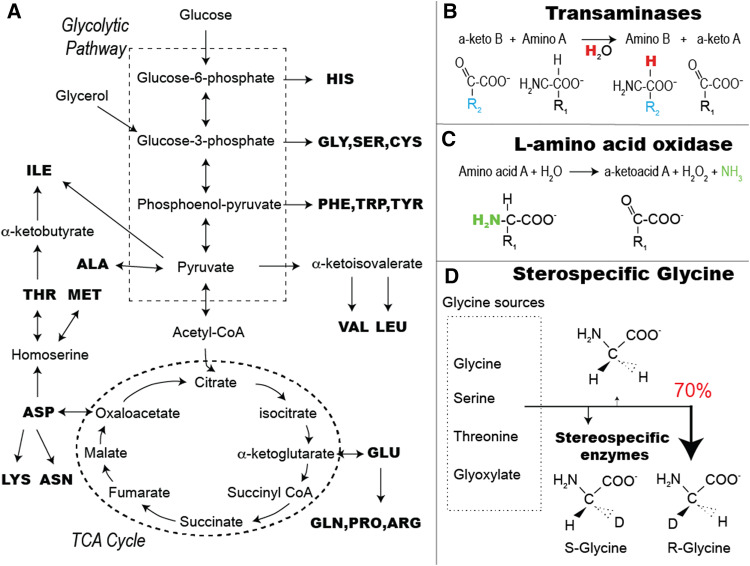
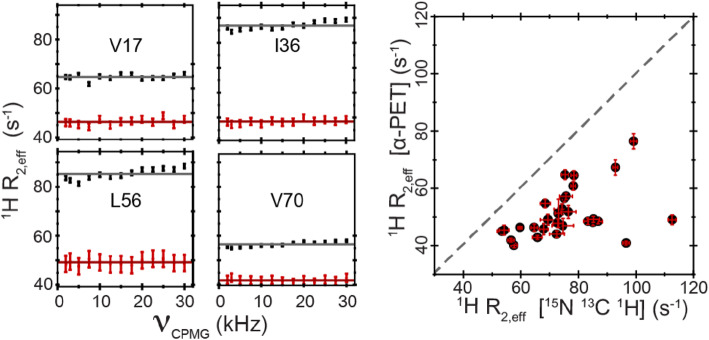
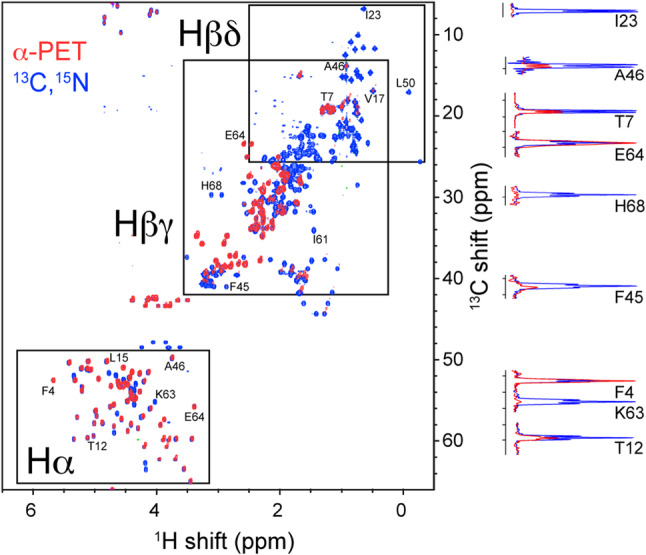
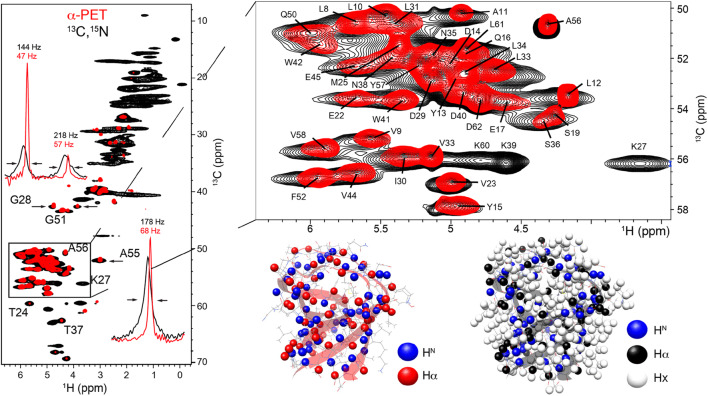
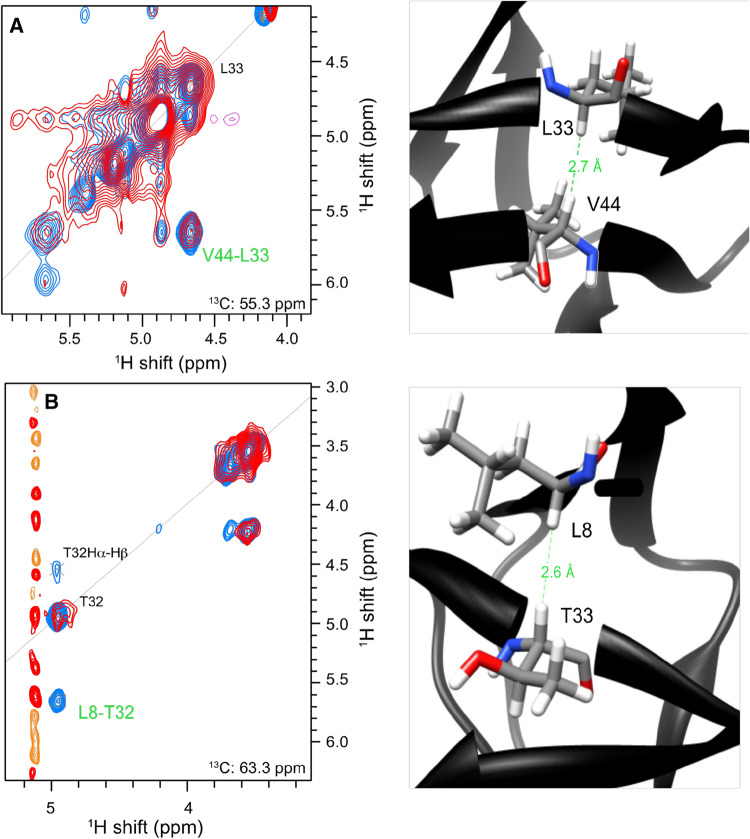
We describe a new labeling method that allows for full protonation at the backbone Hα position, maintaining protein side chains with a high level of deuteration. We refer to the method as alpha proton exchange by transamination (α-PET) since it relies on transaminase activity demonstrated here using Escherichia coli expression. We show that α-PET labeling is particularly useful in improving structural characterization of solid proteins by introduction of an additional proton reporter, while eliminating many strong dipolar couplings. The approach benefits from the high sensitivity associated with 1.3 mm samples, more abundant information including Hα resonances, and the narrow proton linewidths encountered for highly deuterated proteins. The labeling strategy solves amide proton exchange problems commonly encountered for membrane proteins when using perdeuteration and backexchange protocols, allowing access to alpha and all amide protons including those in exchange-protected regions. The incorporation of Hα protons provides new insights, as the close Hα-Hα and Hα-H contacts present in β-sheets become accessible, improving the chance to determine the protein structure as compared with H-H contacts alone. Protonation of the Hα position higher than 90% is achieved for Ile, Leu, Phe, Tyr, Met, Val, Ala, Gln, Asn, Thr, Ser, Glu, Asp even though LAAO is only active at this degree for Ile, Leu, Phe, Tyr, Trp, Met. Additionally, the glycine methylene carbon is labeled preferentially with a single deuteron, allowing stereospecific assignment of glycine alpha protons. In solution, we show that the high deuteration level dramatically reduces R relaxation rates, which is beneficial for the study of large proteins and protein dynamics. We demonstrate the method using two model systems, as well as a 32 kDa membrane protein, hVDAC1, showing the applicability of the method to study membrane proteins.
我们描述了一种新的标记方法,该方法能够使主链Hα位置完全质子化,同时保持蛋白质侧链的高氘代水平。由于该方法依赖于使用大肠杆菌表达所证明的转氨酶活性,我们将其称为转氨作用介导的α质子交换(α-PET)。我们表明,α-PET标记通过引入额外的质子报告基团,在改善固体蛋白质的结构表征方面特别有用,同时消除了许多强偶极耦合。该方法受益于与1.3毫米样品相关的高灵敏度、包括Hα共振在内的更丰富信息,以及高氘代蛋白质所具有的窄质子线宽。该标记策略解决了在使用全氘代和回交方案时膜蛋白常见的酰胺质子交换问题,使得能够获取α质子和所有酰胺质子,包括那些处于交换保护区域的质子。Hα质子的掺入提供了新的见解,因为β折叠中存在的紧密Hα-Hα和Hα-H接触变得可及,与仅依靠H-H接触相比,增加了确定蛋白质结构的机会。对于异亮氨酸、亮氨酸、苯丙氨酸、酪氨酸、甲硫氨酸、缬氨酸、丙氨酸、谷氨酰胺、天冬酰胺、苏氨酸、丝氨酸、谷氨酸、天冬氨酸,Hα位置的质子化程度高于90%,尽管LAAO仅对异亮氨酸、亮氨酸、苯丙氨酸、酪氨酸、色氨酸、甲硫氨酸具有这种程度的活性。此外,甘氨酸亚甲基碳优先被单个氘原子标记,从而实现甘氨酸α质子的立体特异性归属。在溶液中,我们表明高氘代水平显著降低了R弛豫速率,这有利于研究大型蛋白质和蛋白质动力学。我们使用两个模型系统以及一个32 kDa的膜蛋白hVDAC1展示了该方法,表明该方法适用于研究膜蛋白。