Department of Pharmacy, Kaohsiung Chang Gung Memorial Hospital and College of Medicine, Chang Gung University, Kaohsiung 833, Taiwan.
Department of Pediatrics, Kaohsiung Chang Gung Memorial Hospital and College of Medicine, Chang Gung University, Kaohsiung 833, Taiwan.
Int J Mol Sci. 2019 Feb 5;20(3):681. doi: 10.3390/ijms20030681.
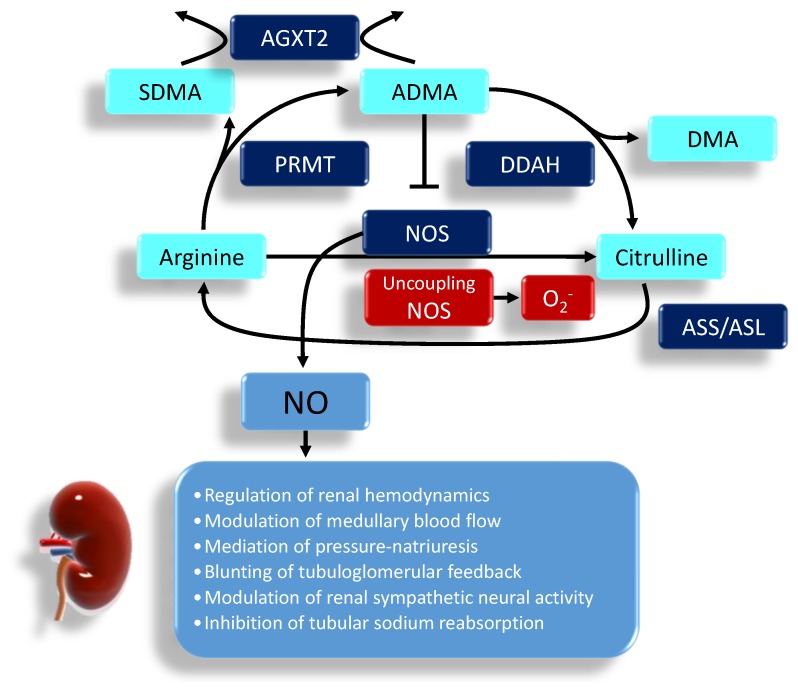
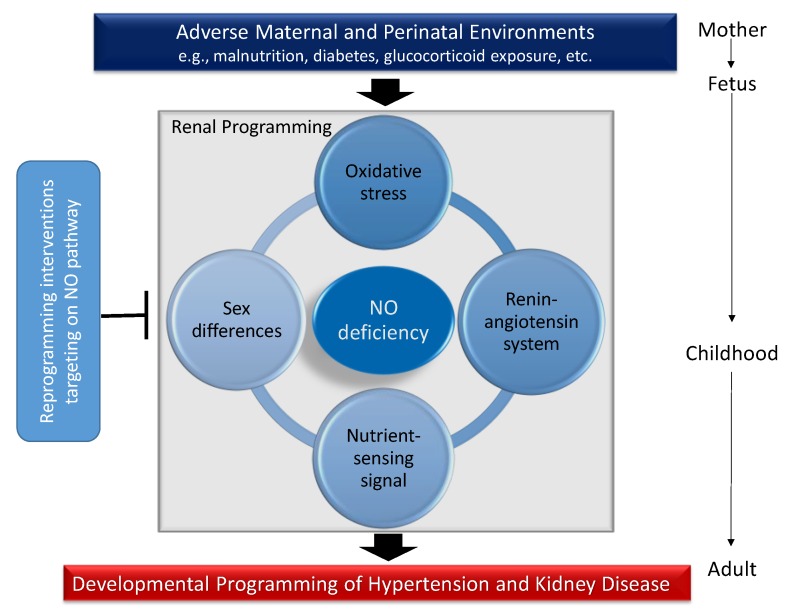
Development of the kidney can be altered in response to adverse environments leading to renal programming and increased vulnerability to the development of hypertension and kidney disease in adulthood. By contrast, reprogramming is a strategy shifting therapeutic intervention from adulthood to early life to reverse the programming processes. Nitric oxide (NO) is a key mediator of renal physiology and blood pressure regulation. NO deficiency is a common mechanism underlying renal programming, while early-life NO-targeting interventions may serve as reprogramming strategies to prevent the development of hypertension and kidney disease. This review will first summarize the regulation of NO in the kidney. We also address human and animal data supporting the link between NO system and developmental programming of hypertension and kidney disease. This will be followed by the links between NO deficiency and the common mechanisms of renal programming, including the oxidative stress, renin⁻angiotensin system, nutrient-sensing signals, and sex differences. Recent data from animal studies have suggested that interventions targeting the NO pathway could be reprogramming strategies to prevent the development of hypertension and kidney disease. Further clinical studies are required to bridge the gap between animal models and clinical trials in order to develop ideal NO-targeting reprogramming strategies and to be able to have a lifelong impact, with profound savings in the global burden of hypertension and kidney disease.
肾脏的发育可能会因不良环境而发生改变,导致肾脏编程,并增加成年后患高血压和肾脏疾病的易感性。相比之下,重编程是一种将治疗干预从成年期转移到生命早期的策略,以逆转编程过程。一氧化氮(NO)是肾脏生理学和血压调节的关键介质。NO 缺乏是肾脏编程的常见机制,而生命早期针对 NO 的干预措施可能是重编程策略,以预防高血压和肾脏疾病的发生。本综述首先总结了 NO 在肾脏中的调节作用。我们还讨论了支持 NO 系统与高血压和肾脏疾病发育编程之间联系的人类和动物数据。接下来将讨论 NO 缺乏与肾脏编程的常见机制之间的联系,包括氧化应激、肾素-血管紧张素系统、营养感应信号和性别差异。最近的动物研究数据表明,针对 NO 途径的干预可能是重编程策略,以预防高血压和肾脏疾病的发生。需要进一步的临床研究来弥合动物模型和临床试验之间的差距,以便开发理想的针对 NO 的重编程策略,并能够产生终身影响,从而大大降低全球高血压和肾脏疾病的负担。