1 Department of Cardiology University of Ulsan College of Medicine Asan Medical Center Seoul Korea.
2 Biomedical Engineering Research Center Asan Institute for Life Sciences Seoul Korea.
J Am Heart Assoc. 2019 Feb 19;8(4):e011685. doi: 10.1161/JAHA.118.011685.
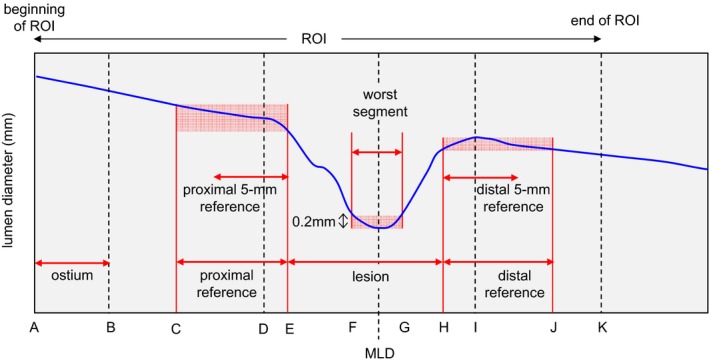
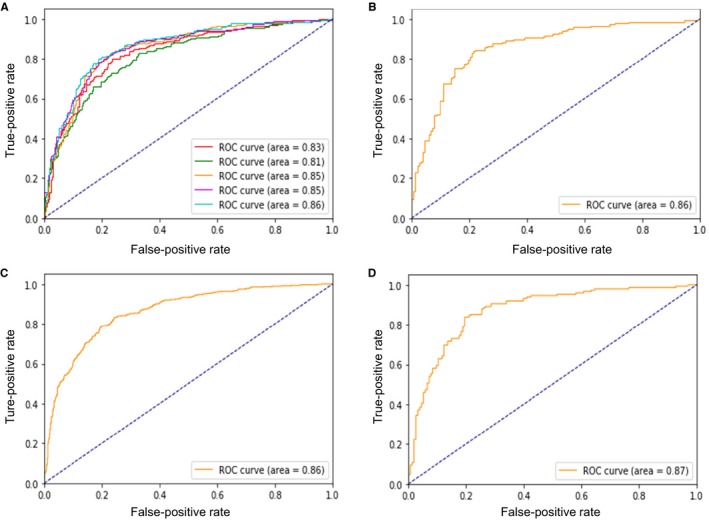
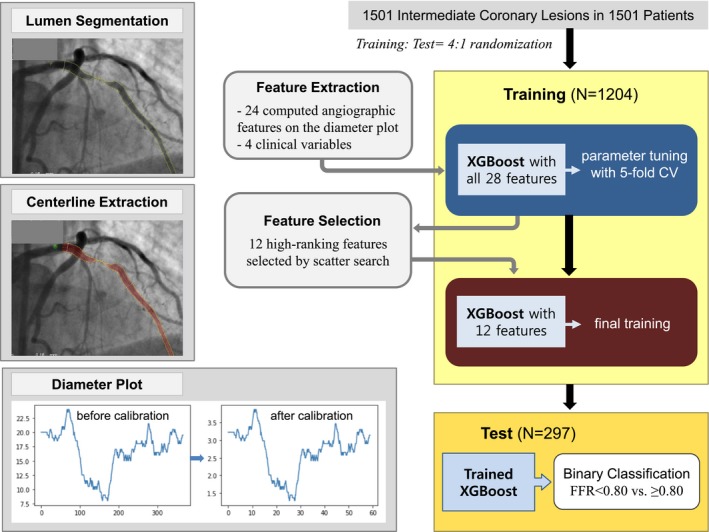
Background An angiography-based supervised machine learning ( ML ) algorithm was developed to classify lesions as having fractional flow reserve ≤0.80 versus >0.80. Methods and Results With a 4:1 ratio, 1501 patients with 1501 intermediate lesions were randomized into training versus test sets. Between the ostium and 10 mm distal to the target lesion, a series of angiographic lumen diameter measurements along the centerline was plotted. The 24 computed angiographic features based on the diameter plot and 4 clinical features (age, sex, body surface area, and involve segment) were used for ML by XGBoost. The model was independently trained and tested by 2000 bootstrap iterations. External validation with 79 patients was conducted. Including all 28 features, the ML model with 5-fold cross-validation in the 1204 training samples predicted fractional flow reserve ≤0.80 with overall diagnostic accuracy of 78±4% (averaged area under the curve: 0.84±0.03). The 12 high-ranking features selected by scatter search were involved segment; body surface area; distal lumen diameter; minimal lumen diameter; length of a lumen diameter <2.0 mm, <1.5 mm, and <1.25 mm; mean lumen diameter within the worst segment; sex; diameter stenosis; distal 5-mm reference lumen diameter; and length of diameter stenosis >70%. Using those 12 features, the ML predicted fractional flow reserve ≤0.80 in the test set with sensitivity of 84%, specificity of 80%, and overall accuracy of 82% (area under the curve: 0.87). The averaged diagnostic accuracy in bootstrap replicates was 81±1% (averaged area under the curve: 0.87±0.01). External validation showed accuracy of 85% (area under the curve: 0.87). Conclusions Angiography-based ML showed good diagnostic performance in identifying ischemia-producing lesions and reduced the need for pressure wires.
一种基于血管造影的监督机器学习(ML)算法被开发出来,用于将病变分类为血流储备分数≤0.80 与>0.80。
采用 4:1 的比例,将 1501 例 1501 例中度狭窄病变的患者随机分为训练组和测试组。在靶病变的近段和远段 10mm 之间,沿着中心线绘制一系列血管造影管腔直径测量值。基于直径图的 24 个计算血管造影特征和 4 个临床特征(年龄、性别、体表面积和受累节段)被用于 XGBoost 的 ML。该模型通过 2000 次自举迭代进行独立训练和测试。对 79 例患者进行外部验证。在 1204 例训练样本中,包含所有 28 个特征的 ML 模型采用 5 折交叉验证预测血流储备分数≤0.80,总体诊断准确性为 78±4%(平均曲线下面积:0.84±0.03)。通过散射搜索选择的 12 个高排名特征包括受累节段、体表面积、远段管腔直径、最小管腔直径、管腔直径<2.0mm、<1.5mm 和<1.25mm 的长度、最严重节段内的平均管腔直径、性别、直径狭窄、远端 5mm 参考管腔直径和直径狭窄长度>70%。使用这 12 个特征,ML 在测试集中预测血流储备分数≤0.80,其敏感性为 84%,特异性为 80%,总准确率为 82%(曲线下面积:0.87)。自举复制的平均诊断准确率为 81±1%(平均曲线下面积:0.87±0.01)。外部验证显示准确率为 85%(曲线下面积:0.87)。
基于血管造影的 ML 在识别产生缺血的病变方面表现出良好的诊断性能,并减少了对压力导丝的需求。