Al-Alimi Khaled Rashad, Razak Abdul Aziz Abdul, Saub Roslan
Department of Restorative Dentistry, Faculty of Dentistry, University of Malaya, Kuala Lumpur, Malaysia.
Department of Community Oral Health & Clinical Prevention, Faculty of Dentistry, University of Malaya, Kuala Lumpur, Malaysia.
Afr Health Sci. 2018 Dec;18(4):1036-1045. doi: 10.4314/ahs.v18i4.25.
People in Yemen and in East African countries chew khat more than five hours daily.
The aim of this study was to assess the relationship between khat and occlusal caries progression.
A cohort study was carried out among 98 Yemeni khat chewers and 101 non-chewers aged 18-35 years old with early occlusal caries lesions. All participants answered questions on socio-demographic, khat , oral hygiene , sugar intake, and oral health knowledge at baseline. All posterior teeth with an early enamel lesion on occlusal surfaces detected by visual inspection at baseline were also subjected to DIAGNOdent assessment to confirm early lesion (DIAGNOdent reading 13-24). Participants were re-examined after 12 weeks. Caries progression was considered to occur when the DIAGNOdent reading was >25. Data were analyzed using Relative risk, Mann-Whitney U test, a Wilcoxon Signed-Rank test and logistic regression analysis.
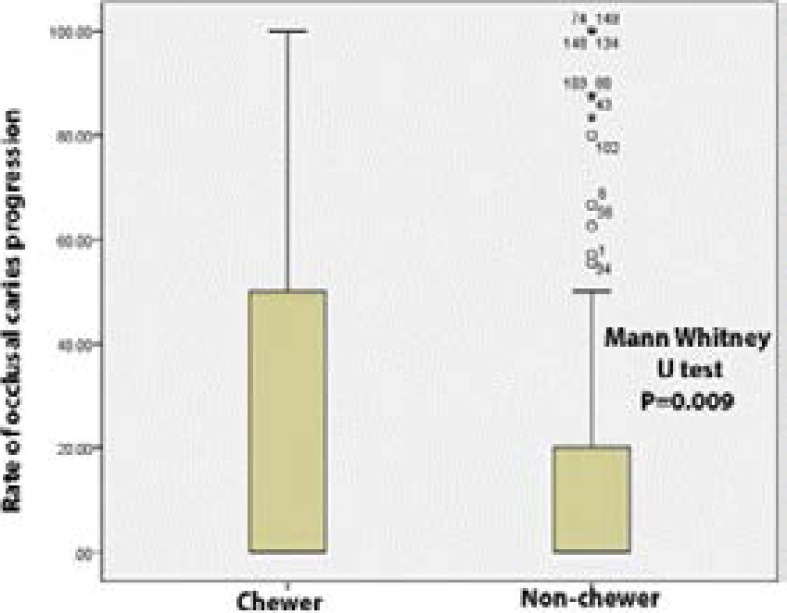
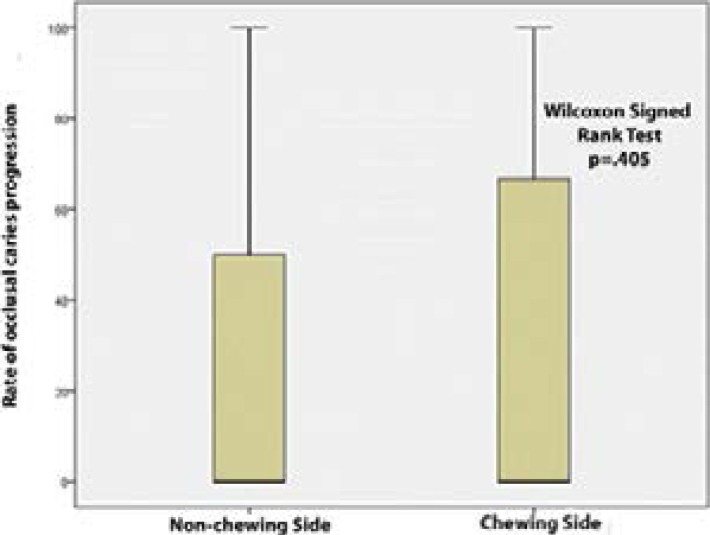
Occlusal caries progression incidence between khat chewers and non-chewers, with the relative risk was 1.68. There was no significant difference in occlusal caries progression on chewing side and non-chewing side among khat chewers. Khat chewing was a statistical predictor for those with low income.
Khat is a risk factor for occlusion caries progression among low income group.
也门和东非国家的人们每天咀嚼巧茶的时间超过5小时。
本研究旨在评估巧茶与咬合面龋进展之间的关系。
对98名年龄在18 - 35岁、患有早期咬合面龋损的也门巧茶咀嚼者和101名非咀嚼者进行了一项队列研究。所有参与者在基线时回答了关于社会人口统计学、巧茶、口腔卫生、糖摄入量和口腔健康知识的问题。所有在基线时通过目视检查在咬合面上发现有早期釉质病变的后牙也接受了龋齿诊断仪评估,以确认早期病变(龋齿诊断仪读数为13 - 24)。12周后对参与者进行复查。当龋齿诊断仪读数>25时,认为发生了龋进展。使用相对风险、曼-惠特尼U检验、威尔科克森符号秩检验和逻辑回归分析对数据进行分析。
巧茶咀嚼者和非咀嚼者之间咬合面龋进展发生率,相对风险为1.68。巧茶咀嚼者中,咀嚼侧和非咀嚼侧的咬合面龋进展没有显著差异。咀嚼巧茶是低收入者龋进展的统计学预测因素。
巧茶是低收入人群咬合面龋进展的一个风险因素。