Faculty of Dentistry, Oral and Craniofacial Sciences, Centre for Host Microbiome Interactions, King's College London, London, UK.
Department of Dental and Maxillofacial Surgery, St Paul's Hospital Millennium Medical College, Addis Ababa, Ethiopia.
BMC Public Health. 2021 Jan 21;21(1):180. doi: 10.1186/s12889-021-10199-9.
Ethiopia is a developing sub-Saharan African country with increasing prevalence of non-communicable diseases (NCDs), including oral conditions. Oral health and dental care have been given little consideration, and there is limited information relating to population oral health and use of dental services in the country. The aim of this study was to examine the burden and associated factors of dental caries experience and investigate access to dental care amongst adults within Ethiopia.
This community-based oral health survey is a baseline study for the ASSET - Health System Strengthening in sub-Saharan Africa project undertaken in the Butajira area, south-central Ethiopia. A stratified random sample of households and individuals participated in the study. The survey instruments were mainly based on the WHO Oral Health Survey Methods manual (5 ed.). Face-to-face interviews and clinical dental examinations were conducted. The data were analysed for descriptive statistics; and Poisson regression models were built to assess the association of dental caries and predictor variables in adults (≥18 years).
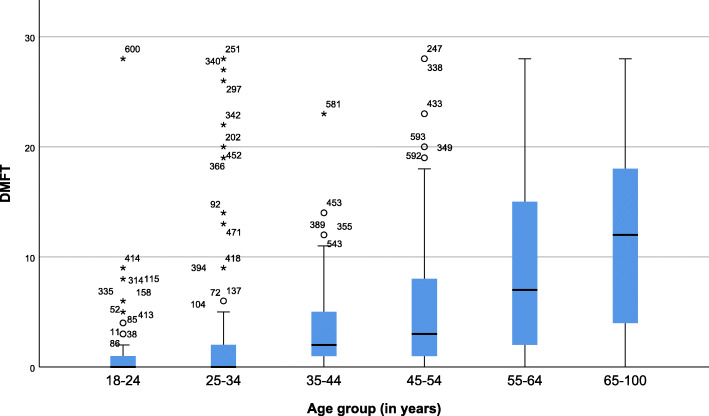
Most of the study population (n = 626) were female (63.9%), married (71.4%) and Muslim (76.0%). Just over half (53.2%) lived in rural areas and many (44.4%) had no formal education. A majority (74.0%) reported never utilising dental care services, and the main reason was never experiencing any dental problem (71.3%). Sixty percent (n = 377) of the adults had experienced dental caries, 88.0% (n = 332) of whom had untreated carious teeth. Pain or discomfort was reported by 16.5, and 7.2% had one or more PUFA component. Most (59.9%) adults with dental caries experience reported tooth pain or discomfort during the last year. In the fully adjusted Poisson regression model, increasing age, dental care utilisation and Khat chewing had positive significant associations with dental caries experience, whilst education status was negatively associated (p < 0.05).
This study demonstrated a high burden of dental caries and considerable consequences resulting from untreated disease in this population of adults. There was evidence of social inequity, limited utilisation of dental care and oral health awareness. This highlights the need for oral health system strengthening focusing on health promotion and expanding overall access to care.
埃塞俄比亚是一个位于撒哈拉以南非洲的发展中国家,非传染性疾病(NCDs)的发病率不断上升,包括口腔疾病。口腔健康和牙科护理一直没有得到重视,有关该国人口口腔健康和使用牙科服务的信息有限。本研究旨在检查埃塞俄比亚成年人的龋齿负担及其相关因素,并调查他们获得牙科保健的情况。
这项基于社区的口腔健康调查是在埃塞俄比亚中南部的巴提拉地区进行的 ASSET-撒哈拉以南非洲卫生系统加强项目的基线研究。分层随机抽取家庭和个人参与研究。调查工具主要基于世界卫生组织口腔健康调查方法手册(第 5 版)。进行了面对面访谈和临床牙科检查。对数据进行了描述性统计分析;并建立泊松回归模型,以评估成年人(≥18 岁)中龋齿和预测变量的关联。
研究人群(n=626)大多数为女性(63.9%)、已婚(71.4%)和穆斯林(76.0%)。超过一半(53.2%)居住在农村地区,许多人(44.4%)没有接受过正规教育。大多数人(74.0%)报告从未使用过牙科保健服务,主要原因是从未经历过任何牙科问题(71.3%)。60%(n=377)的成年人经历过龋齿,其中 88.0%(n=332)的人有未经治疗的龋齿。16.5%的人报告有疼痛或不适,7.2%的人有一个或多个 PUFA 成分。在过去一年中,大多数(59.9%)有龋齿经历的成年人报告有牙痛或不适。在完全调整的泊松回归模型中,年龄增长、利用牙科保健服务和咀嚼恰特草与龋齿经历呈正相关,而教育状况呈负相关(p<0.05)。
本研究表明,该人群的成年人中龋齿负担沉重,且未经治疗的疾病后果严重。存在社会不平等、牙科保健服务利用率有限和口腔健康意识不足的证据。这突显了需要加强口腔卫生系统,重点是促进健康并扩大整体获得保健的机会。