Division of Behavioral Medicine and Clinical Psychology, Cincinnati Children's Hospital Medical Center, OH, and the University of Cincinnati College of Medicine, Cincinnati, OH.
Division of Behavioral Medicine and Clinical Psychology, Cincinnati Children's Hospital Medical Center, OH, and the University of Cincinnati College of Medicine, Cincinnati, OH.
J Am Acad Child Adolesc Psychiatry. 2019 Apr;58(4):433-442. doi: 10.1016/j.jaac.2018.09.439. Epub 2018 Nov 2.
Although poor sleep is often reported in adolescents with attention-deficit/hyperactivity disorder (ADHD), prior studies have been correlational. This study investigated whether sleep duration is causally linked to sleepiness, inattention, and behavioral functioning in adolescents with ADHD.
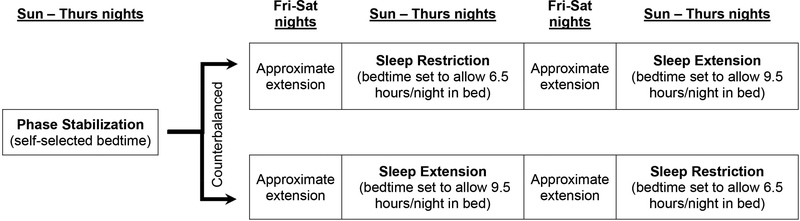
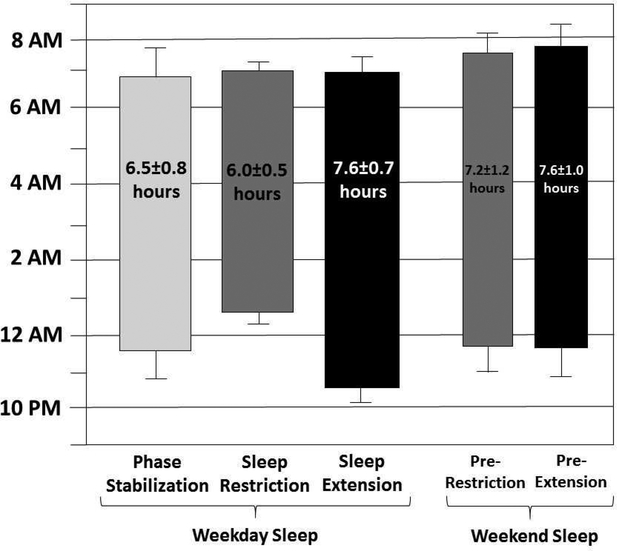
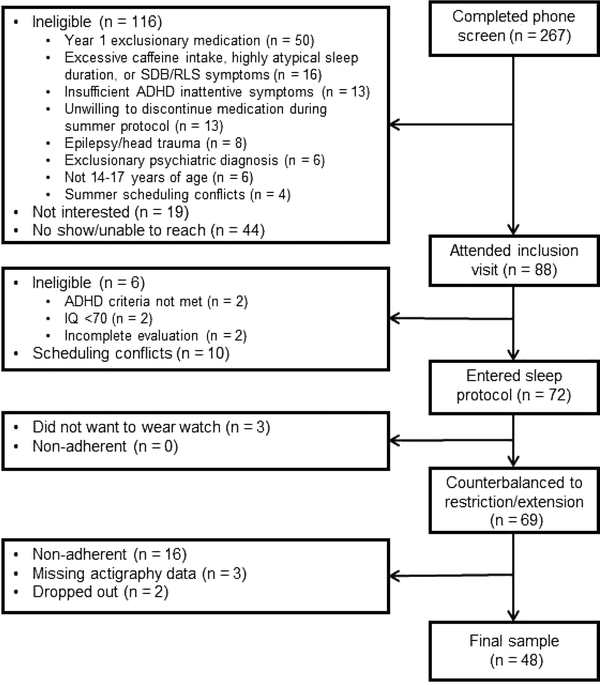
A total of 72 adolescents (aged 14-17 years) entered a 3-week sleep protocol using an experimental crossover design. The protocol included a phase stabilization week, followed in randomized counterbalanced order by 1 week of sleep restriction (6.5 hours) and 1 week of sleep extension (9.5 hours). Sleep was monitored with actigraphy and daily sleep diaries, with laboratory visits at the end of each week. Analyses included 48 adolescents who had complete actigraphy data and successfully completed the sleep protocol (defined a priori as obtaining ≥1 hour actigraphy-measured sleep duration during extension compared to restriction). Parent and adolescent ratings of daytime sleepiness, ADHD symptoms, sluggish cognitive tempo (SCT), and oppositional behaviors were the primary measures. The A-X Continuous Performance Test (CPT) was a secondary measure.
Compared to the extended sleep week, parents reported more inattentive and oppositional symptoms during the restricted sleep week. Both parents and adolescents reported more SCT symptoms and greater daytime sleepiness during restriction compared to extension. Adolescents reported less hyperactivity-impulsivity during sleep restriction than extension. No effects were found for parent-reported hyperactivity-impulsivity, adolescent-reported ADHD inattention, or CPT performance.
This study provides the first evidence that sleep duration is a causal contributor to daytime behaviors in adolescents with ADHD. Sleep may be an important target for intervention in adolescents with ADHD.
Cognitive and Behavioral Effects of Sleep Restriction in Adolescents With ADHD; https://clinicaltrials.gov/; NCT02732756.
尽管注意力缺陷/多动障碍(ADHD)青少年常报告睡眠质量差,但先前的研究均为相关性研究。本研究旨在调查青少年 ADHD 患者的睡眠时间是否与嗜睡、注意力不集中和行为功能有关。
共有 72 名(年龄 14-17 岁)青少年采用实验交叉设计,参与为期 3 周的睡眠方案。该方案包括 1 周的稳定期,随后以随机、平衡的顺序进行 1 周的睡眠限制(6.5 小时)和 1 周的睡眠延长(9.5 小时)。使用活动记录仪和每日睡眠日记监测睡眠,每周结束时进行实验室访问。分析包括 48 名具有完整活动记录仪数据并成功完成睡眠方案的青少年(根据预先定义,在延长期获得的睡眠时间比限制期多≥1 小时)。日间嗜睡、ADHD 症状、认知迟钝(SCT)和对立行为的父母和青少年评定为主要测量指标。A-X 连续性能测试(CPT)为次要测量指标。
与延长睡眠周相比,限制睡眠周时父母报告更多的注意力不集中和对立症状。与延长睡眠周相比,限制睡眠周时父母和青少年报告更多的 SCT 症状和更严重的日间嗜睡,青少年报告在限制睡眠周时的多动冲动症状比延长睡眠周时少。父母报告的多动冲动症状、青少年报告的 ADHD 注意力不集中或 CPT 表现无差异。
本研究首次提供证据表明,睡眠时间是 ADHD 青少年日间行为的一个因果因素。睡眠可能是 ADHD 青少年干预的一个重要目标。