Ihalainen Johanna K, Inglis Alistair, Mäkinen Tuomas, Newton Robert U, Kainulainen Heikki, Kyröläinen Heikki, Walker Simon
Neuromuscular Research Center, Faculty of Sport and Health Sciences, University of Jyväskylä, Jyväskylä, Finland.
Department of Health Sciences, Swedish Winter Sports Research Centre, Mid Sweden University, Östersund, Sweden.
Front Physiol. 2019 Feb 1;10:32. doi: 10.3389/fphys.2019.00032. eCollection 2019.
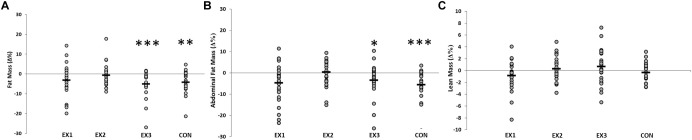
The main purpose of the present study was to investigate the effect of frequency, thereby increasing training volume, of resistance training on body composition, inflammation markers, lipid and glycemic profile in healthy older individuals (age range 65-75 year). Ninety-two healthy participants were randomly assigned to one of four groups; performing strength training one- (EX1), two- (EX2), or three- (EX3) times-per-week and a non-training control (CON) group. Whole-body strength training was performed using 2-5 sets and 4-12 repetitions per exercise and 7-9 exercises per session. All training groups attended supervised resistance training for 6 months. Body composition was measured by dual X-ray absorptiometry and fasting blood samples were taken pre- and post-training. There were significant main effects of time for total fat mass ( = 28.12, < 0.001) and abdominal fat mass ( = 20.72, < 0.001). Pre- to post-study, statistically significant reductions in fat mass (Δ = -1.3 ± 1.4 kg, < 0.001, = 26) were observed in EX3. Pre- to post-study reductions in low density lipoprotein (LDL) concentration (Δ = -0.38 ± 0.44 mmol⋅L, = 0.003, = 19) were observed only in EX3, whereas a significant pre- to post-study increases in high density lipoprotein (HDL) concentration (0.14-0.19 mmol⋅L) were observed in all training groups. Most variables at baseline demonstrated a significant (negative) relationship when correlating baseline values with their change during the study including: Interleukin-6 (IL-6) ( = -0.583, < 0.001), high-sensitivity c-reactive protein (hs-CRP) ( = -0.471, < 0.001, and systolic blood pressure ( = -0.402, = 0.003). The present study suggests that having more than two resistance training sessions in a week could be of benefit in the management of body composition and lipid profile. Nevertheless, interestingly, and importantly, those individuals with a higher baseline in systolic blood pressure, IL-6 and hs-CRP derived greatest benefit from the resistance training intervention, regardless of how many times-a-week they trained. Finally, the present study found no evidence that higher training frequency would induce greater benefit regarding inflammation markers or glycemic profile in healthy older adults.
本研究的主要目的是调查在健康的老年个体(年龄范围65 - 75岁)中,通过增加训练量来提高抗阻训练频率对身体成分、炎症标志物、血脂和血糖水平的影响。92名健康参与者被随机分配到四组中的一组;每周进行一次(EX1)、两次(EX2)或三次(EX3)力量训练以及一个非训练对照组(CON)。全身力量训练采用每组2 - 5次、每次练习4 - 12次重复以及每次训练7 - 9个练习动作。所有训练组接受了6个月的监督抗阻训练。通过双能X线吸收法测量身体成分,并在训练前和训练后采集空腹血样。总脂肪量(F = 28.12,P < 0.001)和腹部脂肪量(F = 20.72,P < 0.001)在时间上有显著的主效应。在EX3组中,研究前至研究后观察到脂肪量有统计学意义的减少(Δ = -1.3 ± 1.4 kg,P < 0.001,n = 26)。仅在EX3组中观察到研究前至研究后低密度脂蛋白(LDL)浓度有下降(Δ = -0.38 ± 0.44 mmol⋅L,P = 0.003,n = 19),而在所有训练组中均观察到研究前至研究后高密度脂蛋白(HDL)浓度有显著升高(0.14 - 0.19 mmol⋅L)。当将基线值与其在研究期间的变化进行相关性分析时,大多数基线变量显示出显著(负)相关性,包括:白细胞介素 - 6(IL - 6)(r = -0.583,P < 0.001)、高敏C反应蛋白(hs - CRP)(r = -0.471,P < 0.001)和收缩压(r = -0.402,P = 0.003)。本研究表明,每周进行超过两次抗阻训练可能有助于管理身体成分和血脂水平。然而,有趣且重要的是,那些收缩压、IL - 6和hs - CRP基线较高的个体从抗阻训练干预中获益最大,无论他们每周训练多少次。最后,本研究没有发现证据表明更高的训练频率会在健康老年人中对炎症标志物或血糖水平产生更大益处。