Marshall Emily A, Shepherd Hana
Franklin and Marshall College, Department of Sociology and Public Health Program, Gerhart House, Lancaster, PA 19104,
Rutgers University, Department of Sociology, Davison Hall, New Brunswick, NJ 08901,
J Marriage Fam. 2018 Apr;80(2):521-536. doi: 10.1111/jomf.12449. Epub 2017 Nov 14.
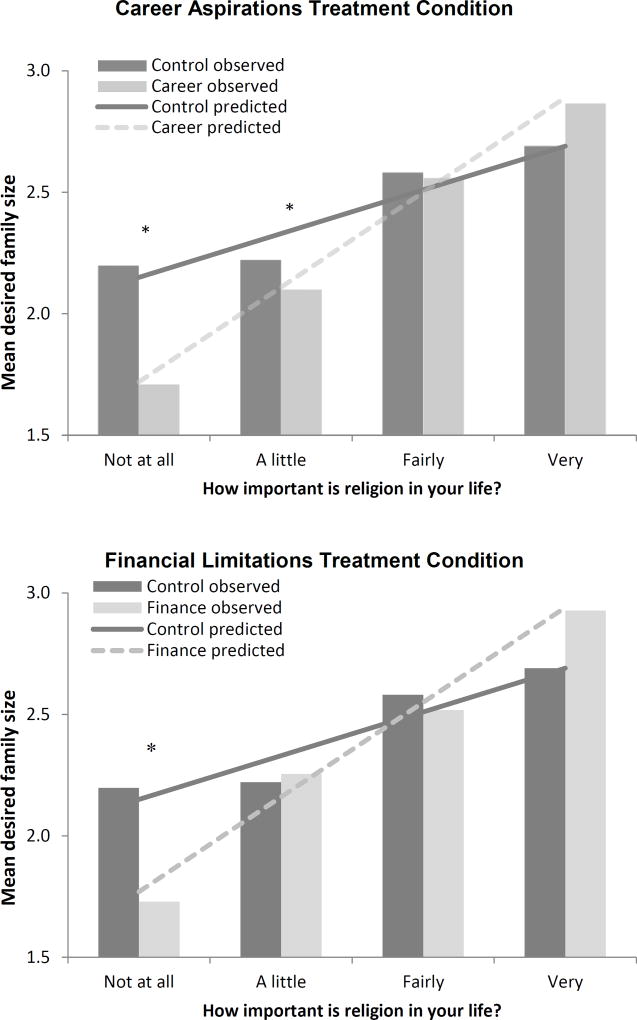
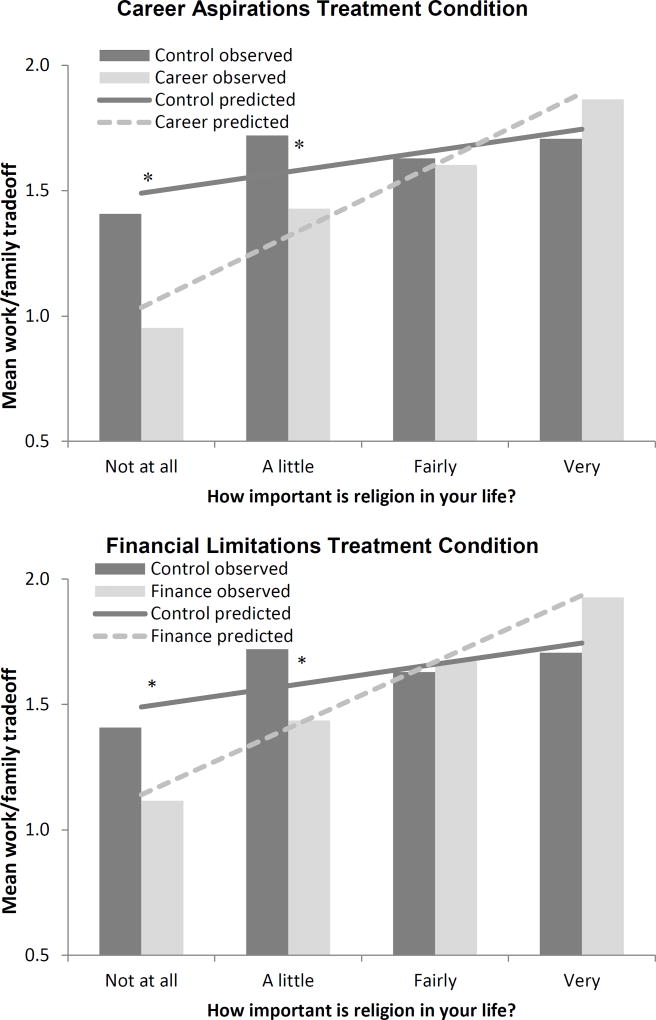
Better models of culture and cognition may help researchers understand fertility and family formation. We examine cognition about fertility using an experimental survey design to investigate how fertility preferences of college women are affected by two prompts that bring to mind fertility-relevant factors: career aspirations and financial limitations. We test the effects of these prompts on fertility preferences and ask how effects vary with respondent religiosity, an aspect of social identity related to fertility preferences. We find significant effects of treatment on fertility preferences when accounting for religiosity: less religious women who considered their career aspirations or financial limitations reported smaller desired family size, but this effect was attenuated for more religious women. Our study demonstrates how fertility preferences are shaped by decision contexts for some socio-demographic groups. We discuss how the findings support a social-cognitive model of fertility.
更好的文化与认知模型或许有助于研究人员理解生育与家庭构成。我们运用实验性调查设计来研究生育认知,以探究大学女生的生育偏好是如何受到两个唤起与生育相关因素的提示的影响:职业抱负和经济限制。我们测试这些提示对生育偏好的影响,并询问这种影响如何随受访者的宗教信仰而变化,宗教信仰是与生育偏好相关的社会身份的一个方面。在考虑宗教信仰因素时,我们发现处理方式对生育偏好有显著影响:那些考虑到职业抱负或经济限制的宗教信仰程度较低的女性报告的理想家庭规模较小,但对于宗教信仰程度较高的女性,这种影响会减弱。我们的研究表明了生育偏好是如何在某些社会人口群体的决策背景下形成的。我们讨论了这些发现如何支持生育的社会认知模型。