Mann Devin, Hess Rachel, McGinn Thomas, Mishuris Rebecca, Chokshi Sara, McCullagh Lauren, Smith Paul D, Palmisano Joseph, Richardson Safiya, Feldstein David A
Department of Population Health, New York University School of Medicine, United States of America.
Department of Population Sciences, University of Utah School of Medicine, United States of America.
Digit Health. 2019 Feb 6;5:2055207619827716. doi: 10.1177/2055207619827716. eCollection 2019 Jan-Dec.
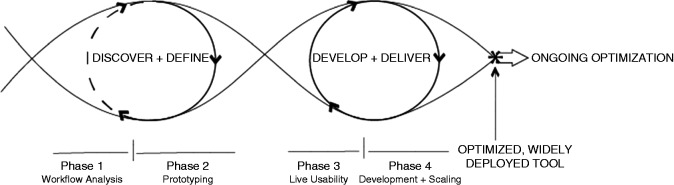
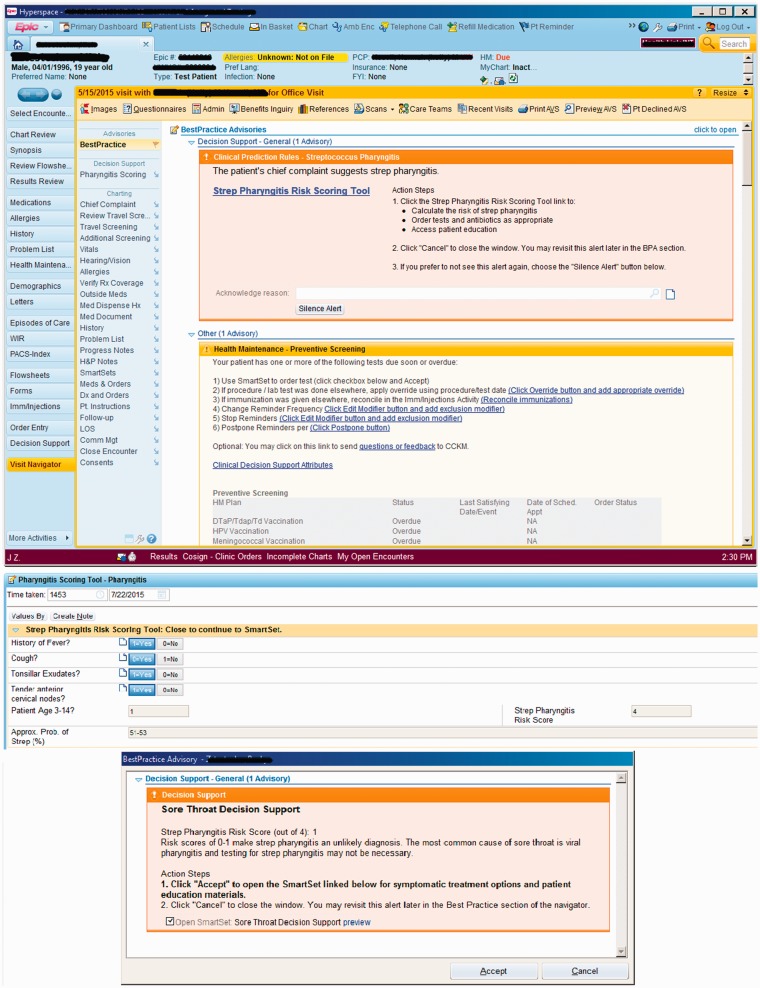
We employed an agile, user-centered approach to the design of a clinical decision support tool in our prior integrated clinical prediction rule study, which achieved high adoption rates. To understand if applying this user-centered process to adapt clinical decision support tools is effective in improving the use of clinical prediction rules, we examined utilization rates of a clinical decision support tool adapted from the original integrated clinical prediction rule study tool to determine if applying this user-centered process to design yields enhanced utilization rates similar to the integrated clinical prediction rule study. We conducted pre-deployment usability testing and semi-structured group interviews at 6 months post-deployment with 75 providers at 14 intervention clinics across the two sites to collect user feedback. Qualitative data analysis is bifurcated into immediate and delayed stages; we reported on immediate-stage findings from real-time field notes used to generate a set of rapid, pragmatic recommendations for iterative refinement. Monthly utilization rates were calculated and examined over 12 months.
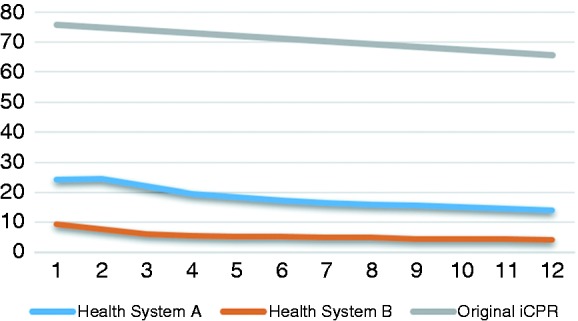
We hypothesized a well-validated, user-centered clinical decision support tool would lead to relatively high adoption rates. Then 6 months post-deployment, integrated clinical prediction rule study tool utilization rates were substantially lower than anticipated based on the original integrated clinical prediction rule study trial (68%) at 17% (Health System A) and 5% (Health System B). User feedback at 6 months resulted in recommendations for tool refinement, which were incorporated when possible into tool design; however, utilization rates at 12 months post-deployment remained low at 14% and 4% respectively.
Although valuable, findings demonstrate the limitations of a user-centered approach given the complexity of clinical decision support.
Strategies for addressing persistent external factors impacting clinical decision support adoption should be considered in addition to the user-centered design and implementation of clinical decision support.
在我们之前的综合临床预测规则研究中,我们采用了一种敏捷的、以用户为中心的方法来设计临床决策支持工具,该研究取得了很高的采用率。为了了解将这种以用户为中心的流程应用于调整临床决策支持工具是否能有效提高临床预测规则的使用,我们检查了一个从原始综合临床预测规则研究工具改编而来的临床决策支持工具的利用率,以确定将这种以用户为中心的流程应用于设计是否能产生与综合临床预测规则研究相似的更高利用率。我们在两个地点的14个干预诊所对75名提供者进行了部署前可用性测试,并在部署后6个月进行了半结构化小组访谈,以收集用户反馈。定性数据分析分为即时和延迟阶段;我们报告了即时阶段的结果,这些结果来自实时现场记录,用于生成一组快速、实用的迭代改进建议。计算并检查了12个月内的每月利用率。
我们假设一个经过充分验证的、以用户为中心的临床决策支持工具将导致相对较高的采用率。然后在部署后6个月,综合临床预测规则研究工具的利用率大大低于基于原始综合临床预测规则研究试验预期的68%,在卫生系统A为17%,在卫生系统B为5%。6个月时的用户反馈产生了工具改进建议,并在可能的情况下纳入工具设计;然而,部署后12个月的利用率仍然很低,分别为14%和4%。
尽管有价值,但研究结果表明,鉴于临床决策支持的复杂性,以用户为中心的方法存在局限性。
除了以用户为中心的临床决策支持设计和实施外,还应考虑应对影响临床决策支持采用的持续外部因素的策略。