Department of Neurophysiology and Pathophysiology, University Medical Center Hamburg-Eppendorf, Hamburg-Eppendorf 20251, Germany,
Department of Experimental Psychology, Ghent University, Ghent 9000, Belgium.
J Neurosci. 2019 Apr 24;39(17):3309-3319. doi: 10.1523/JNEUROSCI.2620-18.2019. Epub 2019 Feb 25.
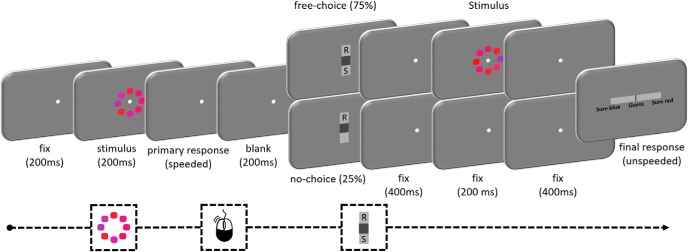
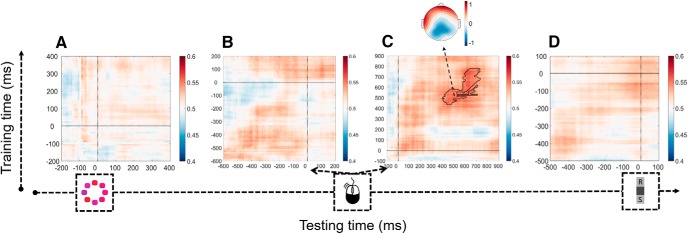
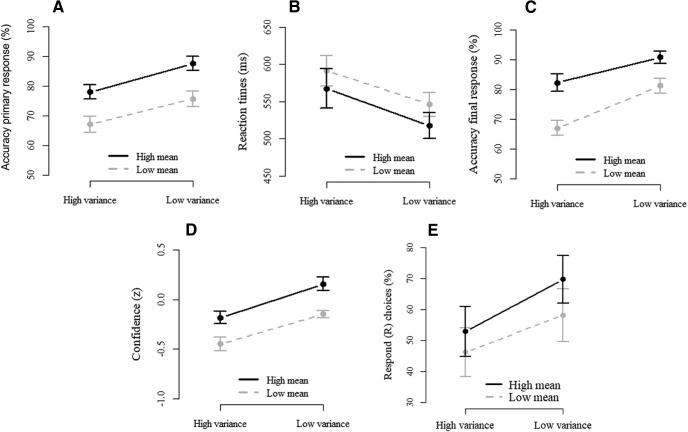
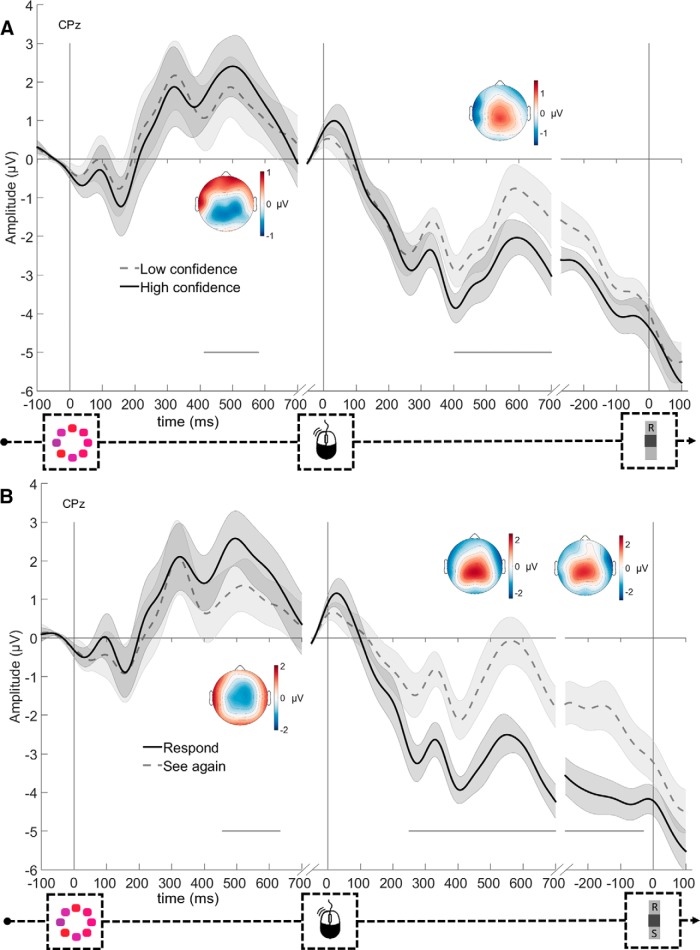
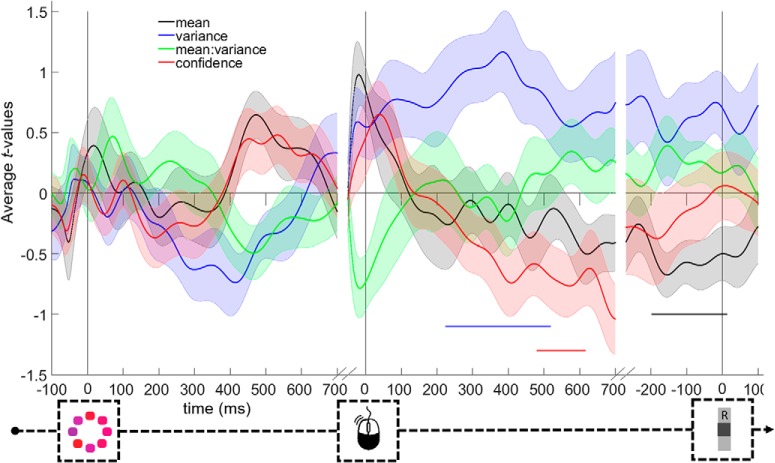
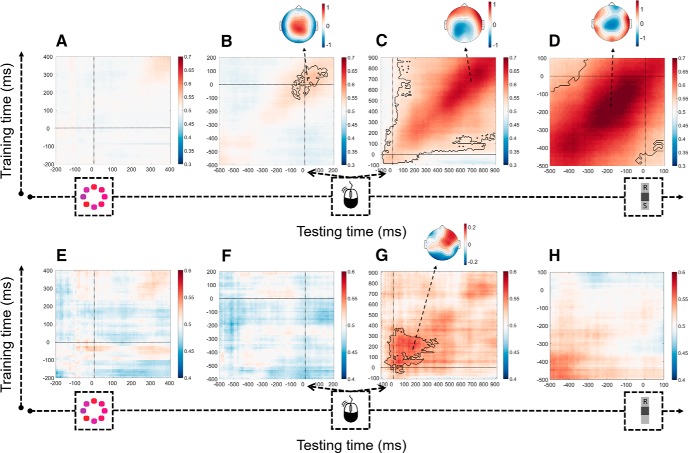
Theoretical work predicts that decisions made with low confidence should lead to increased information-seeking. This is an adaptive strategy because it can increase the quality of a decision, and previous behavioral work has shown that decision-makers engage in such confidence-driven information-seeking. The present study aimed to characterize the neural markers that mediate the relationship between confidence and information-seeking. A paradigm was used in which 17 human participants (9 male) made an initial perceptual decision, and then decided whether or not they wanted to sample more evidence before committing to a final decision and confidence judgment. Predecisional and postdecisional event-related potential components were similarly modulated by the level of confidence and by information-seeking choices. Time-resolved multivariate decoding of scalp EEG signals first revealed that both information-seeking choices and decision confidence could be decoded from the time of the initial decision to the time of the subsequent information-seeking choice (within-condition decoding). No above-chance decoding was visible in the preresponse time window. Crucially, a classifier trained to decode high versus low confidence predicted information-seeking choices after the initial perceptual decision (across-condition decoding). This time window corresponds to that of a postdecisional neural marker of confidence. Collectively, our findings demonstrate, for the first time, that neural indices of confidence are functionally involved in information-seeking decisions. Despite substantial current interest in neural signatures of our sense of confidence, it remains largely unknown how confidence is used to regulate behavior. Here, we devised a task in which human participants could decide whether or not to sample additional decision-relevant information at a small monetary cost. Using neural recordings, we could predict such information-seeking choices based on a neural signature of decision confidence. Our study illuminates a neural link between decision confidence and adaptive behavioral control.
理论工作预测,低置信度的决策应该会导致更多的信息寻求。这是一种适应性策略,因为它可以提高决策的质量,而之前的行为研究表明,决策者会进行这种基于信心的信息寻求。本研究旨在描述介导信心与信息寻求之间关系的神经标记物。使用一种范式,其中 17 名人类参与者(9 名男性)做出初始感知决策,然后决定是否在做出最终决策和置信判断之前是否要采样更多证据。预决策和后决策事件相关电位成分同样受到信心水平和信息寻求选择的调节。头皮 EEG 信号的时间分辨多元解码首先揭示,信息寻求选择和决策信心都可以从初始决策时间解码到随后信息寻求选择的时间(条件内解码)。在预反应时间窗口中看不到高于随机的解码。至关重要的是,一个经过训练可以从高到低解码信心的分类器可以在初始感知决策后预测信息寻求选择(跨条件解码)。这个时间窗口对应于决策后信心的神经标记物的时间窗口。总的来说,我们的发现首次证明,信心的神经指数在信息寻求决策中具有功能作用。尽管目前对我们信心感的神经特征有很大的兴趣,但仍然很大程度上不知道信心是如何用于调节行为的。在这里,我们设计了一个任务,其中人类参与者可以决定是否以较小的货币成本采样额外的决策相关信息。使用神经记录,我们可以根据决策信心的神经特征来预测这种信息寻求选择。我们的研究阐明了决策信心与适应性行为控制之间的神经联系。