Clinical Research Centre, Medical University of Bialystok, MC Sklodowskiej 24A, 15-276 Bialystok, Poland.
Department of Dietetics and Clinical Nutrition, Medical University of Bialystok, Mieszka I-go 4B, 15-054 Bialystok, Poland.
Nutrients. 2019 Feb 26;11(3):493. doi: 10.3390/nu11030493.
The energy balance regulation may differ in lean and obese people. The purposes of our study were to evaluate the hormonal response to meals with varying macronutrient content, and the differences depending on body weight.
The crossover study included 46 men, 21⁻58 years old, normal-weight and overweight/obese. Every subject participated in two meal-challenge-tests with high-carbohydrate (HC), and normo-carbohydrate (NC) or high-fat (HF) meals. Fasting and postprandial blood was collected for a further 240 min, to determine adiponectin, leptin and total ghrelin concentrations.
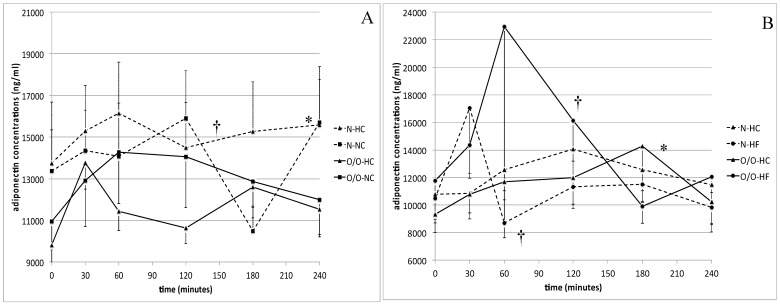
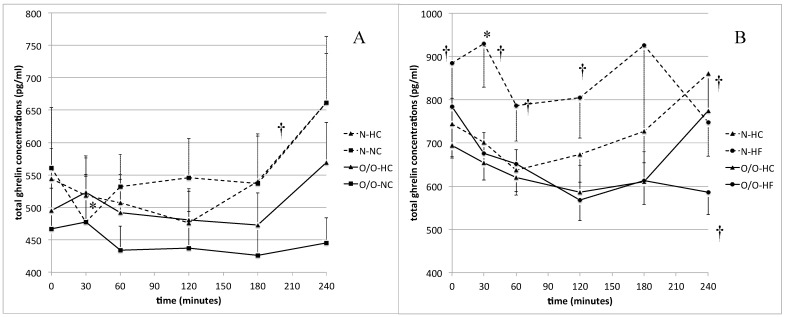
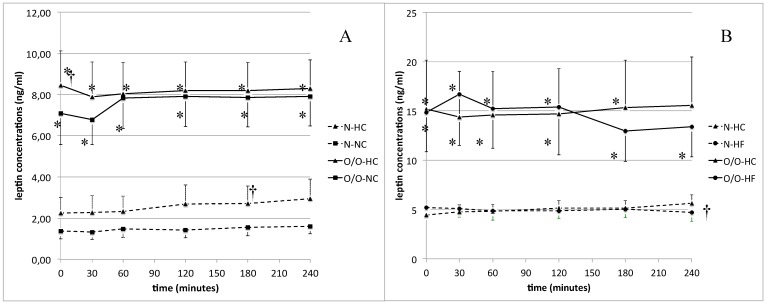
In normal-weight individuals after HC-meal we observed at 60min higher adiponectin concentrations (12,554 ± 1531 vs. 8691 ± 1070 ng/mL, = 0.01) and significantly ( < 0.05) lower total ghrelin concentrations during the first 120 min, than after HF-meal intake. Fasting and postprandial leptin levels were significantly ( < 0.05) higher in overweigh/obese men. Leptin concentrations in normal-weight men were higher (2.72 ± 0.8 vs. 1.56 ± 0.4 ng/mL, = 0.01) 180 min after HC-meal than after NC-meal intake.
Our results suggest that in normal-body weight men we can expect more beneficial leptin, adiponectin, and total ghrelin response after HC-meal intake, whereas, in overweight/obese men, the HC-meal intake may exacerbate the feeling of hunger, and satiety may be induced more by meals with lower carbohydrate content.
评估不同宏量营养素含量的膳食对激素反应的差异,并根据体重差异进行评估。
本交叉研究纳入 46 名年龄在 21-58 岁的男性,体重正常和超重/肥胖。每位受试者均参加了两次高碳水化合物(HC)、正常碳水化合物(NC)或高脂肪(HF)膳食的餐挑战试验。空腹和餐后采集进一步 240 分钟的血液,以确定脂联素、瘦素和总胃饥饿素浓度。
在体重正常的个体中,HC 餐后 60 分钟时,脂联素浓度较高(12554±1531 比 8691±1070ng/ml, = 0.01),并且在前 120 分钟内总胃饥饿素浓度显著降低( < 0.05),而 HF 餐后摄入则相反。超重/肥胖男性的空腹和餐后瘦素水平明显较高( < 0.05)。体重正常男性的瘦素水平在 HC 餐后 180 分钟时(2.72±0.8 比 1.56±0.4ng/ml, = 0.01)更高,而 NC 餐后摄入时则较低。
我们的研究结果表明,在体重正常的男性中,HC 餐后摄入可能会引起更有益的瘦素、脂联素和总胃饥饿素反应,而在超重/肥胖男性中,HC 餐后摄入可能会加剧饥饿感,而较低碳水化合物含量的膳食可能会诱导更高的饱腹感。