Kalmoni Yusra, Addai Frederick Kwaku, Adjenti Saviour Kweku, Adutwum-Ofosu Kevin Kofi, Ahenkorah John, Hottor Bismarck Afedo, Blay Richard Michael
Department of Hematology, 37 Military Hospital, Accra, Ghana.
Department of Anatomy, School of Biomedical & Allied Health Sciences, College of Health Sciences, University of Ghana, Accra, Ghana.
Int J Trichology. 2019 Jan-Feb;11(1):8-13. doi: 10.4103/ijt.ijt_70_18.
Relatively scanty literature on autochthonic African Negroid hair morphology provokes research interest for anthropological, forensic, and cosmetic purposes.
This study aimed to contribute basic morphological information on Ghanaian African hairs.
The study was done in selected second-cycle schools in Accra, Ghana, using convenient sampling.
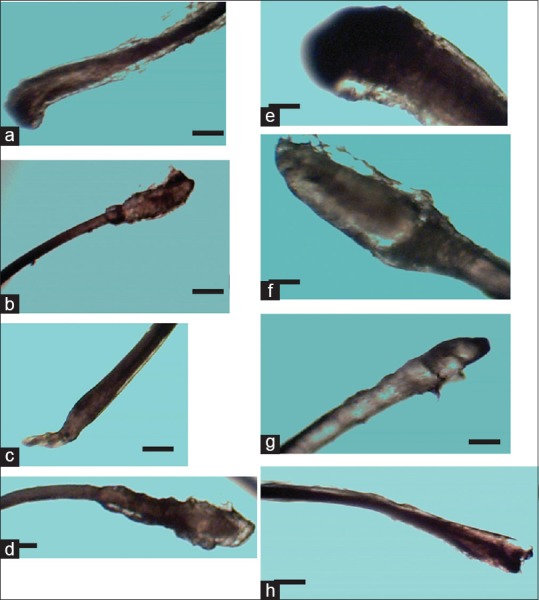
Hairs were obtained by pluck method, from 30 males and 30 females aged 15-20 years. Ghanaian African autochthony was established if individuals had two generations of indigenous Ghanaian parentage. Scalp, eyebrow, axilla, and pubic hairs were image captured using a digital light microscope eyepiece connected to a computer. Diameters of hair strands were measured; types of the medulla and the form and shape of the hair roots were studied.
ANOVA test (SPSS Version 17.0) was used to compare the means of quantitative hair features among the sexes and the four regions of the body studied.
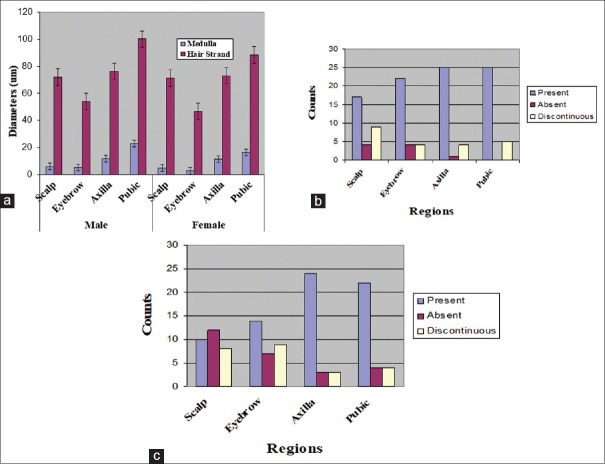
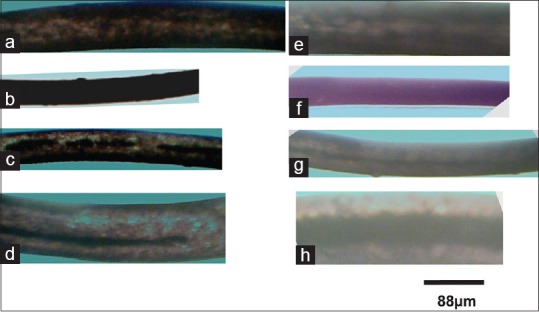
Pubic hair shaft was thickest (respective male and female diameters were 100.21 μm, 88.40 μm) and eyebrow hair was thinnest (53.97 and 46.69-μm diameters in males and females, respectively). Axillary and scalp hairs were the closest in diameters with 76.21 and 72.02 μm, respectively, in males and 73.07 and 71.15 μm, respectively, in females. Continuous type medulla was predominant in all hairs, with a trend of percentage occurrence in descending order from the pubic, axilla, eyebrow, and scalp in both sexes.
Bodily regional differences in diameter of hair shaft and medullary presence were affirmed.
关于非洲本土黑人头发形态的文献相对较少,这引发了出于人类学、法医学和美容目的的研究兴趣。
本研究旨在提供有关加纳非洲人头发的基本形态学信息。
本研究在加纳阿克拉选定的第二周期学校进行,采用方便抽样。
通过拔取法从30名年龄在15至20岁的男性和30名女性获取头发。如果个体有两代加纳本土父母,则确定为加纳非洲本土人。使用连接到计算机的数字光学显微镜目镜对头皮、眉毛、腋窝和阴毛进行图像采集。测量发丝直径;研究髓质类型以及发根的形态和形状。
采用方差分析测试(SPSS 17.0版)比较两性以及所研究身体四个部位的头发定量特征均值。
阴毛最粗(男性和女性的直径分别为100.21μm和88.40μm),眉毛最细(男性和女性的直径分别为μm和46.69μm)。男性腋窝和头皮毛发直径最接近,分别为76.21μm和72.02μm,女性分别为73.07μm和71.15μm。连续型髓质在所有头发中占主导地位,两性中从阴毛、腋窝、眉毛到头皮的出现百分比呈下降趋势。
证实了身体不同部位在发丝直径和髓质存在方面的差异。