White Daniel A, Rooks Paul A, Kimmance Susan, Tait Karen, Jones Mark, Tarran Glen A, Cook Charlotte, Llewellyn Carole A
Plymouth Marine Laboratory, Prospect Place, The Hoe, Plymouth, Devon PL1 3DH, UK.
Department of Biosciences, Singleton Park, Swansea University, Swansea, Wales SA2 8PP, UK.
Metabolites. 2019 Feb 28;9(3):39. doi: 10.3390/metabo9030039.
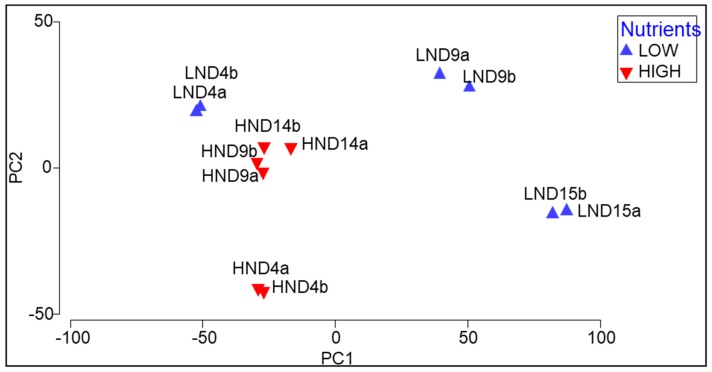
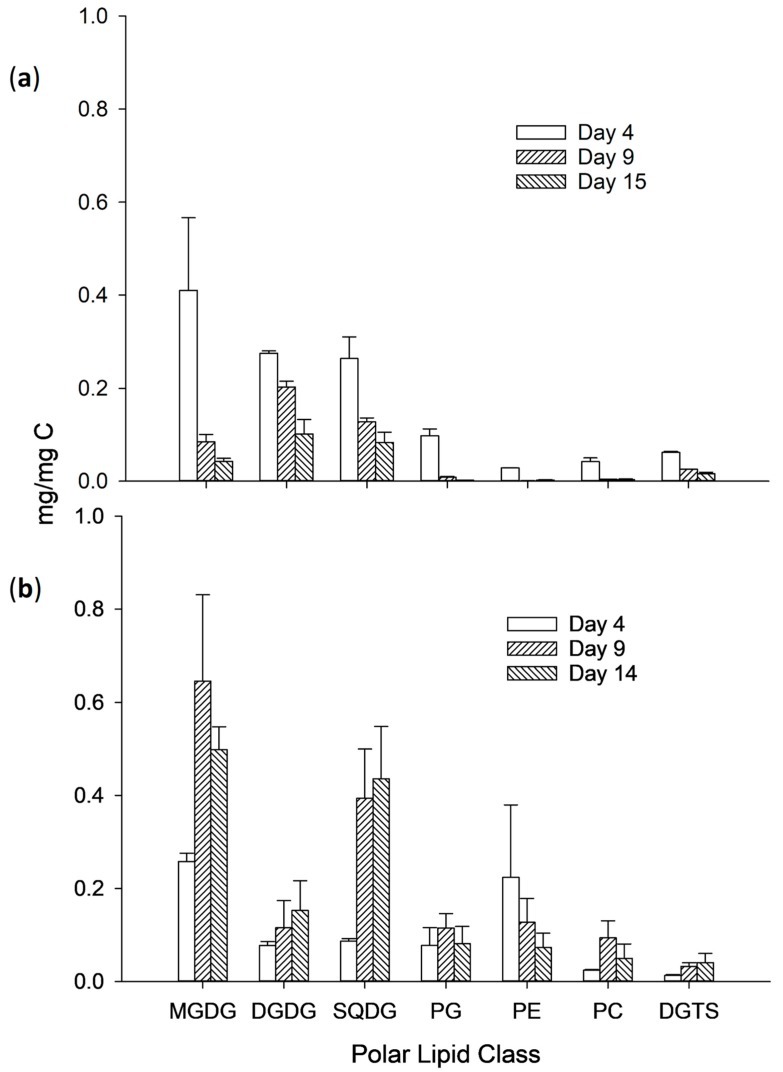
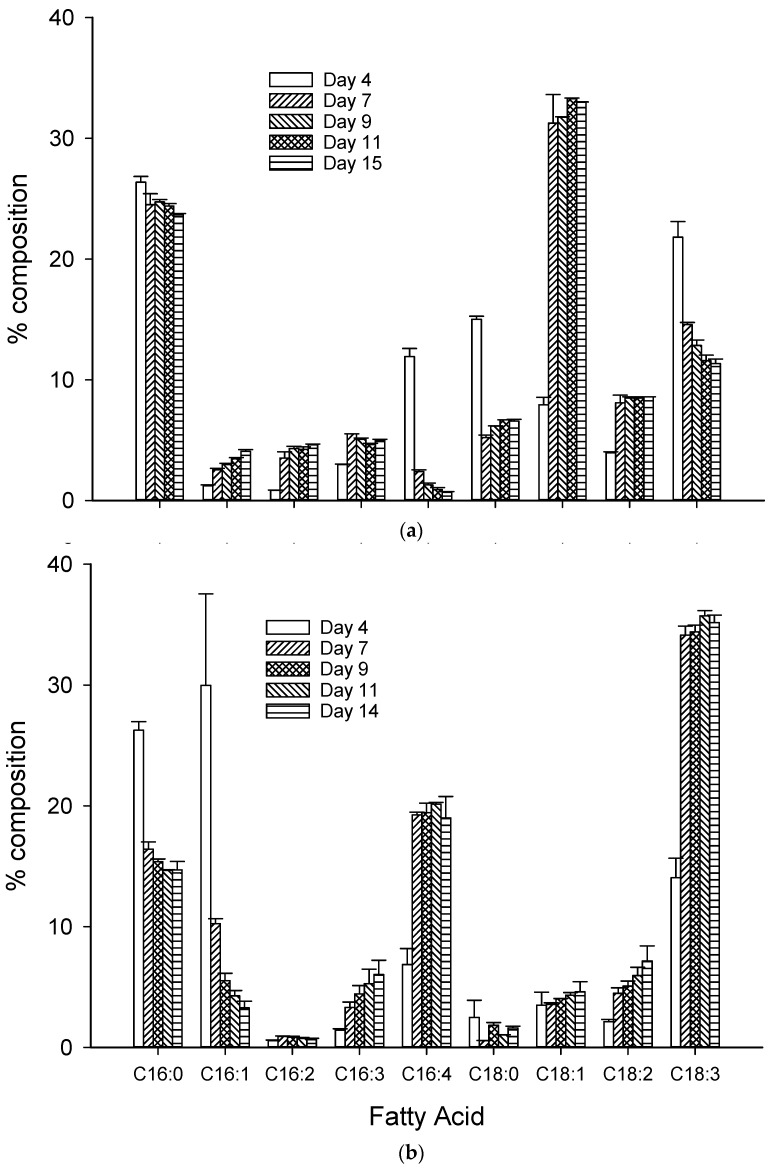
We evaluate the effects of nutrient limitation on cellular composition of polar lipid classes/species in sp. using modern polar lipidomic profiling methods (liquid chromatography⁻tandem mass spectrometry; LC-MS/MS). Total polar lipid concentration was highest in nutrient-replete (HN) cultures with a significant reduction in monogalactosyldiacylglycerol (MGDG), phosphatidylglycerol (PG), phosphatidylcholine (PC), and phosphatidylethanolamine (PE) class concentrations for nutrient-deplete (LN) cultures. Moreover, reductions in the abundance of MGDG relative to total polar lipids versus an increase in the relative abundance of digalactosyldiacylglycerol (DGDG) were recorded in LN cultures. In HN cultures, polar lipid species composition remained relatively constant throughout culture with high degrees of unsaturation associated with acyl moieties. Conversely, in LN cultures lipid species composition shifted towards greater saturation of acyl moieties. Multivariate analyses revealed that changes in the abundance of a number of species contributed to the dissimilarity between LN and HN cultures but with dominant effects from certain species, e.g., reduction in MGDG 34:7 (18:3/16:4). Results demonstrate that sp. significantly alters its polar lipidome in response to nutrient limitation, and this is discussed in terms of physiological significance and polar lipids production for applied microalgal production systems.
我们使用现代极性脂质组学分析方法(液相色谱-串联质谱法;LC-MS/MS)评估了营养限制对 种中极性脂质类别/种类的细胞组成的影响。在营养充足(HN)的培养物中,总极性脂质浓度最高,而在营养耗尽(LN)的培养物中,单半乳糖基二酰基甘油(MGDG)、磷脂酰甘油(PG)、磷脂酰胆碱(PC)和磷脂酰乙醇胺(PE)类浓度显著降低。此外,在LN培养物中,相对于总极性脂质,MGDG的丰度降低,而二半乳糖基二酰基甘油(DGDG)的相对丰度增加。在HN培养物中,极性脂质种类组成在整个培养过程中保持相对恒定,酰基部分具有高度不饱和性。相反,在LN培养物中,脂质种类组成向酰基部分更大程度的饱和转变。多变量分析表明,许多种类丰度的变化导致了LN和HN培养物之间的差异,但某些种类具有主导作用,例如MGDG 34:7(18:3/16:4)的减少。结果表明, 种在营养限制下会显著改变其极性脂质组,并从生理意义和应用微藻生产系统的极性脂质生产方面进行了讨论。