Eawag, Swiss Federal Institute of Aquatic Science and Technology, Department of Environmental Toxicology, 8600 Dübendorf, Switzerland.
The Procter & Gamble Company, Global Product Stewardship, Mason, Ohio 45040, USA.
Toxicol Sci. 2019 Jun 1;169(2):353-364. doi: 10.1093/toxsci/kfz057.
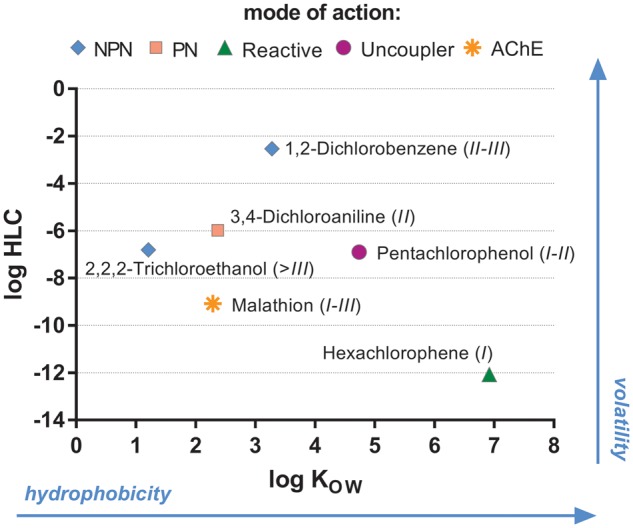
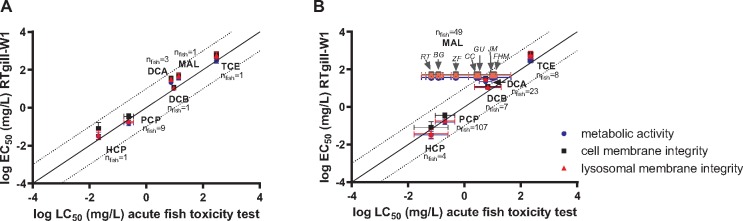
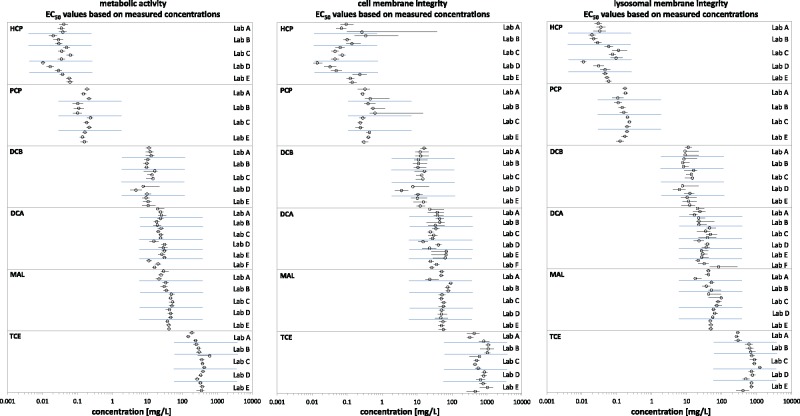
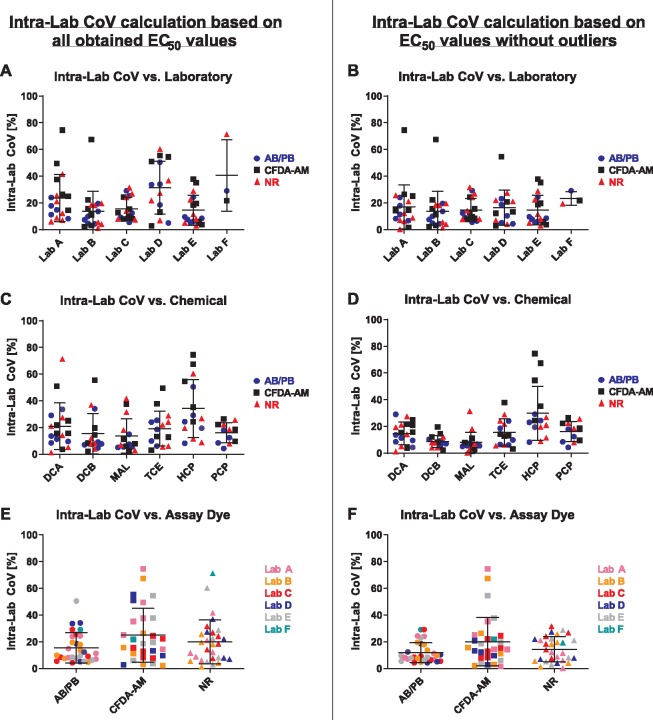
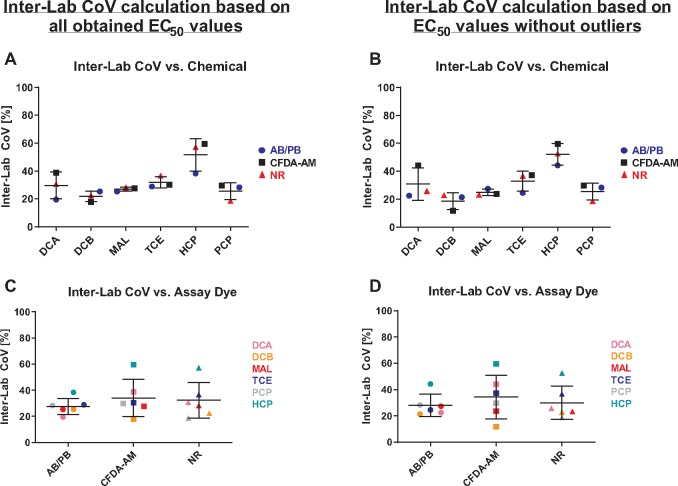
Predicting fish acute toxicity of chemicals in vitro is an attractive alternative method to the conventional approach using juvenile and adult fish. The rainbow trout (Oncorhynchus mykiss) cell line assay with RTgill-W1 cells has been designed for this purpose. It quantifies cell viability using fluorescent measurements for metabolic activity, cell- and lysosomal-membrane integrity on the same set of cells. Results from over 70 organic chemicals attest to the high predictive capacity of this test. We here report on the repeatability (intralaboratory variability) and reproducibility (interlaboratory variability) of the RTgill-W1 cell line assay in a round-robin study focusing on 6 test chemicals involving 6 laboratories from the industrial and academic sector. All participating laboratories were able to establish the assay according to preset quality criteria even though, apart from the lead laboratory, none had previously worked with the RTgill-W1 cell line. Concentration-response modeling, based on either nominal or geometric mean-derived measured concentrations, yielded effect concentrations (EC50) that spanned approximately 4 orders of magnitude over the chemical range, covering all fish acute toxicity categories. Coefficients of variation for intralaboratory and interlaboratory variability for the average of the 3 fluorescent cell viability measurements were 15.5% and 30.8%, respectively, which is comparable to other fish-derived, small-scale bioassays. This study therefore underlines the robustness of the RTgill-W1 cell line assay and its accurate performance when carried out by operators in different laboratory settings.
体外预测化学品对鱼类的急性毒性是一种有吸引力的替代方法,可替代使用幼鱼和成鱼的传统方法。为此设计了虹鳟(Oncorhynchus mykiss)细胞系 RTgill-W1 细胞测定法。它使用荧光测量法来量化细胞活力,以评估同一组细胞的代谢活性、细胞膜和溶酶体膜的完整性。超过 70 种有机化学品的结果证明了该测试具有很高的预测能力。我们在此报告了在一项重点关注 6 种测试化学品的轮次研究中,RTgill-W1 细胞系测定法的重复性(实验室内部变异性)和再现性(实验室间变异性),该研究涉及来自工业和学术界的 6 个实验室。所有参与实验室都能够根据预设的质量标准建立该测定法,尽管除了主导实验室外,其他实验室以前都没有使用过 RTgill-W1 细胞系。基于名义或几何平均值衍生的测量浓度的浓度反应建模产生了效应浓度(EC50),这些浓度在化学范围内跨越了大约 4 个数量级,涵盖了所有鱼类急性毒性类别。3 个荧光细胞活力测量平均值的实验室内部和实验室间变异性的变异系数分别为 15.5%和 30.8%,与其他源自鱼类的小规模生物测定相当。因此,这项研究强调了 RTgill-W1 细胞系测定法的稳健性及其在不同实验室环境中由操作人员进行时的准确性能。